Friday, January 18, 2013

Dragonfly: If you have ever raised chickens...


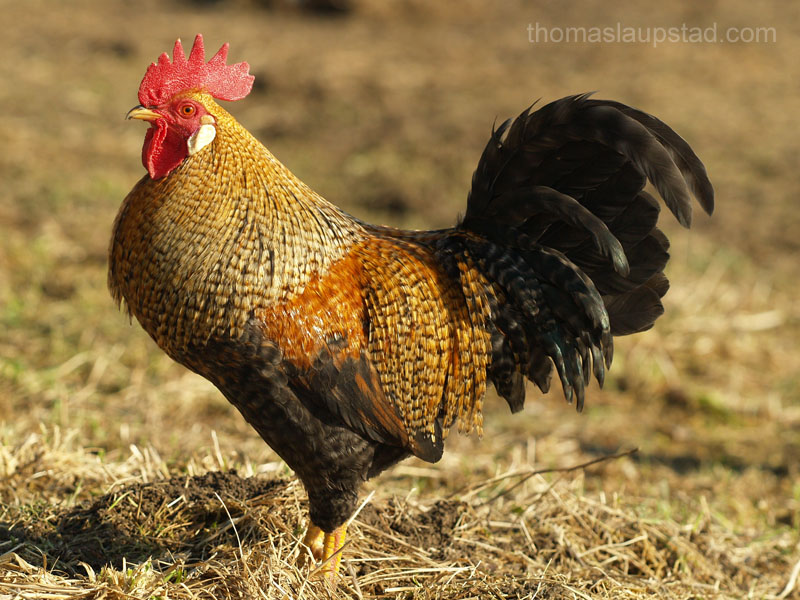
 This lovely rooster pic can be found here.  Photo is copyrighted to Thomas Laupstad.


...then you know how true this is:
     The sound of a cock crowing at full blast lifted me off the pillow, as though a stick of dynamite had been touched off beneath the bed. 
     "Idiot!" I said, every nerve in my body twanging from the shock.  I got up and cracked the shutter. It had stopped snowing, but the sky was still pale with cloud, a uniform color from horizon to horizon.  The rooster let loose another bellow in the hen-coop below. 
     "Shut up!!" I said. "It's the middle of the night, you feathered bastard!"  The avian equivalent of a raspberry echoed through the still night.... (Dragonfly 567)
This is one of the chickens my mother and siblings raised:


Enough said.


Wednesday, January 16, 2013

Dragonfly: Where is God in Time Travel?

There are definitely questions about which I'm not interested in speculating. These are mostly questions that resolve themselves within the novels, or questions that do not resonate outside of the novels.  They are interesting, but there is no need to elaborate.  One such question asserts itself in Dragonfly in Amber, in the chapters titled "Untimely Resurrection" and "The Royal Stud": the question of Jamie's vengeance upon Jack Randall, and whether Claire is right to make him postpone that vengeance.  It could be that I think Claire is more wrong about preventing Jamie from killing Jack Randall on this particular occasion than she is to make him betray his country and kin to prevent the Battle (and devastation) of Culloden.  I'll never tell.  But it's also true that Gabaldon brings the matter around very neatly, giving Jamie the ability to reclaim some of his own by determining his own reason for postponing vengeance (and getting in some nice foreshadowing as well).  It's a lovely narrative card that she plays, and well worth giving a nod.  (See pp. 401-403 in the small, Dell paperback version with the orange cover.)  But--it is part of the narrative, and in terms of Jamie's justification, what he does or does not owe Claire, the question of conscience, or anything involving their feelings about other characters, it works itself out, and doesn't really require speculation or further analysis of motivations.  I like to leave the characters to themselves, and allow their motivations to emerge through the action of the story rather than through my own suppositions and psychoanalysis.  It's why criticism is (or should be) sort of the anti-fan-fiction.  (Just for fun, check out Diana Gabaldon's Fan Fiction Policy.)

What is interesting in the maneuverings of Claire to prevent Jamie from killing Jack Randall too soon is (first) that the question is never the morality of the vengeance.  That is taken for granted, and I'm glad.  Moralistic posturing would do no one any good in this case.  Claire's conscience is evoked, rather neatly, to turn the guilt of preventing Frank's birth (indirectly, by the death of Jack Randall) to Claire's decision to abandon Frank for Jamie--at least, that is how Jamie casts Claire's decision not to pass again through the stones: "it's one thing to abandon a man, and another to condemn him to death" (401).  Non-birth/prevention of conception is not quite death, but we'll let that go for the moment.  Jamie's conscience is never an issue, except insofar as killing always leaves a mark:  "I remember the face of every man I've killed, and always will" (400).  And that's just fine.

But the deeper implications of the maneuverings leave some room for consideration.  If this novel is instrumental to the series, it may well be--first and foremost--the working out of what a time traveler can and can't accomplish with reference to history that gives it it's highest value in the big picture.  (I have other considerations of time travel here and here.)  The reason I drag God into it in my title is because the question of conscience was right in front of me in the narrative.  Brother Anselm and his theology, the moral implications of preventing someone from being born.  But a larger question emerges:  could anything Jamie and Claire have done prevent the beginning of the bloodline that eventually produces Frank Randall, Claire's husband in the year 1943?

It's something like the question my son asked of his 4th grade teacher at the fourth-rate Catholic school that he went to for most of that year:  if Adam and Eve hadn't sinned, would any of us exist?  Need I say that the teacher didn't know how to answer the question?  I consulted a deacon friend of mine, and came up with the response that our existence in God's plan didn't depend on sin.  We simply don't know how things would have worked out without it.  There is something tangentially related to this question happening in Perelandra, the second book of C. S. Lewis's Space Trilogy.  An alien world is experiencing its own Creation, and Lewis's Ransom is a spectator and intercessor, preventing the successful temptation of the newly-Created female of the alien species so that the world might emerge without the taint of Original Sin.  The idea is--Sin or no Sin, our existence as individuals is part of God's plan.

So is this worldview somehow reflected in Gabaldon's novel?  At first glance it may seem not to be.  Clearly, it is absent from the Back to the Future movie trilogy--things change, people disappear.  But there's nothing about God in those films.  Religion is simply not part of the picture(s).  By contrast, there's Catholicism all over the place in the Outlander series.  You can't get around it, the novels have a Catholic consciousness, whatever their orthodoxy.  You might say that it proceeds from what has been called "the Catholic imagination," though I wouldn't quote Andrew Greeley for orthodoxy's sake...

Without saying how, I will say that Frank's bloodline works itself out.  It works itself out with Jack Randall alive, but it does so in a way that his survival has precious little to do with the birth.  Clever.  So does that mean Predestination?  I'm not sure.  Although there is implied argument between Predestination and Free Will in the novels (especially with reference to Roger Wakefield in some of the later books), there seems to be quite a bit of room for Free Will--or really, would readers enjoy the books so much?  But characters' Free Will seems to feed directly into what they know to have been going to happen.  (I'm absolutely playing with verb tense there.  Too bad I'm not writing in a romance language!)  In other words, the characters end up proving their own instrumentality to the events that will unfold--or have unfolded--or will have unfolded.  Everything fits neatly into place.  Some would consider this as evidence for God in the Outlander worldview--or in its representation of time travel.  I think there's evidence, at least, that the man who was Frank Randall was "meant" to exist--which does, in fact, suggest some greater intentionality beyond the machinations of Claire and Jamie.

Monday, January 14, 2013

Dragonfly: A Question of Honor

My last post addresses the first significant treatment of reproductive issues in the Outlander series, with the question of whether Louise de la Tour, married mistress of Bonnie Prince Charlie, should chemically abort her child.  Although Claire expects that the "solution" to Louise's "problem" will anger Jamie, his reaction to "Louise de la Tour foisting a bastard on her husband" is more measured, revealing how Jamie is having to adapt to the business of espionage:
     "Well, I'm no verra much in favor of it, I'll tell ye, Sassenach, but what's the poor bloody woman to do otherwise?" He shook his head, then glanced at the desk across the room and smiled wryly.
     "Besides, it doesna become me to be takin' a high moral stand about other people's behavior.  Stealing letters and spying and trying generally to subvert a man my family holds as King? I shouldna like to have someone judging me on the grounds of the things I'm doing, Sassenach." (247)
The contrast between Jamie's own actions and Louise's seems an interesting rhetorical move:
"Louise de La Tour had a reason, too," he said. "She wants to save one life, I want ten thousand.  does this excuse my risking wee Fergus--and Jared's business--and you?" (247)
Although there is much more at stake, according to these terms, for Jamie, the sense is one of incongruity.  While she has violated the moral code a couple of times over, Louise's action--saving her unborn child--seems to redeem her betrayal of her husband, if not quite to Jamie's sensibilities. Nevertheless, he does seem to place her in a moral gray area.  Jamie's moral dilution puts him more in line with 20th Century thought--decidedly post-Scarlet Letter.  At the same time, Jamie's idealism was one of his defining characteristics in Outlander, part of what made his character attractive--his unwillingness to compromise his honor and his standards.

By contrast, Louise is already compromised, and, as a woman, her limited options are openly acknowledged.  If discovered as an adulteress, she will be divorced, cast out, possibly excommunicated (243).  By a single act of betrayal--which will be an ongoing act of betrayal if she succeeds in convincing her husband that the child is his--she will certainly save an innocent life.  By several, ongoing acts of betrayal, and by sacrificing his own idealism and honor, Jamie attempts to save the lives of many--an act that should seem noble, but perhaps is tainted by its political aspect, its uncertainty, or the hubris I mention here.

While Jamie has endured physical and psychological suffering--and indeed, has been broken and restored, it is in reference to this sacrifice of his honor--putting his will in the service of betrayal--that his face registers physical change:
The light flickering on his face hollowed his cheeks and threw shadows in the orbits of his eyes.  It made him look older than he was; I tended to forget that he was not quite twenty-four.  (247)
This might also be read as a reference to how differently people age in the past, but most of the time, the references are to Claire's relative preservation compared to 18th C women, and the usual reason is health care (and especially pregnancy).  A 24-year-old Jamie in 1745 would look very different from a 24-year-old in 1945 (and perhaps more different still in 1984 or 2013), but that does not seem to be quite the narrative point at this moment in the novel.

Jamie's struggle with betrayal--of vows, of family, of country--or with others' betrayal of him runs throughout all of the books in the Outlander series.  My sense is that it remains a personal struggle rather than a political or nationalist one, and that any inkling that there is a deeper betrayal in leaving one's country--which is very important to Jamie--in the hands of the conqueror is purely implied, at least with reference to Scotland.  There is an article that includes the Outlander books in a consideration of contemporary "Appropriations of Scottish Identity" that might offer a different perspective, but my sense is that the novels never quite reach postcolonial status.

If there is a postcolonial point to be made, it begins with Jamie's reconstruction of his identity in reference to, but without the comfort of, his native country.  Jamie has been in exile before (fertile backstory territory that Gabaldon covers--in part--in "Virgins," a novella to be published in the anthology Dangerous Women, ed. George R. R. Martin, info publication date to be found at the Outlandish Observations blog), but there was the sense that returning home would be a possibility.  In Dragonfly, the exile seems more absolute (for about half of the narrative), leaving Jamie in a position of  protective nostalgia with reference to his country, and not in a position suitable for fierce defensive nationalism.

The argument in Dragonfly seems to be that doomed nationalism isn't particularly noble, but neither is fruitless sacrifice.  Not a lot to latch onto ideologically, here, and Jamie becomes a rather tragic figure through the course of the novel--literally fighting a losing battle from beginning to end.

Friday, January 11, 2013

Dragonfly: "Women's Issues" #1

Okay, so there's something a little disingenuous about the title of this post--hence the quotation marks.  Though it is common for contraception and abortion to be termed "women's health issues," and though political platforms that provide for such are considered sensitive to "women's issues," I generally protest that designation, since it reduces women to their reproductive functions, while at the same time denigrating those functions, and relegating them to the status of a medical problem.  That said, I maintain the title of the post as a kind of protest of the designation, and a reluctant acknowledgment that "women's issues" is generally understood to mean reproduction--and specifically contraception and abortion.  This is the disclaimer for my own use of the phrase, and does not reflect at all on the author or the novel, though I may offer a critique of the ways in which the later novels deal with "women's issues"--as such.

Chemical abortifacients have been mentioned before this point, and the dangers of childbirth as well, but the chapter "Deceptions" in Dragonfly in Amber is the first "up close and personal" encounter that the reader has with a reproductive issue, and the narrative comes down on the side of protecting the unborn child.  The relevant scene, in which Claire discusses with Louise de La Tour, mistress of Prince Charles, Louise's proposed decision to abort her child, raises other issues of women's place in 18th C society, evoking in the process Wollstonecraft's admonition against a society that would value women for their most superficial attributes, leaving them virtually no choice but to act in shallow and immoral ways.

Louise is caught in exactly this trap--she is bound to a man whom she marries for status and money (Wollstonecraft advocates for friendship in marriage).  She has a vivacious personality, and finds herself attracted to Prince Charles.  Now, there is not much to say about this attraction, because the Prince, while portrayed as personable, and lordly at will, seems pretty vapid himself, mooning over Louise, and yet blaming her for getting pregnant before the time he deems appropriate. Their attachment seems genuine enough, and yet also proceeds from the coquetry of the time (for a primer of the French coquette, see Molière, who admittedly predates this period by 100 years, but who gives a scathing portrait of the woman presiding over admirers in Le Misanthrope).  One way or another, Louise finds herself in the position of asking Claire for an abortifacient potion, for fear of utter ruin, divorce, excommunication (Dragonfly 243).

Not being an expert, I am not certain of the origin of the term "angel-maker" (and Google is no help), but it is used in Dragonfly to underscore the prevalence of abortion in 18th C France.  Claire, while protective of her own unborn child and careful to indicate that her child is not subject to the practice, registers no shock at the practice.  No moral judgment is passed from Claire's character to others in the novel(s)--at least, not beyond Claire's exclamation at Louise's question of whether Claire has used the concoction:  "God, no!"  Claire's own struggles with (presumed) infertility might excuse the vehemence of her reaction.  Rather, as a good counselor, she questions Louise:
"Louise," I said.  "Do you want the child?"
I find Louise's response particularly revealing:
     She lifted her head and stared at me in astonishment.
     "But of course I want it!" She exclaimed. "It's his--it's Charles's! It's..." Her face crumpled, and she bowed her head once more over her hands, clasped so tightly over her belly.  "It's mine," she whispered. (243)
Louise moves, in these lines, from desiring the child for Charles's sake--because the pregnancy proceeds from the man she loves--to desiring it for her sake, and for its own.  "Owning" the pregnancy allows her to accept the circumstance of being pregnant, and to devise--with more than the hint of a suggestion from Claire--a strategy for keeping her child.  It's a useful exercise, and a valuable (pro-life?) literary moment to turn panic into planning.

Although Louise wants to save the child--a point reinforced by Jamie's assessment of the situation (247)--Claire's concern does not focus on the child, but on Louise herself.  With fresh memory of "a young servant-girl, dying in protracted, blood-smeared agony"(244), Claire sees "no good reason for her to risk her life for the sake of Charles Stuart's pride" (243).

I'm not sure I find that thoroughly convincing from a 1940s woman--even a field nurse.  Her moral compass, in 1940, would likely have registered both the child's life and the woman's, especially as a woman who had herself struggled with infertility.  But it is so that the novel skirts the issue of abortion and morality in the scene rather neatly, avoiding giving offense to either "camp" of readers (except insofar as portrayal of botched abortion is argument for legalized abortion--unless it is explicitly an argument for improved social conditions for women and a world in which abortion is not even on the table, like the world in Charlotte Perkins Gilman's Herland) while normalizing the practice--at least in 18th Century France.

It is perhaps worth noting that while Dragonfly rather openly allows for feminist interpretations in support of abortion choice, the narrative takes a definite stance on adultery:
     "Why, why couldn't I be as fortunate as you--to be bearing the child of a husband I loved?" [...]
     There were any number of answers to that particular question, but I didn't think she really wanted to hear any of them. (242-243)

Wednesday, January 9, 2013

Dragonfly: Humiliations Galore

Warning:  This discussion cites, and elaborates upon, some of the more intense and disturbing imagery in the first two Outlander books.

In The Princess Bride, as Fezzig wrestles the Man in Black (i.e. the Dread Pirate Roberts, i. e. Wesley, i. e. Cary Elwes), he says, "I just want you to feel you're doing well.  I hate for people to die embarrassed."  The line sounds amusing.  If one is about to die, what does embarrassment have to do with it?  Would having one's fighting ability validated in some way matter?

I believe that the Outlander books answer the second question constantly.  Death in battle is definitely the most noble way to die, for those who are able, but it is clear that this is not the only way that people die--and that many suffer much more ignoble deaths.

Of all of the tortures enacted upon Jamie Fraser in Wentworth prison by Jack Randall to satisfy his sadistic lusts, the most chilling account, to the mind of this critic, occurs in Ch. 8: "Unlaid Ghosts and Crocodiles," as Jamie presumably unburdens his soul onto Claire. The disembodied voice of Jack Randall, which Jamie tries to separate from all physical sensation, taunts him as it abuses him:
     "Have you ever seen a man hanged, Fraser?" The words went on, not waiting for him to reply....
     "Yes, of course you have; you were in France, you'll have seen deserters hanged now and again.  A hanged man loses his bowels, doesn't he? As the rope tightens fast round his neck." [...] He clenched his good hand tight around the edge of the bed and turned his face hard into the scratchy blanket, but the words pursued him.
     "That will happen to you, Fraser.  Just a few more hours, and you'll feel the noose." The voice laughed, pleased with itself. "You'll go to your death with your arse burning from my pleasure, and when you lose your bowels, it will be my spunk running down your legs and dripping on the ground below the gallows." (Dragonfly 156)
Taken out of context, the words lose some of their disturbing quality. We might get hung up on words like "spunk" and "arse," wonder whether the sadist and torturer would have really led off with the rhetorical question, "Have you ever seen a man hanged, Fraser?"  When I read, "A hanged man loses his bowels, doesn't he?" I think of a particular episode of Futurama, in which a comatose Leela hallucinates Fry's funeral, and the minister intones, "And it goes without saying that it caused him to empty his bowels."

But it is that bowel emptying, and the rapist's semen, and most of all, that the perpetrator should choose this particular taunt to a doomed man with no hope who is suffering every pain and indignity--these are what cause the horror that lingers, and prompts me to write this post.  The humiliation of the doomed.

There was a billboard that I used to pass every time a road trip took me through Orange, TX.  It said, "Raped While Dying."  There was a snippet of a story involving a man's rape and murder of his ex-wife, and possible desecration of her grave.  I can't find a link to the story, but I did find a Google archive of a Houston Chronicle archived story that no longer exists online:

This story held the same kind of haunting horror because it combined torture and humiliation with the sure knowledge of death.  Of course, the details are not really known when the victim dies.  Fictional Jamie lives to recount--remember--relive.  It is fiction, but the horror is real.

There is yet another account of humiliation in death that carries the same sickening sense of horror as the narrative moment in Dragonfly in Amber, as Jamie recalls Jack Randall's taunts.  This one feels particularly relevant, as it is World War II horror--the horror of the 20th Century war that Claire lived through.  Although I can't find a "linkable" reference, late night documentary-watching acquainted me with the execution of one of the members of--I believe--the Valkyrie plot, or someone only marginally associated with the plot, if memory serves.  He was filmed--being hanged--with his pants pulled down. Humiliation in death.

And so when I read the moment in Dragonfly in Amber, it sort of explodes in my mind.  Whatever else might be going on in the narrative--"bowels," "spunk," or "arse"--this particular moment conveys the kind of psychological torture that would break a man who seemingly could not be broken.  The preceding analogous examples underscore the emasculation that Jamie suffers, as well as the dehumanization.  And the humiliation--the blending of sex and death--makes the detail of Jack Randall's torture more chilling than the warning description of the traitor's death--hanging, drawing, and quartering--in a later chapter (430-433).

I am reminded of the line from Tolkien, "It is perilous to study too deeply the arts of the Enemy." Because to dwell on torture is to do exactly that.  I have not seen it questioned whether the depiction of torture was realistic, but the horror it evokes feels real, and brings me back to Fezzig's gallantry:
"I hate for people to die embarrassed." 
And that, by contrast, is why Jack Randall is a monster.  It's about dignity.

Monday, January 7, 2013

Dragonfly: The Danger of a Woman without Tact (A Reactionary Moments Post)

Twentieth-Century Claire does not learn her place in Outlander, and the reader, on the whole, can be grateful for that, since playing by the rules accorded to women in 18th Century France, where she and Jamie are for the better part of Dragonfly in Amber, would be unsatisfactory to Claire and to the reader who has become accustomed to the tensions that her 1940s, war-nurse sensibilities bring to the narrative.  But she is still not given carte blanche to act like a freethinking, liberated woman (insofar as we think women in the 1940s were "liberated" in the contemporary, post-1960s sense of the word!).

This becomes abundantly clear during Claire's first meeting with Jamie's cousin Jared, and with his rival the Comte St. Germain.  Ever-conscious of illness, hygiene, and infection, Claire diagnoses a case of smallpox among the crewe of St. Germain's ship, the Patagonia, in a very public manner.  To prevent an epidemic, the ship (and its pricey cargo) are destroyed.

A careful reader of Outlander might remember the Comte's name.  Or might not.  I did not--until rereading Outlander, having already read the rest of the series.  Among the books in Geilie Duncan's secret room in Outlander is L'Grimoire d'le Comte St. Germain: "A grimoire. A handbook of magic" (Outlander 503).  It is a connection--a name that likely means nothing to the reader (though St. Germain is a suspicious historical figure), hence a detail easily missed, and testimony to the value of rereading!

Historical details notwithstanding, the Comte becomes a focal point for further instruction for Claire on her social limitations as a woman, and simply the lethal rules of social interactions.  Jamie asks whether she values their attempt to prevent the Jacobite Rising, and when Claire responds affirmatively, Jamie lays things on the line for her:
     "Aye, well.  If ye do, then you'll come here, sit yourself down, and drink wine with me until Jared comes back.  And if ye don't..."  He paused and blew out a long breath that stirred the ruddy wave of hair above his forehead.
     "If ye don't, then you'll go down to a quay full of seamen and merchants who think women near ships are the height of bad luck, who are already spreading gossip that you've put a curse on St. Germain's ship, and you'll tell them what they must do.  With luck, they'll be too afraid of ye to rape you before they cut your throat and toss you into the harbor, and me after you.  If St. Germain himself doesna strangle you first.  Did ye no see the look on his face?" (Dragonfly 123)
In a comment on a previous post, Melanie Bettinelli of the Wine Dark Sea blog asks why Claire's character hails from the 1940s, rather than later in the Twentieth Century.  The point comes back to me as I consider Claire's readiness to diagnose.  I am not sure about the 1940s, but I do know (from my mother's experiences assisting in surgery and working in a VA hospital) that in the 1970s, a nurse would never, ever have been permitted to make a diagnosis.  And Claire is trained as a nurse, though she acts like a doctor given that her knowledge is superior to 18th Century medicine.  Still... she should have had more restraint when it came to making a diagnosis.  As a woman from later in the 20th C, Claire would have been able to be a doctor, and would have had more of an excuse for her brash brazenness.

Or perhaps this is a hint of an argument that a feeling of historical and cultural superiority--a real hubris--runs through the 20th Century, as early as 1945.

Friday, January 4, 2013

Dragonfly: Why Failure? (UPDATE)

Before leaving the idea of time travel and politics, I want to ruminate for a moment on Claire's particular historical perspective in Dragonfly:
     "What's to come."  What was to come?  I wondered.  What would come, if we were not successful in our efforts here, was an armed rebellion, an attempt at restoration of the Stuart monarchy, led by Prince Charles Edward Casimir Maria Sylvester Stuart, the son of the exiled king.
     "Bonnie Prince Charlie," I said softly to myself, looking over my reflection in the large pier glass.  He was here, now, in the same city, perhaps not too far away.  What would he be like?  I could think of him only in terms of his usual historical portrait, which showed a handsome, slightly effeminate youth of sixteen or so, with soft pink lips and powdered hair, in the fashion of the times.  Or the imagined paintings, showing a more robust version of the same thing, brandishing a broadsword as he stepped out of a boat onto the shore of Scotland.
     A Scotland he would ruin and lay waste in the effort to reclaim it for his father and himself.  Doomed to failure, he would attract enough support to cleave the country, and lead his followers through civil war to a bloody end on the field of Culloden.  Then he would flee to safety in France, but the retribution of his enemies would be exacted upon those he left behind.
     It was to prevent such a disaster that we had come.  It seemed incredible, thinking about it in the peace and luxury of Jared's house.  How did one stop a rebellion?  Well, if risings were fomented in taverns, perhaps they could be stopped over dinner tables.  (130-131)
There is a curious logic to Claire's and Jamie's attempt to prevent the Jacobite uprising.  There is no abstraction here--quite different from most 18th Century causes, in fact--no sense of justice or liberty to guide their endeavors.  Rather, this is what the genuine Jacobite's possess--and, in fact, what Geilis/Geilie possesses.

Knowing that an attempt--one, particular historical attempt--to recapture the throne of Scotland will end in failure, Claire decides that to prevent the failure, she (and Jamie) should try to prevent the attempt.  Best to stop the idealist--usurper?--rather than the English, who would be dealing out the retribution?  Assuming that it is possible to prevent the whole Rising, why would it not also be possible to insure its success?  If failure can be prevented by preventing the attempt, then surely failure might also be prevented by orchestrating success.  But then, how much of Claire's perspective comes from her own biases?  She was raised by an anthropologist, wedded to a historian, and remains altogether English.

For all the demonization of Geilis/Geilie, time traveler from 1968 whom, at this point in the narrative, the reader assumes burned as a witch, she is a Scot, and her (admittedly obsessive and fanatical) 1960s patriotism is a postcolonial one.  Perhaps it is once again a reactionary move that Claire, the representative of Empire, is the sympathetic voice?  Or perhaps the reader is asked to disagree with Claire and her prevention of the Rising.  I will be searching for narrative clues to whether the reader is asked to be skeptical of Claire's endeavor (which can theoretically happen--even though Claire controls the narrative).  I suspect that she is the voice of our sympathies--the worldly pacifist, or else the virtuous Imperialist.  At least, for now...

Update, January 10:

When I posited earlier that Claire chose failure rather than success for Charles Stuart's expedition, I was considering Claire's and Jamie's efforts to sabotage Charles's attempt at reclaiming the throne of Scotland in the hopes that he would change his mind and abandon the doomed quest. Since he does not change his mind, their efforts to sabotage and dissuade become successful efforts to sabotage his efforts--thereby insuring the failure of the Jacobite Rising. It's rather as if someone went back in time to sabotage the funding for weapons, supplies, and boats to carry soldiers to the beaches of Normandy in order to prevent the invasion from happening and prevent loss of life, only to have the plans carried out with inadequate resources so that the invasion ultimately fails, resulting in even more massive loss of life.  Except that in the case of Culloden, history does not change.

When it becomes clear that Charles has involved Jamie in treason, only one option remains. As his sister Jenny says,
"There's only one thing ye can do, my dearie. Ye must go and fight for Charles Stuart. Ye must help him win." (584)
Considering that Jamie is effectively forced to play the role he has been feigning throughout the novel, it becomes lamentable that he and Claire had indeed "succeeded in preventing Charles Stuart from getting money to finance his rebellion" (592). How, then, if they had instead used Jamie's business sense to finance it, and his apparent magnetism to gain the support of the nobles and the king?  Might we have had a genre change? And a whole lot more work for the author in the coming volumes?

Is it in fact the case that Jamie and Claire orchestrated the self-fulfilling prophecy of Culloden and the failed uprising and destruction of the Highland clans?

Speculative food for thought...


Wednesday, January 2, 2013

The Thing About Time Travel - Pt. 2

This discussion of time travel is continued from The Thing About Time Travel - Pt. 1.

I've already mentioned that it was hard for me to read Dragonfly in Amber the first time.  Let me qualify that--it was hard for me to reconcile myself to the beginning of the novel and its implications.  Once I was reading, I was zipping through.  However, it was very difficult for me to suspend my disbelief--specifically with reference to the time travel.  What was the problem?--you might wonder.  It clearly wasn't an issue with Outlander.  Stepping through standing stones into the 18th C--why not?  But hindsight-is-not-quite-20-20 with a time traveler transported the 18th C?--not so much.  Even so, there was a lot to keep me zipping through, and I will continue to chronicle those things.  But the whole premise--"should we change the course of history?"--grated on me.

It seems to me that the whole question of "changing the future" by the time traveler's actions is a fruitless question.  It's something akin to the "chicken and the egg."  Sure--the act of time travel changes something.  It must, right?  If we believe that even the smallest thing affects everything else, and we want to believe this.  George Bailey knows it to be true, whatever the dark, Walmart-facilitating, community-destroying implications of his progressive endeavors.

But here's the thing...  In the future from which the proverbial time traveler departs, it is not necessarily clear whether the time traveler's experience in the past has already happened.

Now, I don't know anything about Dr. Who, so perhaps the creators of the Dr. Who series (both of them) deal with this issue better.  But as a child of the 80s, I was raised on the logic of Back to the Future, so I know a thing or two about how time travel is supposed to work--when you go to the past, you either have to stay out of the way to prevent crucial events from being interrupted, or you have to engineer a way to get them back on the right track again--hopefully with better results than the first go-round.

These days, the time travel motif--its groundwork firmly laid by Back to the Future--can be casually employed without over-explanation (that whole "space-time continuum" thing) in the Disney children's series Phineas and Ferb.  Though the show is generally a stroke of genius, I nevertheless quibble a bit with their elimination of "alternate universe" Candace.  In the manner of Heinlein, in The Cat who Walks through Walls, I would like to see the alternate histories existing as parallels.

Heinlein employs agents in The Cat who Walks through Walls (O! Wikipedia, how I hate thee!) to alter history in a way that will be favorable to their cause--possibly the Lunar Revolt.  Each altered timeline creates a parallel universe in which events continue along their logical paths.  Long before I read the (somewhat convoluted) Cat who Walks through Walls, I remember seeing ads for a short-lived TV-show called Voyagers!, in which time-traveling agents are sent to correct historical events that were somehow disrupted.  Given the dates, I am surprised that I remember the commercial so vividly, but I do: a boy's shrill voice intones, "Moses was found by the pharaoh's daughter--" [pushes basket] "--in the Nile!"  We can only be grateful that the constraints of the TV show did not allow for the creation of parallel timelines.  There was only one, and its events were either correct or incorrect.

The Outlander books deal with time travel as a dilemma more or less frequently, depending on the novel.  The question hangs over Dragonfly in Amber like the sword of Damocles--(I stand by the metaphor)--because the actions of Claire and Jamie (which include multiple counts of betrayal) hinge on the question of whether one (or two) mere mortals might prevent the disastrous Battle of Culloden--or the entire Jacobite Rising of 1745.

George Bailey notwithstanding, I don't believe in the ability of one person or two to make that kind of impact, even with the benefit of limited hindsight.  It seems the height of arrogance for them to make the attempt, particularly since Claire, in so doing, completely sacrifices Jamie's personal honor.  So my own skepticism limits my enjoyment--and it's pretty important to be able to admit to these biases when reading.  It's part of the "rhetorical situation" of the reader.

Literarily speaking, if the characters accomplish what they set out to do, the books would change from historical fiction to alternate history.  So if we know what genre we're reading, it's a foregone conclusion.  Watching machinations that are doomed to failure makes me glaze over a bit, right up to the point when political intrigue becomes personal tragedy.  Consider the classic Star Trek episode "City on the Edge of Forever," which crosses personal and political destinies as Kirk is forced to sacrifice the woman he loves to prevent Hitler from winning World War II.

A far more interesting question to me--and perhaps what I think we should be asking--is whether history as the characters know it (which is also how the reader knows it) depends on time travel itself.  In Outlander, there is implicit suggestion of this very question in Claire's instructions to Jenny of what she should do to prepare for impending doom:
     "Plant potatoes," I said. 
     Jenny's mouth dropped slightly open, then she firmed her jaw and nodded briskly. "Potatoes. Aye. There's none closer than Edinburgh, but I'll send for them. How many?" 
     "As many as you can. They're not planted in the Highlands now, but they will be.  They're a root crop that will keep for a long time, and the yield is better than wheat.  Put as much ground as you can into crops that can be stored.  There's going to be a famine, a bad one, in two years.  If there's land or property that's not productive now, sell it, for gold.  There's going to be a war, and slaughter.  Men will be hunted, here and everywhere through the Highlands." (Outlander 672)
In preparing Lallybroch for the aftermath of Culloden, which in the 20th Century is historical fact, Claire might raise a question in the mind of the reader--when were potatoes introduced to the Highlands? Is the introduction of potatoes--and the survival of Lallybroch--a fact in Claire's 20th Century as well?  It is impossible to know, since Lallybroch was not on Claire's radar when she was in the 20th C (the first time--sigh).

The question of how time travel influences personal history is a little easier--both easier to accept change and easier to see the influence that has already occurred.  Would, for example, characters not exist had someone else not traveled back in time?  Well, no.  In fact, some characters would not exist if a time traveler had not traveled to the past.  So there are clues that the things Claire will go back and do in the 1740s will have already affected the future/present of1945 or 1965...  The very existence of Roger MacKenzie Wakefield--descendant of a woman who went from the 1960s to the 1740s (and arrived before Claire, our traveler from 1945)--strongly implies that history as we know it depends on the activity of time travel.  That's a little bit mind blowing, but not unprecedented!

Re-enter pop culture.  The Futurama episode "Roswell that Ends Well" actually has a nice treatment of the paradox of time travel--Professor Farnsworth's warning to the crewe is "You mustn't interfere with the past.  Don't do anything that affects anything.  Unless it turns out that you were supposed to do it; in which case, for the love of God, don't not do it!"  Fry takes the advice to heart, and when he inadvertently places his (presumed) grandfather in the way of nuclear testing, he assumes that his grandma must not, in fact, be his grandma, and assures his own existence by yielding to her advances.  History--and thus, the future--depend on time travel.

Meanwhile, H. G. Wells' time traveler plays it safe--he leaves the past alone and only meddles in the future, where he can't jeopardize his own existence or the history of the world.

I'm not going to touch Time Bandits.  After all, it proceeds from the warped mind of Terry Gilliam.

For me, having the characters actions explain history, or tie neatly into it, is preferable.  When there is a neat intersection, I can sit back and admire the cleverness of it all.  If changing history is going to be a valid possibility in a time travel novel, go big with it.  Have the Americans lose the Revolutionary War--I dare you!  But accept the consequences, and show me what would have happened. It never really is a possibility in the Outlander novels.  We know that from Roger's date with Brianna to view the Culloden battlefield in the beginning of Dragonfly in Amber that Jamie and Claire do not succeed.

So at the end of the day--and the novel--it really is the personal tragedy that is most important, and the impulse to change history, the hubris that propels it.  The function of the fantasy element, then?  Perhaps to reveal that hubris for what it is, and to justify Claire's suffering when she returns to the 20th Century.
Monday, December 31, 2012

The Thing About Time Travel - Pt. 1


     "And you, my Sassenach?  What were you born for? To be lady of a manor, or to sleep in the fields like a gypsy? To be a healer, or a don's wife, or an outlaw's lady?" 
     "I was born for you," I said simply, and held out my arms to him. (Outlander 650)
Admittedly, I couldn't resist this quote.  The beautiful thing about a blog post as compared to, say, an academic paper, is that you can quote simply for the sake of quoting, without heavy justification.  Not that academics don't quote because they feel like it--they simply load on the justification afterwards.  I do in fact have a reason for quoting this particular exchange--and it has to do with the complexity of who one is meant to be--one's vocation if you will--to which I will no doubt return when the question of Claire's doctoring becomes a narrative "big deal."  But here, the question of vocation is bound to marriage, and to what kind of man Claire is meant to be joined.  There is a strong sense of destiny that is very romantic, but not particularly Catholic--perhaps more pagan, or a hint of Scots Presbyterian predestination?

These lines also show Claire leaving behind a husband she chose--in the 20th Century--for one she did not choose in the same kind of conscious act of will, reversing a trope of Celtic music that is represented by such songs as "Mattie Groves" (one of the Child ballads) and "Raggle Taggle Gypsy" (which I first heard performed by the Jolly Rogues on the Irish and Celtic Music Podcast).  In these songs (and many more), the woman leaves or betrays the man she has married or been forced to marry for money or status for a man with only his charms.  Jamie is like those ideal men because he is less strictly "civilized" and does, in fact, have only his charms to offer.

And there is yet another question embedded here--can one be born in the future for someone who exists in the past?

The time travel post has been long in coming.  I'm posting now, in part, because we're heading into the new year, and it seems appropriate.  I am also posting now because I'm rereading Dragonfly in Amber, and in some ways the notion of time travel is more important to this particular novel than to Outlander--though for me, less satisfying, as it brings up more of the frustrations of the time travel motif.

If you ask "why time travel?" in reference to Outlander--which you might, considering that it could have been a perfectly satisfying historical novel without time travel--what do you get?  Well, a change in genre, for starters, and a whole fan base of druid-wannabes who will be stalking stone circles all over the British isles in the hopes of finding Jamie.  The kind of fan base that I belonged to in my Mists of Avalon days back in high school.  But that change in genre is important, because the addition of a fantasy element suggests that there's something more to the story than meets the eye.  Fantasy functions rhetorically to turn the reader's mind to difference, or to wonder.

In Outlander, the time travel difference throws into sharp relief the difference between the men--Frank and Jamie--and all they represent to Claire.  If there wasn't a suave, sophisticated, worldly, experienced Frank to calmly ask whether Claire had had an affair during the war (in not so many words) and reassure her that it would be okay (whether sincerely or not), then Jamie's sexual inexperience and more physical, rough worldliness would not have a foil.  The reader would only have his or her (let's just say "her," shall we?) experience of the Twentieth- and Twenty-first centuries to draw on for comparison, and with only a historical novel, neatly contained in the Eighteenth Century, would the reader make the comparison?  Some might.  I venture to say, though, that most wouldn't.  The novel's representation of the past would reflect only on the past, and the reader would remain quite comfortably in her own present, content to believe her current circumstance preferable in everything except the lack of a 6-foot Scot with rippling muscles and flaming red hair.  Oh, and a kilt.  Commando.

Time travel, as the "fantasy element,"functions as a means of turning the reader's attention to the contrast between the two time periods--and it does so admirably well, for the reader who is open to it.  Now, for my sister, who had regrettably read Outlander before I gave it to her for Christmas, the dilemma of whether Claire should return to Frank was a false one, given the (to her) obvious choice of Jamie.  But (Catholic understanding of faithfulness, Sacrament, and marriage vows notwithstanding), the choice of 20th Century husband vs. 18th Century husband, possible only because of time travel, underscores the differences between the men who are constructed by the centuries they inhabit.  And if the decks are stacked a bit against Frank, well... they just are.  But they're stacked against the 20th Century as well.

Now, none of this touches what I find bothersome and irritating about time travel.  And for that, because I'm being conscious of the length of my posts, you will have to wait for part 2, due after New Year's so that we can do a little time traveling ourselves.  (I know, I know.)

Happy New Year, friends!

Friday, December 28, 2012

Dragonfly: Things

The novel Dragonfly in Amber opens with Roger Wakefield clearing his deceased foster-father's house of the latter's possessions.  The first time I read the novel, I was trying to overcome the trauma of the transition between book 1 and book 2--and it was traumatic.  It took me a while to work up the will to read it because I didn't--DIDN'T--want to hear that what had (apparently) happened, happened.  So as Roger looks through the later Reverend's possessions, I didn't particularly notice what the possessions were, though I did catch the general significance of the Reverend's Jacobite artifacts, and his interest in the eighteenth century.  Nothing is placed by accident in a novel, so just for the record:
He moved toward one of the tables and picked up a smal china dish.  It was filled with small metal rectangles; lead "gaberlunzies," badges issued to eighteenth-century beggars by parishes as a sort of license.  A collection of stoneware bottles stood by the lamp, a ramshorn snuff mull, banded in silver, next to them.  (4)
The snuff mull calls to my mind Claire's attempt to spring Jamie from Wentworth prison.  Murtagh uses attempted theft as an excuse for knocking out the guard, but when Claire suggests that he take something--a snuffbox--to make it convincing, he scoffs--actual theft is a capital offense, while attempted theft is a much lighter sentence (maiming or flogging).  The snuff mull is further described as having inscriptions, "the names and dates of the Deacons and Treasurers of the Incorporation of Tailors of the Canongate, from Edinburgh, 1726" (4), but this is a detail that I can't fit into place at this point.

The "gaberlunzies" recall Jamie's friend Hugh Munro from Outlander, who gives Claire the dragonfly in amber that provides the novel's title.

I admit to having been a bit perplexed at the title otherwise.  However, there is an explanatory moment when the sense of self that a child possesses from birth, that develops during the toddler years, puts up defenses during the teen years, and then hardens itself against the world through adulthood is described as that dragonfly (69-70). The narrative voice of Claire explains:
I had thought I was well beyond that stage, had lost all trace of softness and was well set on my way to a middle age of stainless steel. But now I thought that Frank's death had cracked him in some way. And the cracks were widening, so that I could no longer patch them with denial. (70)
By this early analogy, the formation of Claire's self in relation to--and through--Jamie, and the whittling away of the amber, are the subjects of the novel.  And yet, in some ways, I would argue that the true subject of the novel is the reconstruction of Jamie--and especially, of Jamie's manhood--in Claire's image.  And it takes, in my opinion, the next few novels for Jamie to recover his own sense of self in relation to his time-traveling wife--and time travel itself is very much to blame.


Monday, December 24, 2012

Outlander: Ghosts

By way of wrapping up my posts on Outlander, I want to step back into the early chapters of the book, before Claire is transported to the 18th Century.  There is a moment so haunting that it stays with me, and periodically, while reading the rest of the series, I wonder how it could happen, and if it will be explained.  Had Outlander been a stand-alone book, it would not need to be explained the same way, because, (paradoxically) with less detail provided, the mystery would not require explanation.  But as it is, I think back occasionally, and think, "But when--and why?"

It is not a moment that involves Claire, but her (first, 20th Century) husband Frank.  Returning to their lodgings on a blustery night, Frank recounts, in stages, what he has seen:
"Well, only a man, really," he began, measuring out a jigger for himself and two for me. "Standing down in the road outside."
...
"Yes, he was down at the edge of the garden on this side, standing by the fence.  I thought"--he hesitated, looking down into his glass--"I rather thought he was looking up at your window."
...
"[H]e seemed terribly unhappy about something.  Not that I could see his face well; just something about the wat he moved.  I came up behind him, and when he didn't move, I asked politely if I could help him with something. He acted at first as tough he didn't hear me, and I thought perhaps he didn't, over the noise of the wind, so I repeated myself, and I reached to tap his shoulder, to get his attention, you know. But before I could touch him, he whirled suddenly round and pushed past me and walked off down the road." (19-20)
Asked to describe the figure, whom Claire observes sounds "rude," but "not very ghostly," Frank reviews both his appearance and what was, in fact, ghostly:
"Big chap," said Frank, frowning in recollection.  "And a Scot, in complete Highland rig-out, complete to sporran and the most beautiful running-stag brooch on his plaid.  I wanted to ask where he'd got it from, but he was off before I could."
...
"[I]t wasn't his dress that was odd.  But when he pushed past me, I could swear he was close enough that I should have felt him brush my sleeve--but I didn't.  And I was intrigued enough to turn round and watch him as he walked away.  He walked down the Gereside Road, but when he'd almost reached the corner, he. . . disappeared."
...
"The wind was cutting up like billy-o, but his drapes--his kilts and his plaid, you know--they didn't move at all, except to the stir of his walking." (20)
The Outlander books are peopled with ghosts, and this is merely the first appearance.  But most often, they seem present to people who want or need them, and provide some kind of comfort. This early apparition, whom we will later recognize as Jamie, is mournful, and roaming.  And in particular--and most disturbingly--he seems to be separated from Claire.

I find it interesting that Jamie seeks Claire in a time when he has not entered into her life, but hundreds of years after he was part of his.  It speaks to the nature of the connection between them, but it suggests a parting--the kind of parting that their vows forbid:

Ye are Blood of my Blood, and Bone of my Bone. 
I give ye my Body, that we Two might be One.  
I give ye my Spirit, 'til our Life shall be Done.  (267)

If their parting from life should be a parting in the afterlife as well, then that undermines the spiritual and physical unity built up in the novels.  But the afterlife is uncertain, and mysterious, and perhaps there is something in the novels' cosmology that would explain the apparent contradiction.  I hope not!  If having the mystery solved means having Jamie roaming after death, separated from Claire, I would prefer not to have the mystery solved.  After all, I'm Catholic.  I'm okay with m/Mystery!

Happy Christmas, friends!

Wednesday, December 19, 2012

Outlander: Gaining (18th C) Perspective...

This is likely my penultimate post on Outlander.  One of the things I have tried to avoid is analyzing the most dramatic events, or disclosing too much for a potential reader.  So there is one major even that I will not discuss.  And really? I enjoy looking at the smaller moments.  The larger ones make their own impact.  The small things that really give the novel its character are more easily overlooked.

In one of my earlier posts, I mention how the novel draws the reader's attention to our historical biases, catching the reader in the act of thinking like a 21st Century person.  One such moment occurs in one of the final chapters in the novel, as Claire, unnoticed, observes Jaime examining his mutilated right hand, which she has set for him.  First, she examines the hand with him, from a distance, and from the doctor's perspective, taking responsibility for the current state of the injured hand:
     The stigma of the nail wound in the palm of the hand was quite small, and well healed, I was glad to see; no more than a small pink knot of scar tissue that would gradually fade.  On the back of the hand, the situation was not so favorable.  Eroded by infection, the wound there covered an area the size of sixpence, still patched with scabs and the rawness of a new scar.
     The middle finger, too, showed a jagged ridge of pink scar tissue, running from just below the first joint almost to the knuckle.  Released from their splints, the thumb and index finger were straight, but the little finger was badly twisted; that one had had three separate fractures, I remembered, and apparently I had not been able to set them all properly.  The ring finger was set oddly, so that it protruded slightly upward when he laid the hand flat on the table, as he did now.
     Turning the palm upward, he began to manipulate the fingers gently.  None would bend more than an inch or two; the ring finger not at all.  As I had feared, the second joint was likely permanently frozen.  (838)
When, in an earlier chapter, she sets the bones in the hand, Claire regrets the absence of modern medical conveniences--notably, the x-ray machine.  Her examination of Jamie's hand focuses on the shortcomings in her abilities, and it is not too much of a stretch to imagine that these shortcomings are, from the perspective of the WWII field nurse, due to the absence of the proper equipment. Claire's Twentieth-Century perspective guides her interpretation of Jamie's emotional reaction as he examines the hand:
     He turned the hand to and fro, holding it before his face, watching the stiff, twisted fingers and the ugly scars, mercilessly vivid in the sunlight.  Then he suddenly bent his head, clutching the injured hand to his chest, covering it protectively with the sound one.  He made no sound, but the wide shoulders trembled briefly.
     "Jamie." I crossed the room swiftly and knelt beside him, putting my hand softly on his knee.
     "Jamie, I'm sorry," I said.  "I did the best that I could."
     He looked down at me in astonishment.  [....]
     "What?" he said, gulping, clearly taken aback at my sudden appearance.  "Sorry?  For what, Sassenach?"
     "Your hand." I reached out and took it....
     "It will get better," I assured him anxiously.  "Really it will.  I know it seems stiff and useless right now, but that's only because it's been splinted so long, and the bones haven't fully knitted yet.  I can show you how to exercise, and massage.  You'll get back a good deal of the use of it, honestly---"
     "Did you mean...?" [...] "Sassenach," he said, "ye didna think that I was grieving for a stiff finger and a few more scars?"  He smiled, a little crookedly.  "I'm a vain man, maybe, but it doesna go that deep, I hope." (838-839)
At this point, the narrative has led the reader through Claire's perspective, which is close to our own.  We want perfection and wholeness, because we have medicine and science that offer near-perfection and wholeness.  Jamie's words, rather than reflection on his own vanity, register as an indictment of our own time, with its vanities.  He continues:
"I was crying for joy, my Sassenach," he said softly.  He reached out slowly and took my face between his hands.  "And thanking God that I have two hands to hold you with.  To serve you with, to love you with.  Thanking God that I am a whole man still, because of you." (839)
These words, spoken within the walls of an abbey, remind Claire and the reader that the practice of amputation was historically the only (limited) way to prevent infection of damaged limbs that could not be repaired because of incomplete anatomical knowledge, among other things.  Beyond the practical concern--that a man with missing limbs would have limited prosthetic options (Jamie's brother-in-law has a wooden leg), and would have strict limitations on his abilities and ability to support himself and his family--the phrase, "I am a whole man still," which also suggests his other, primary anatomical manifestation of manhood, evokes bodily integrity--the bodily integrity that would, according to Catholic theology, be preserved in heaven after the General Resurrection (the reason why Catholicism has always either prohibited or discouraged cremation).  By saving that part of his body, Claire has saved part of his soul.  But she was, until that moment, in ignorance of his fear:
[T]hen I remembered the butcherous assortment of saws and knives I had seen among Beaton's implements at Leoch, and I knew.  Knew what I had forgotten when I had been faced with the emergency.  That in the days before antibiotics, the usual--the only--cure for an infected extremity was amputation of the limb. (839)
Thus, while a Twentieth- or Twenty-first Century sensibility agonizes over ugliness, imperfection, and limited use, the Eighteenth Century man rejoices in the soundness of his flesh, and the wholeness of his body, which is, after all, the container for the soul.

Monday, December 17, 2012

Outlander: Innocence and Experience Pt. 2

Claire's sexual experiences in the Twentieth Century--from her first kiss at 8, then premarital sex (mentioned casually in a later novel) before wedding Frank--as compared with Jaime's relative inexperience throughout the series, highlight i/Innocence in a way that ultimately transcends sexual inexperience.  In this first book at least, Jamie--in spite of his experience of war and colonial "justice"--is an innocent.  He is a virgin, he has a strong sense of honor, and his sense of honor is, at least partially, tied to his idea of virginity.  Beyond a demonstrated unwillingness to compromise Claire's honor when they are mere acquaintances by spending the night in her room, and absolute indignation at the idea that he might have bedded Claire without wedding her, Jaime recounts his father's romanticism and good advice:
"[O]nce I got old enough for such a thing to be a possibility, he told me that a man must be responsible for any seed he sows, for it's his duty to take care of a woman and protect her.  And if I wasna prepared to do that, then I'd no right to burden a woman with the consequences of my own actions." (602)
and
"He said the greatest thing in a man's life is to lie wi' a woman he loves...." (603)
It is important to recognize the tie between sex and love in the latter, and the tie between sex and reproduction in the former.  These--and the concept of honor that, for Jamie, ties them all up in a neat package--go hand-in-hand with his innocence.  Though his r/Romanticism sets him apart from the men around him, many of whom do exploit women, he is also set apart from Claire's time, in part by comparison with Frank's experience:
There was nearly fifteen years' difference in their ages, for one thing, which likely accounted for some of the differences between Frank's urbane reserve and Jamie's frank openness.  As a lover, Frank was polished, sophisticated, considerate, and skilled.  Lacking experience or the pretense of it, Jamie simply gave me all of himself, without reservation. (305)
Earlier, the narrative voice of Claire had remarked that he "made love with a sort of unflagging joy that made [her] think that male virginity might be a highly underrated commodity" (287).

Not surprisingly, Jamie's innocence--almost prelapsarian--is the blurring of the distinction between soul and body--a split that manifests itself in striking ways when the texts introduce additional Twentieth-century characters.

Claire responds to Jamie's innocence.  It connects her soul to his.  But she views the world through her Twentieth-century lens of experience (represented by her own early experiences of physical demonstration), which Jamie negotiates from his vantage point:
     "Not the same thing, is it?" I said.  "Loving and wanting, I mean."
     He laughed, a little huskily.  "Damn close, Sassenach, for me, at least." (599)
It is Jaime's i/Innocence, here, that closes the gap between the physical (wanting) and the spiritual (loving).
***

And in some ways, Claire steals his innocence--a topic I will revisit when I move through Dragonfly in Amber and Voyager.

Saturday, December 15, 2012

ROTK: Thinking about Denethor

On Friday, December 14,  many lives were interrupted--some permanently.  In the face of this, I am interrupting my posts on Outlander, just for a moment.

On Friday, December 14, Peter Jackson also released another of his interpretations of Tolkien.  I have not seen The Hobbit.  But I remember that, when Fellowship of the Rings was released into theaters on the heels of September 11, 2001, it offered some comfort in its portrayal of Tolkien's noble, beautiful Middle Earth--a world that was crumbling, but was still worth fighting for.  The film reminded us, in Tolkien's words, that "All we have to decide is what to do with the time that is given to us."  It gave us a vision of joining hands and bravely facing what might lie ahead, however beautiful or terrible.

By the third film, many of these ideas--prominent in Tolkien-- had been left by the wayside, or reduced to an afterthought.  I focus on Denethor, because Jackson's film gives us a vision of Denethor as a near-demonic madman, first with a mouth full of berry juice, dripping red down his chin--heavily (and heavy-handedly) symbolic of the blood of his people, and of a flaming Denethor hurling himself off a cliff.

Denethor has always registered with me as painfully tragic.  He kills himself, and tries to kill his son.  He is corrupted by the absolute evil of Sauron.  But he is not a demon, or, strictly speaking, a monster.  He is simply a soul in absolute despair.  And Tolkien gives the reader, in the words of Gandalf, the tools to understand Denethor's actions:
"Authority is not given to you, Steward of Gondor, to order the hour of your death," answered Gandalf.  "And only the heathen kings, under the domination of the Dark Power, did thus, slaying themselves in pride and despair, murdering their kin to ease their own death." (835)
Because of his despair and pride in his own false knowledge, Denethor is unable to face life.  But he is equally unable to face death alone.

Tolkien evokes "heathen kings."  Wives thrown onto the pyres at Norse funerals, or buried alive.  The accompaniment of souls into the afterlife is an idea evoked in Marion Zimmer Bradley's The Mists of Avalon, when Nimue kills herself after betraying Kevin the Bard to his death--Morgaine is comforted that Kevin will have someone waiting for him on the other side.

We are afraid of death.  We seek company in our fear.  We want a blaze of destruction to signify our mark on the world, and to give us the courage to die.  A grand gesture.  I am reminded of the video to Pearl Jam's "Jeremy," which does not (as some suggested when the video was popular) show the boy committing an act of violence on others, but rather, depicts suicide and death as a grand performance.  It is a madness of pride and egotism.  But it is very, painfully, human--and a symptom of our broken world.  A world that, in some ways, returns to primitive customs in the absence of Faith and in response to despair.

And as we ask why, one discourse is lacking--a discourse that centers on our fear of death, but also human desire for companionship, despair in isolation, and pervasive lack of faith in a world to come, or in a God who will comfort us on the other side.

Friday, December 14, 2012

Outlander: Innocence and Experience Pt 1 (-or- Analysis of a Misreading)

I pause tonight on a troubling passage that requires a bit more work than a fluid, popular novel should--not because of its difficulty, but because of its ambiguity.  The curious passage occurs as Jaime and Claire are discussing how Jaime happened to remain a virgin for 23 years, which involves a story of his first kissing his cousin--at 14--and the consequent conversation with his uncle, which resulted in his not kissing another girl until he was 16.  The passage goes something like this:

    "And what of you, my bonny Sassenach?" he asked, grinning.  "Did ye have the wee laddies panting at your heels, or were ye shy and maidenly?"
     "A bit less then you," I said circumspectly.  "I was eight."
     "Jezebel.  Who was the lucky lad?"
     "The dragoman's son.  That was in Egypt.  He was nine."
     "Och, well, you're no to blame then.  Led astray by an older man.  And a bloody heathen, no less." (605).

I admit to being troubled by this the first time I read it.  Why, I wondered, should the author make this particular decision?  I have seen numerous discussions--academic and less so--on childhood sexuality, including claims from adults that they had sexual encounters which were not forced, with peers at young ages.  And certainly children can be sexually curious.  But what this passage seemed to be implying seemed a bit extreme, first.  Second, Claire's revelation does not at all disconcert Jaime, who simply laughs it off.  Jaime's opinion of sexual honor has been well established, and in later novels, he expresses shock that Claire was not a virgin when she was first married (to Frank, in the 20th Century). That seemed to me to contradict this exchange rather blatantly.

Or does it?

It occurs to me that my puzzle is based on a misreading.  There are two possibilities here.  Since they are discussing virginity, Claire could be referring to her own when she says, "I was eight."  (Because I tell you--no claim related to sexuality is so far-fetched that it couldn't show up in fiction.)  But they are also talking about kissing.  So I will now eagerly conclude that Claire's first kiss was a 9-year-old Egyptian boy, when she was eight.  And that makes me much happier.  Though seriously?  I shouldn't have had to work so hard to get there.  I think the author was being cryptic.  Although no doubt scholarship on childhood sexuality has poisoned my brain, influencing my initial interpretation.

Wednesday, December 12, 2012

Outlander: Wives and Punishment

The contemporary mind recoils from wife-beating.  It largely rejects physical punishment of any kind except that self-inflicted kind that falls under the heading of keeping 'fit'.  So spanking as child discipline frequently registers as child abuse.  Corporal punishment in schools is still on the books in Texas, but is generally rejected.  And it is from this vantage point--this thoroughly modern rejection of physical punishment--that the reader shares in Claire's outrage that her new husband proposes to physically discipline her--an adult woman, his beloved wife--by taking a strap to her bare @ss.

I am certain that I disapproved when I first read the novel.  I must have disapproved.  I was not necessarily outraged, because it is, after all, a historical novel, and I was wholeheartedly along for the ride.  We have already had two near-rapes, by this point, as well as a forced marriage, so the real questions are 1) whether Jaime will go through with it, and 2) how or whether Claire--with her 20th Century sensibilities--will react to it.  There are two additional questions, however:  3) how the narrative will justify it, and 4) whether the reader can accept it.  #4 depends, of course, on the answer to #3, and in justifying corporal punishment of a wife, the text returns to the physicality of existence--the embodiment of the individual consciousness.

In preparing Claire for her punishment, Jamie stresses the influence of the body on the mind:
"Now, listen.  Ye understand me, ye say, and I believe it. But there's a difference between understandin' something with your mind and really knowing it, deep down. [...] I will have to punish you... so that you will know." (392)
Truth, he suggests, is felt in the body in a more real way than it is known in the mind.  As troubling as the situation is to a modern sensibility, corporal punishment will reinforce what she has already confessed to understanding--that she needs to obey and trust her husband, because he knows the tangible consequences of action in a way that she does not.

Without knowledge of where she has come from, Jamie nevertheless connects Claire's failure to understand the physical, tangible realities of existence to her origins:
"Ye come from a place where things are easier, I think.  'Tis not a matter of life and death where ye come from, to disobey orders or take matters into your own hands.  At worst, ye might cause someone discomfort, or be a bit of a nuisance, but it isn't likely to get someone killed." [...] "It's the hard truth that a light action can have verra serious consequences in places and times like these." (391)
In Claire's time, things happen on a different scale, and though she feels connected to the horrors of mechanized warfare, she is detached from the relationship between personal actions and consequences.  Consequences in the modern world are less harsh, less tangible, and less connected to the physical reality of existence.

There are other possible justifications for corporal punishment in Claire's case, if one allows for one minute that corporal punishment of a wife by a husband can be justifiable.  The reader might consider the fact that Claire has just betrayed Jaime--not simply refused to follow his orders, but engaged in an actual act of betrayal, which, however justified, was still betrayal.  The narrative allows the reader to sympathize with Claire's motives, however, so this is not a valid justification for corporal punishment--even if the mind were inclined to turn in that direction, which it likely is not.

Jamie also provides possible justifications by painting a picture of the 18th Century Scottish culture of corporal punishment.  His stories of being beaten evoke a kind of primitive justice--but one meted out by elders and parents to children, not by a husband to a wife, whom we would wish to see as his equal. The closest we come to accepting this kind of logical rationale based on a kind of justice comes from a different analogy--the punishment of a wife as akin to the punishment of a soldier.

Before she knows that Jamie plans to discipline her, Jamie presses Claire to understand the seriousness of her actions:
"Do ye realize, Claire.. that all of us came close to bein' killed this afternoon? [...] Aye, so ye realize," he said. "Do ye know that if a man among us had done such a thing, to put the rest in danger, he would ha' likely had his ears cropped, or been flogged, if not killed outright?" (390)
 A kind of equality arises, in which Claire is put on par with the men in the party, who would also be expected to follow orders and to avoid acting rashly and putting the others in jeopardy.  Again, he stresses:
"There's such a thing as justice, Claire,  You've done wrong to them all, and you'll have to suffer for it."  He took a deep breath. "I'm your husband; it's my duty to attend to it, and I mean to do it." (392)


Monday, December 10, 2012

Outlander: Reactionary Moments #2

I should say that the Outlander books are looooooong books.  The small paperback I have is 850 pages.  This means that I will have many more "moments" (no--not generally THOSE kind of moments) before I'm finished reading.  That was my disclaimer--I hope I don't lose you along the way, and that you will be interested in what I'm saying even if you're not interested in the book, per se.

What I'm calling the "reactionary" moments interest me in particular.  The novels are not quite fantasy--fantasy has been presumed traditionalist.  They are not quite that, either.  They are mostly historical fiction, and I've mentioned before that the author flirts with a romance classification, which could almost be justified by the fact that it's a forced marriage, but the heroine likes it.  It's not the "romance" style of reactionary novel that we have when it comes to gender, though.

We have a very strong female protagonist and narrator in Outlander, and she does hail from the Twentieth Century.  She does, in fact, try to change the culture--or, rather, the men--around her.  In failing, she reveals some things to the reader about historical gender roles.  For example, as she travels with her new husband and his kinsmen, it becomes apparent to the men that she should be able to defend herself.  Although one remains firm in his conviction that "the only good weapon for a woman is poison" (349), the others, collectively, teach her to defend herself with a dirk and a sgian dhu ("sock dagger").  She learns, however, that a misplaced stab can numb the forearm.  The next line of defense for a man is a gun (and they all laugh uproariously at that), but when asked, her husband firmly refuses to teach her to shoot--because she is a woman.  Her response is perhaps predictable:
"Oh?" I said sarcastically. "You think women aren't bright enough to understand the workings of a gun?" (348)
Their responses foil her post-suffrage indignation, however.  First,
"I've a mind to let ye try it," he said at last.  "It would serve ye right."
Rupert clicked his tongue in annoyance at us both.  "Dinna be daft, Jaime.  As for you, lass," turning to me, "it's not that women are stupid, though sure enough some o' 'em are; it's that they're small." (348)
And then, after a description of the difficulty of firing the weapon and the bruises that result, even when  fired by a muscular Scot of over 6 feet,
"I'd let ye see for yourself," he said, raising one eyebrow, "but I like ye better wi' all of your teeth.  You've a nice smile, Sassenach, even if ye are a bit feisty."  (348)
This argument convinces our heroine.  The wry commentary is typical of Jamie--as Claire and the reader begin to learn--who is not especially sexist, by the way.  So begins a battle of wills that interrupts the honeymoon--a battle fought, more often than not, with gender as the playing field (in this book, at least).  I'm not putting my money on modern sensibilities.

Friday, December 7, 2012

Outlander: "Flesh of My Flesh"?

Continuing my reread of Diana Gabaldon's Outlander, I have come to what I feel is one of the most important and central ideas that runs throughout books 1-7 in the  Outlander series:  the embodiment of love.  And whatever boundaries the books might challenge or cross, including the frank representation of sexual encounters, as much for the purpose of titillation as for any other purpose, the representation of embodied love--and I mean this to be distinct from embodied gender or sexuality--can be read as distinctly Catholic.

The moment against which the amorous physical encounters (and there are non-amorous physical encounters as well) should be measured occurs after the marriage liturgy of the two main characters.  In a gesture that the male protagonist, Jamie, admits is somewhat pagan, the bride and groom have their wrists cut and bound together as they recite, in Gaelic, the following lines:
Ye are Blood of my Blood, and Bone of my Bone. 
I give ye my Body, that we Two might be One. 
I give ye my Spirit, 'til our Life shall be Done.  (267)
There are obvious correlations here to Christian marriage (and the narrative admits as much), particularly the central line, with the union of bodies through marriage joining two into one.  Two become one in the sexual act, but also in the conception of a child--the creation of a new soul that is One from the Two of the married couple.  The procreative meaning is implicit and explicit in the marriage liturgy and in Catholic theology of marriage.  However, though the lines sort of rhetorically evoke that idea--tapping into the things we might already know about marriage--the novel's particular dramatization of the marriage rite does not evoke the possibility of offspring.  Frankly, there's no time to consider it.  The circumstances in which the marriage occurs--with both characters on the run from the English (and a sadistic bastard of an Englishman, to boot), the bride dealing with a coerced marriage of necessity, knowing that she is already married to a man who will not be born for 200 years (and that her two weddings will take place in the same church)--do not leave room for fruitful considerations.  Claire's childbearing hips do receive some attention in the following chapter, but as her previous marriage has been sterile (the separation of spouses during the war receives partial blame), procreation just isn't an urgent concern.

In the first line of this presumably pagan vow, "Ye are Blood of my Blood, and Bone of my Bone," there is (appropriately) an echo of biblical Creation.  The creation of generic 'woman' from generic 'man' is echoed in the first line, which is predictable, as that particular verse from Genesis generally frames the Sacrament of Marriage, and is transferred to this particular man and woman.  The Man and Woman recreate each other.  In marriage, each, somehow, participates in the creation of the other.

Taken as a whole, the vow also evokes Incarnation and Sacrament--the physical manifestations of spiritual Truth.  The giving of Spirit that accompanies the giving of the Body firmly connects the spiritual and the physical.  There is no dichotomy--no split between Body and Soul in the Outlander novels.  Sex--married physical union in particular--as the expression of a transcendent spiritual love, binds the body and the soul together.  Love is Embodied. (Love is Incarnate.)  The Soul is Embodied.  And there's the hint that this embodied love--this complete connectedness--is the means by which the Soul endures.

This is particularly worth noting in a book with such... thorough dramatization of... enthusiastic marital sexuality.  It becomes difficult to dismiss the scenes as gratuitous when they so very clearly represent what is right between Jamie and Claire. The Outlander books inundate the reader with physical unity. That's nothing special in itself--any romance novel might do the same. But there is something about the connection between the two that is desirable, and special, and different, and feels True.  This novel tells the reader something about love that bears thinking about.  The series is peppered with counterexamples as well.  So here, in the first novel, in the context of a marriage--THE marriage--the reader is told explicitly:  Love is Embodied.  Love is physical.  And to commit to Love spiritually and emotionally is to commit to its Physicality.  That's a profoundly Catholic concept--even when we're not talking about marriage and sex.  Love has a body.   And when that Embodiment is denied, and when commitment to the physical union is incomplete or lukewarm--that's when the reader can expect conflicts.

Wednesday, December 5, 2012

Outlander: Notable Moment #1

I am currently re-reading the first in a series of books that first embarrassed me, then engrossed me, and finally inspired me.  I have now--in the course of a very few months--read every work of fiction that author Diana Gabaldon has produced.  This is a blushworthy admission, since some all of the books are quite blushworthy, at least in part.  But--I hasten to add--that is not all that's going on in them.

By way of description, I will refer you to the author's own web site.  To give some context, I will say that they are not for all readers--if they were muted down to, say, PG-13, perhaps.  But I would not advocate that, and I'll reveal why in the course of rereading and writing about them.  I will further say that they involve time travel.  A woman from the 1940s finds herself--quite unexpectedly, and with an unraveling explanation--in the 1740s in Scotland.  And the conflicts that arise because of this displacement form the context for my first "notable moment."

When I first read the book, while still feeling rather sure that I was reading a romance novel, part of my brain was trying very hard to justify reading it.  My first observation was that this novel has moments when it is quite reactionary.  Perspectives that we comfortably take for granted in the 21st Century, the novel subverts quite neatly by reintroducing historicity.  That is, Gabaldon doesn't stretch historical plausibility to help our heroine get along in 18th Century Scotland (well, not much).  Things that could have happened, happen.  When the protagonist, Claire, acts like a 20th Century woman (albeit an early 20th Century woman), consequences ensue.

So as I was rereading, I was struck by the particular way in which the narrative--through the consciousness of Claire--inducts the reader into this way of thinking about historical practices.  A young boy has been accused of theft.  The likely punishment will be to lose a hand or an ear.  A lesser punishment would be to have his ear nailed to the post.  Claire is horrified by the barbarity, but has to face her situation practically. She has little opportunity to influence the outcome (though what opportunity she has, she does exercise).

As she is ruminating on the unfolding event, she turns first to her knowledge of history:
Like any schoolchild, I had read Dickens.  And earlier authors, as well, with their descriptions of the pitiless justice of those times, meted out to all ill-doers, regardless of age or circumstance.  But to read, from a cozy distance of one or two hundred years, accounts of child hangings and judicial mutilation, was a far different thing than to sit quietly pounding herbs a few feet above such an occurrence. (170)
 This is something akin to saying, "This isn't something that you have to worry about, dear reader," without the direct narrative address.  We are sitting pretty; our character is not.  She has been jostled out of her comfort zone, and the narrative endeavors to jostle us as well, even if we are sitting pretty in our fluffy couches reading about horrors.  And let me tell you--this narrative will jostle you.  And it even jostles a bit as, not quite content with distant historical context, Gabaldon brings the reader a little closer in to the process of looking back on historical events:
Like so many, I had heard, appalled, the reports that trickled out of postwar Germany: the stories of deportations and mass murder, of concentration camps and burnings.  And like so many others had done, and would do, for years to come, I had asked myself, "How could the people have let it happen? They mist have known, must have seen the trucks, the coming and going, the fences and the smoke.  How could they stand by and do nothing?" Well, now I knew. (170)
 In the space of a page, the reader has moved from 18th Century Scotland, to 19th Century England, to 20th Century Germany, as the narrative asks her to consider the power of an individual conscience in the face of overwhelming cultural and social opposition in each separate context.  Suddenly, the judgments that contemporary readers are content to pass on the past from positions of relative complacency are called into question.  And that is a nice rhetorical move.

Monday, December 3, 2012

Reviving Booknotes?

It's been a while, but I am considering resuscitating and re-imagining my Booknotes blog.  Yesterday, I was talking to a friend outside of church, and I mentioned that in my present job of software trainer, I find myself pouncing on the student workers, or even participants in my Microsoft Word or Outlook classes.  It goes something like this:

"Hey--is that a book you're reading?  [...]  What book are you reading?  [...]  I read books.  [...]  Is it a good book?  [...]  What's it about? [...]  Oh!  Have you read [x] book?"

Yes, I'm a little starved for literary conversation.  But at the same time, I have read more books over the past year than I did during all of grad school.  I enjoy talking to people about what I'm reading while I'm reading it.  But generally the people around me have not read the book I'm reading when I'm reading it.  So I either talk anyway, or I let it go and keep reading.  Enter the blog.

When I taught my last children's lit course as a postdoc, I required blogging assignments for each book in the course.  The students were required to write three posts--one that "anticipated" the novel (sort of a go-ahead-and-judge-the-book-by-its-cover assignment), one that closely analyzed a "notable moment" in the novel (something that caught their attention while reading), and one that looked back on the novel and offered a finished analysis.

The one that resonates most with me is the second, because that's how I read, and that is how an advanced student of literature should read.  It is the collection of "notable moments" that forms itself into innovative research ideas, since these are the ideas that stimulate the mind of the reader/researcher.  So the posts you will be reading are these:  my "notable moments."  Whether or not they form themselves into any other shape, or simply mirror the shape of my own mind as it engages with texts, I don't know.  But I feel like the externalizing will be... well, something that wasn't out in the world before.  And right now, that feels like something.