From the introduction to the Penguin Twentieth-Century Classics version of The Razor's Edge by Anthony Curtis, in reference to "a stage-play that was neither performed nor published called The Road Uphill":
. . . [T]he young man, Joseph Sheridon, has had the same experience as Larry in The Razor's Edge. He is a former aviator who formed a close friendship with a fellow fighter-pilot. During a dogfight in the air, his friend risked his own life to beat off an attacker from Joe's aircraft, and as a result of a hit sustained during the encounter he dies on landing, in full sight of Joe. The spectacle of his dead friend gives the young man so unforgettable a trauma that it causes him on his release from the air force to give up all chances of a business career in order to spend every hour of the day reading and studying to try to make sense of what has happened to him. He becomes wholly possessed by the task of trying to discover, through the received wisdom of mankind, if human life really does have a meaning." (xi)
Monday, June 29, 2009

Saturday, June 27, 2009
Graham Greene, Catholic Discourse, and the Dark Night of the Soul
The above title is what I would title the article if I were writing one. Unfortunately, the ideas that I get in the shower or bath never seem as unified once I get back to my computer. My husband suggested that the humidity in the air might influence the way the oxygen gets to the brain. If so, that might explain why I feel smarter in New Orleans than in Texas.
I finished reading a second book by Graham Greene last night, The Heart of the Matter. It was an interesting read, but not what I would call riveting all the way through--unlike The Power and the Glory. It picked up momentum at the end, though. An interesting thing about this book is that it didn't begin as a Catholic novel, but it became one, and certainly ended that way. It presents a number of particularly Catholic dilemmas, asks theological questions, and only begins to hint at any possible answers. As the protagonist is British in West Africa, his fellow countrymen are not Catholic, which becomes a subject of comment and contrast as the book progresses, and his fellow Catholics (other than the priests, who do not enter into the story much) are separate from him by station, skin color, culture, and language. His wife is separated from him both because of the human dilemma of what it means, what it costs, and whether it is possible to understand another person, and also because she wishes to leave the place they are living, and he arranges for her passage to a more hospitable part of the coast while he remains to perform his police duties. So the concept of the Church as "One Body" is only present in its insistent absence. There is nothing in the text to indicate that that was a concept stressed in Greene's time in the way it is now.
Indeed, there is a real conflict in The Heart of the Matter, as in The Power and the Glory, between duty to one's own soul and duty to others. In The Power and the Glory, the conflict arises because the unnamed priest, whom critics call the "whiskey priest," a derogatory term used in the novel which the character nevertheless transcends, has an unconfessed mortal sin, but still must preside over Masses when he arrives in villages (including consuming the Body of Christ himself), administer the Sacrament of Reconciliation, and finally, instead of crossing the border into a relatively "safe" zone for Catholics, who were being persecuted throughout Mexico during the revolution, he is called to give the Last Rites to a dying criminal. So his choice is to face almost certain capture and execution in order to perform his priestly duty, or to tend to his own soul by going into safety, where he can easily confess the sin he has carried with him since before the time frame of the novel. The person of the priest and his office, though sometimes conflated in the reflections of the character on his own actions, are distinct from each other in the eyes of the reader, who realizes that the priest does not fail (though he does falter) in his vocational duties, and so judges him lightly both for his unworthy reception of the Body of Christ, and for his sin and inability to Confess. Throughout both novels, the characters repeat (and in The Power and the Glory it takes the tone of a mantra), that an individual's first duty is the salvation of his own soul.
In The Heart of the Matter, the conflict between personal salvation and attention to others' needs is more ambiguous, as the duties to others are secular, perceived needs based on social and self-imposed obligations. Interestingly, though he has spent his life attending to others' needs at the expense of his own peace, it is duty to God that causes the central character, Scobie, to lose hope. That in itself is a strange concept, that while the main character doubts his faith in God, and resolves himself to mortal sin because he can not find the motivation to stop or to confess, he nevertheless is moved to the unforgivable sin--suicide--by his knowledge that to receive God in his state of mortal sin is desecration, like inflicting wounds on an already suffering Christ. His desire not to wound anyone, and least of all God, leads him to inflict wound after wound on his own soul, descending finally into despair and rationally calculated damnation. Greene leads us to question the notion that any sin--including suicide, final abandonment to despair, the final rejection of the redeeming and healing power of God--is truly unforgivable, even indicating in one scene that God, who is capable of anything and can break His own rules, can certainly break this one, and allow for redemption. Greene suggests at the end that Scobie calls upon God in something that might be seen as repentance, but is too brief. But it is essential that Scobie does not believe that there will be an exception for himself. Had he killed himself with the notion that he could be forgiven, the act would not have held the pathos or illustrated the despair that it does otherwise.
I read a review of The Power and the Glory by a user of an application that I access through Facebook--I forget the name of the app--that says that "only Catholicism can find beauty in spiritual rot." This was intended as a backhanded comment--a critique, insult, what have you. I had to read further to determine this for myself, though, as my instinctive reaction was "YES! YES!!" But truly, there is a tradition in Catholic fiction, nonfiction and poetry that acknowledges the dark times of faith--the Dark Night of the Soul tradition that St. John of the Cross so poignantly displays in his poetry, that Dante chronicles before meeting Virgil in the Commedia, that Santa Theresa de Avila experiences as well as Mother Theresa. It is, in fact, a mark of great faith to have experienced such spiritual darkness. It is also a mark of great twentieth-century Christian writers of the Catholic and Anglo-Catholic traditions that they see in the darkness of humanity something of beauty, as if by acknowledging the darkness we are reaching out to forces larger than ourselves, acknowledging their power and our smallness in the face of such things. I think, here, of Eliot in The Four Quartets, or Auden in many of his poems, but especially "Musée des Beaux Arts": "About suffering they were never wrong, the Old Masters. . . ." In a sense, there is redemption in despair for these writers. In the writings of the saints, they struggle not to succumb to despair, and in the performance of everyday tasks, as in the sustenance of the Eucharist, they are able to continue, though the blackness might continue also. In the writings of Tolkien, the inexorable sense of loss that permeates even victory against evil suggests a final defeat of humanity, and a light that transcends that defeat. Even Joyce partakes of this to a degree in Dubliners, most notably in "The Dead."
In the Liturgy of the Eucharist, the congregation and priest pray "protect us from all anxiety as we wait in joyful hope for the coming of our Savior, Jesus Christ." There is much less of "joyful hope" in the works of the writers I have mentioned than there is of "anxiety." And if we are supposed to wait "in joyful hope," why do we find beauty in works that emphasize the darkness? Certainly, in his portrayal of spiritual darkness in The Heart of the Matter, Greene shows how descent into despair leads to an acknowledgment of need for God. It even opens up the possibility of a dialogue with God, which may lead to personal spiritual redemption. This dialogue with God is dramatized in the final pages of The Heart of the Matter. But there is an even earlier precedent that dramatizes the power of spiritual darkness that leads to dialogue with God--the Agony of Christ in the Garden. And it is perhaps His spiritual darkness that is poignantly evoked, that makes us feel the power and beauty of the questioning and striving against the darkness, and makes the most skillfully executed accounts reach out to something larger rather than staying within the meanness of human experience. It is what makes Father Rake declare in the end that Scobie perhaps loved God more than anything at all: that his despair, though he was finally unable to conquer it, was larger than the despair of human existence.
"Le Mont des oliviers," a French Romantic poem by Alfred de Vigny transforms the Agony in the Garden into a dialogue of the Son with the Father. Though Vigny lived during the Revolution in France, at a time when the Church was challenged, rejected, and even demonized, and participated in a literary and artistic movement that sought to glorify the "energy" of evil (as in Blake's Marriage of Heaven and Hell) and redeem Satan (as in one of Vigny's own poems), he taps into the Dark Night of the Soul in all of its poignancy, power, loneliness, and near despair in "Le Mont des oliviers"--"The Mount of Olives"--which I translated (in part) when I was an undergraduate: Then it was night, and Jesus walked alone/ Clothed in white, like one who is already dead/ the disciples slept at the foot of the hill,/ Towards the olives, a sinister wind blew. . . A few lines later: He fell to his knees, his chest against the earth;/ Then looking at the sky, called, "Oh My Father!"/ -But the sky was black, and God did not respond.
The conclusion of the poem is to reject the divinity by whom we are rejected--a truly existential moment in French Romantic poetry. And given that the twentieth century saw the advent of existential philosophy as such, one might expect that Greene would come to similar conclusions. While he is able to condemn humanity to the judgment of God, Greene is unable to condemn humanity to God's indifference.
Here, I have lost a reference I believed I read in The Power and the Glory to Christ's Agony in the Garden--one of those pieces that would have tied everything together for me and created beautiful symmetry in my discussion. There are many references to the sacrifice of Christ in The Heart of the Matter--more obvious references than in The Power and the Glory, though it too has many New Testament references. But this brings me to the Liturgy of the Eucharist again. In the Liturgy, one finds represented the Last Supper ("On the night He was betrayed, He took bread and gave You thanks and praise. . .") and the Crucifixion. However, apart from the Triduum, the Church does not reenact the Agony in the Garden during the Sacrifice of the Mass. (The Agony in the Garden is memorialized in the Sorrowful Mysteries of the Rosary, however.) In rhetorical terms, we might conclude that that absence in the regular liturgy of reference to the Christ's Agony creates a kind of discursive space which is filled by the experiences of the faithful, the writings of the saints, and the moments of spiritual darkness that emerge in Catholic Sacramental literature.
Here, I'm afraid I must end abruptly, as this is the beginning of something rather than something complete and unified. Without being too abrupt in this transition, I want to finish with the observation that both of Greene's novels, as well as The Painted Veil by W. Somerset Maugham, strike me as mature works--not pointing to the maturity of the novelist as a practitioner of his craft, but rather his representation of the life of the individual. In The Heart of the Matter, there is great emphasis on responsibility, and on the consequences of one's actions. The Power and the Glory could not have been written without the sense of responsibility that is greater than oneself. But that responsibility is not something that the characters rebel against--they recognize that it would not remove the responsibility to rebel. I have been fond of saying lately that the Romantics are the adolescents of English literature while Modernism is its mid-life crisis. Which would leave mature adulthood for the Victorians? Perhaps. Perhaps not. But I have found myself disillusioned with the Romantics and the Modernists both because well, that's not where I am in life right now. And admittedly, the Greene novels and Maugham novels do not portray characters that I can relate to, but they engage me with ideas that I find compelling from where I am in life, and actions that do not disgust me with their triviality.
I finished reading a second book by Graham Greene last night, The Heart of the Matter. It was an interesting read, but not what I would call riveting all the way through--unlike The Power and the Glory. It picked up momentum at the end, though. An interesting thing about this book is that it didn't begin as a Catholic novel, but it became one, and certainly ended that way. It presents a number of particularly Catholic dilemmas, asks theological questions, and only begins to hint at any possible answers. As the protagonist is British in West Africa, his fellow countrymen are not Catholic, which becomes a subject of comment and contrast as the book progresses, and his fellow Catholics (other than the priests, who do not enter into the story much) are separate from him by station, skin color, culture, and language. His wife is separated from him both because of the human dilemma of what it means, what it costs, and whether it is possible to understand another person, and also because she wishes to leave the place they are living, and he arranges for her passage to a more hospitable part of the coast while he remains to perform his police duties. So the concept of the Church as "One Body" is only present in its insistent absence. There is nothing in the text to indicate that that was a concept stressed in Greene's time in the way it is now.
Indeed, there is a real conflict in The Heart of the Matter, as in The Power and the Glory, between duty to one's own soul and duty to others. In The Power and the Glory, the conflict arises because the unnamed priest, whom critics call the "whiskey priest," a derogatory term used in the novel which the character nevertheless transcends, has an unconfessed mortal sin, but still must preside over Masses when he arrives in villages (including consuming the Body of Christ himself), administer the Sacrament of Reconciliation, and finally, instead of crossing the border into a relatively "safe" zone for Catholics, who were being persecuted throughout Mexico during the revolution, he is called to give the Last Rites to a dying criminal. So his choice is to face almost certain capture and execution in order to perform his priestly duty, or to tend to his own soul by going into safety, where he can easily confess the sin he has carried with him since before the time frame of the novel. The person of the priest and his office, though sometimes conflated in the reflections of the character on his own actions, are distinct from each other in the eyes of the reader, who realizes that the priest does not fail (though he does falter) in his vocational duties, and so judges him lightly both for his unworthy reception of the Body of Christ, and for his sin and inability to Confess. Throughout both novels, the characters repeat (and in The Power and the Glory it takes the tone of a mantra), that an individual's first duty is the salvation of his own soul.
In The Heart of the Matter, the conflict between personal salvation and attention to others' needs is more ambiguous, as the duties to others are secular, perceived needs based on social and self-imposed obligations. Interestingly, though he has spent his life attending to others' needs at the expense of his own peace, it is duty to God that causes the central character, Scobie, to lose hope. That in itself is a strange concept, that while the main character doubts his faith in God, and resolves himself to mortal sin because he can not find the motivation to stop or to confess, he nevertheless is moved to the unforgivable sin--suicide--by his knowledge that to receive God in his state of mortal sin is desecration, like inflicting wounds on an already suffering Christ. His desire not to wound anyone, and least of all God, leads him to inflict wound after wound on his own soul, descending finally into despair and rationally calculated damnation. Greene leads us to question the notion that any sin--including suicide, final abandonment to despair, the final rejection of the redeeming and healing power of God--is truly unforgivable, even indicating in one scene that God, who is capable of anything and can break His own rules, can certainly break this one, and allow for redemption. Greene suggests at the end that Scobie calls upon God in something that might be seen as repentance, but is too brief. But it is essential that Scobie does not believe that there will be an exception for himself. Had he killed himself with the notion that he could be forgiven, the act would not have held the pathos or illustrated the despair that it does otherwise.
I read a review of The Power and the Glory by a user of an application that I access through Facebook--I forget the name of the app--that says that "only Catholicism can find beauty in spiritual rot." This was intended as a backhanded comment--a critique, insult, what have you. I had to read further to determine this for myself, though, as my instinctive reaction was "YES! YES!!" But truly, there is a tradition in Catholic fiction, nonfiction and poetry that acknowledges the dark times of faith--the Dark Night of the Soul tradition that St. John of the Cross so poignantly displays in his poetry, that Dante chronicles before meeting Virgil in the Commedia, that Santa Theresa de Avila experiences as well as Mother Theresa. It is, in fact, a mark of great faith to have experienced such spiritual darkness. It is also a mark of great twentieth-century Christian writers of the Catholic and Anglo-Catholic traditions that they see in the darkness of humanity something of beauty, as if by acknowledging the darkness we are reaching out to forces larger than ourselves, acknowledging their power and our smallness in the face of such things. I think, here, of Eliot in The Four Quartets, or Auden in many of his poems, but especially "Musée des Beaux Arts": "About suffering they were never wrong, the Old Masters. . . ." In a sense, there is redemption in despair for these writers. In the writings of the saints, they struggle not to succumb to despair, and in the performance of everyday tasks, as in the sustenance of the Eucharist, they are able to continue, though the blackness might continue also. In the writings of Tolkien, the inexorable sense of loss that permeates even victory against evil suggests a final defeat of humanity, and a light that transcends that defeat. Even Joyce partakes of this to a degree in Dubliners, most notably in "The Dead."
In the Liturgy of the Eucharist, the congregation and priest pray "protect us from all anxiety as we wait in joyful hope for the coming of our Savior, Jesus Christ." There is much less of "joyful hope" in the works of the writers I have mentioned than there is of "anxiety." And if we are supposed to wait "in joyful hope," why do we find beauty in works that emphasize the darkness? Certainly, in his portrayal of spiritual darkness in The Heart of the Matter, Greene shows how descent into despair leads to an acknowledgment of need for God. It even opens up the possibility of a dialogue with God, which may lead to personal spiritual redemption. This dialogue with God is dramatized in the final pages of The Heart of the Matter. But there is an even earlier precedent that dramatizes the power of spiritual darkness that leads to dialogue with God--the Agony of Christ in the Garden. And it is perhaps His spiritual darkness that is poignantly evoked, that makes us feel the power and beauty of the questioning and striving against the darkness, and makes the most skillfully executed accounts reach out to something larger rather than staying within the meanness of human experience. It is what makes Father Rake declare in the end that Scobie perhaps loved God more than anything at all: that his despair, though he was finally unable to conquer it, was larger than the despair of human existence.
"Le Mont des oliviers," a French Romantic poem by Alfred de Vigny transforms the Agony in the Garden into a dialogue of the Son with the Father. Though Vigny lived during the Revolution in France, at a time when the Church was challenged, rejected, and even demonized, and participated in a literary and artistic movement that sought to glorify the "energy" of evil (as in Blake's Marriage of Heaven and Hell) and redeem Satan (as in one of Vigny's own poems), he taps into the Dark Night of the Soul in all of its poignancy, power, loneliness, and near despair in "Le Mont des oliviers"--"The Mount of Olives"--which I translated (in part) when I was an undergraduate: Then it was night, and Jesus walked alone/ Clothed in white, like one who is already dead/ the disciples slept at the foot of the hill,/ Towards the olives, a sinister wind blew. . . A few lines later: He fell to his knees, his chest against the earth;/ Then looking at the sky, called, "Oh My Father!"/ -But the sky was black, and God did not respond.
The conclusion of the poem is to reject the divinity by whom we are rejected--a truly existential moment in French Romantic poetry. And given that the twentieth century saw the advent of existential philosophy as such, one might expect that Greene would come to similar conclusions. While he is able to condemn humanity to the judgment of God, Greene is unable to condemn humanity to God's indifference.
Here, I have lost a reference I believed I read in The Power and the Glory to Christ's Agony in the Garden--one of those pieces that would have tied everything together for me and created beautiful symmetry in my discussion. There are many references to the sacrifice of Christ in The Heart of the Matter--more obvious references than in The Power and the Glory, though it too has many New Testament references. But this brings me to the Liturgy of the Eucharist again. In the Liturgy, one finds represented the Last Supper ("On the night He was betrayed, He took bread and gave You thanks and praise. . .") and the Crucifixion. However, apart from the Triduum, the Church does not reenact the Agony in the Garden during the Sacrifice of the Mass. (The Agony in the Garden is memorialized in the Sorrowful Mysteries of the Rosary, however.) In rhetorical terms, we might conclude that that absence in the regular liturgy of reference to the Christ's Agony creates a kind of discursive space which is filled by the experiences of the faithful, the writings of the saints, and the moments of spiritual darkness that emerge in Catholic Sacramental literature.
Here, I'm afraid I must end abruptly, as this is the beginning of something rather than something complete and unified. Without being too abrupt in this transition, I want to finish with the observation that both of Greene's novels, as well as The Painted Veil by W. Somerset Maugham, strike me as mature works--not pointing to the maturity of the novelist as a practitioner of his craft, but rather his representation of the life of the individual. In The Heart of the Matter, there is great emphasis on responsibility, and on the consequences of one's actions. The Power and the Glory could not have been written without the sense of responsibility that is greater than oneself. But that responsibility is not something that the characters rebel against--they recognize that it would not remove the responsibility to rebel. I have been fond of saying lately that the Romantics are the adolescents of English literature while Modernism is its mid-life crisis. Which would leave mature adulthood for the Victorians? Perhaps. Perhaps not. But I have found myself disillusioned with the Romantics and the Modernists both because well, that's not where I am in life right now. And admittedly, the Greene novels and Maugham novels do not portray characters that I can relate to, but they engage me with ideas that I find compelling from where I am in life, and actions that do not disgust me with their triviality.
Sunday, June 14, 2009
Summer Reading
Cross-posted on Words, Words.
I have actually been motivated to read more in the past few weeks/months, which has its good points and bad--good, because I have been feeling that I should read more (or at all), bad because when I read, other things are pushed aside. It started with the campus visit. On the trip, I brought as reading material the student essays and creative writing that the school had provided for me, and also Bernard Schlink's The Reader. The appeal should be obvious: as I tell my students (sometimes, when I feel like mentioning my scholarly interests will help the rapport), when a novel portrays someone reading or writing, that's when I become interested. And there were so many other interesting things going on. I became interested in the book when I saw a commercial on TV for the film--which I saw afterwards (watched it on DVD with my mom), and was vastly disappointed. The book, however, is brilliantly complex and suggests some interesting ideas about literacy that I plan to form into a new chapter of my (conceptually) evolving (finished) dissertation. I have yet to read the other contemporary work that I plan to pair it with but Oprah would be proud (unfortunately, I think both books are Oprah Book Club selections, though for the life of me, I can't understand why she liked The Reader, unless she misread it or someone else selected it).
After that, my reading didn't pick up the way I wanted it to for one reason or another. I think the primary reason may have been a lack of direction--I have been feeling it for a while. So much is out there that I'm just not sure where to turn next. One writer in particular has kept creeping into my peripheral vision, however. Many of you have read him, I'm sure--Graham Greene, England's premier twentieth century Catholic novelist (well, I guess G. K. Chesterton could contend for that position from the opposite end of the political spectrum!). I didn't quite know what to read by him, and had no particular motivation to seek him out, except that the position I desperately wanted (yes, there was ONE that I knew I wanted) that was cancelled (hopefully to be reopened) was a position to teach 20th Century Catholic writers, and Greene was one specifically named. But he kept coming up. So when I accidently found myself reading an article about his file with the Vatican, I made up my mind to read The Power and the Glory, and did so during the drive to New Orleans. It is nothing short of brilliant. It captures with poignancy the struggle of the believer who recognizes his/her sinfulness, but even more than that, it captures the coexistence of hope and despair, and the contrast between the office of the priesthood and the fallible humans who are ordained to that office. I find it hard to consider it a work of British literature, since it is set in Mexico and focuses on Mexicans rather than the foreigners who live there, but even in that there is a curious Englishness, and I may be inclined to investigate in the future the strange draw that English writers have to Mexico, or more interestingly (to me), to Catholic culture(s). I am eager to read more of Greene, but I do not find that any of his novels sound as compelling as The Power and the Glory. I checked out a couple, though--Monsignor Quixote and The Heart of the Matter--so they're on the "to read" list.
A few days ago, I was in a local book/media store looking for more Graham Greene, and in the classics section I stumbled across a work by W. Somerset Maugham, The Painted Veil. The summary sounded intriguing, and it occurred to me that Maugham is in my time period, but another whose works I had never read. So when I went to the library to get the aforementioned Greene, I also grabbed The Painted Veil and another by Maugham, The Magician. On the way out, as I was thinking that I should look up some Walker Percy (another name on the list of Catholic authors desired by that coveted Assistant Professor position), I glanced to the side and found--the Walker Percy shelves! It was uncanny. So I have The Thanatos Syndrome and Love in the Ruins to read also.
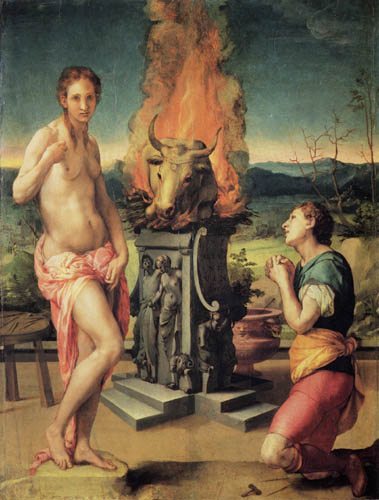
I am currently reading The Magician by Maugham, and it is turning out to be your basic fin de siècle novel, and would pair nicely with The Picture of Dorian Grey and The Strange Case of Dr. Jekyll and Mr. Hyde, Walter Pater and Baudelaire. I have yet to see that it does anything incredibly interesting, and some of its invocation of the occult is disturbing. There is a passage that evokes artworks and artists with which (and whom) I was previously unacquainted: this one by Juan Valdés de Leal, who seems rather generally extraordinary, Jusepe (or José) de Ribera, whose "dwarfs" don't seem to be well represented online (I only found this one), and a Pygmalion by Bronzino, which is the only one that seems to fit Maugham's description. Maugham's works and Greene's seem to suffer from a lack of footnotes that I attribute to a more general lack of critical attention--and yet, both names are well-known.
The Painted Veil is intriguing, and I may require it in the course I am teaching in the fall. It raises some interesting questions about depictions of women, includes some elements of the society novel that would not be out of place in Henry James or Edith Wharton, depicts the sexual act in a way that that would have seemed bold for Lawrence (who was generally more subtle), and contains lots & lots of colonialism. Of particular interest to me is Maugham's depiction of a convent of French missionary nuns in China, situated literally in the middle of a cholera epidemic. The nuns are easily the most noble characters in the novel, both in terms of bloodline and lineage (the Mother Superior is descended from nobility) and in terms of their bearing, serenity, closeness to the divine (though this is not quite how the characters in the novel or the narrator articulate it). It is interesting here to see the contrast between how the English speak of clergy of the Church of England, or how dismissive the characters are of the Anglican Church, and how the French nuns are portrayed. I'm not sure I have much to say about it beyond that, but I'm collecting data! ;)
So I am engaged in filling in a few less-than-apparent gaps in my reading of early- to mid-20th-century British fiction, asking along the way why I have not encountered these authors before, and whether it will matter at all, after I have read them, that I have read them--matter professionally, that is. I am already glad that I am reading them, and still believe in the inherent value of the act of reading--yes, I really do.
I have actually been motivated to read more in the past few weeks/months, which has its good points and bad--good, because I have been feeling that I should read more (or at all), bad because when I read, other things are pushed aside. It started with the campus visit. On the trip, I brought as reading material the student essays and creative writing that the school had provided for me, and also Bernard Schlink's The Reader. The appeal should be obvious: as I tell my students (sometimes, when I feel like mentioning my scholarly interests will help the rapport), when a novel portrays someone reading or writing, that's when I become interested. And there were so many other interesting things going on. I became interested in the book when I saw a commercial on TV for the film--which I saw afterwards (watched it on DVD with my mom), and was vastly disappointed. The book, however, is brilliantly complex and suggests some interesting ideas about literacy that I plan to form into a new chapter of my (conceptually) evolving (finished) dissertation. I have yet to read the other contemporary work that I plan to pair it with but Oprah would be proud (unfortunately, I think both books are Oprah Book Club selections, though for the life of me, I can't understand why she liked The Reader, unless she misread it or someone else selected it).
After that, my reading didn't pick up the way I wanted it to for one reason or another. I think the primary reason may have been a lack of direction--I have been feeling it for a while. So much is out there that I'm just not sure where to turn next. One writer in particular has kept creeping into my peripheral vision, however. Many of you have read him, I'm sure--Graham Greene, England's premier twentieth century Catholic novelist (well, I guess G. K. Chesterton could contend for that position from the opposite end of the political spectrum!). I didn't quite know what to read by him, and had no particular motivation to seek him out, except that the position I desperately wanted (yes, there was ONE that I knew I wanted) that was cancelled (hopefully to be reopened) was a position to teach 20th Century Catholic writers, and Greene was one specifically named. But he kept coming up. So when I accidently found myself reading an article about his file with the Vatican, I made up my mind to read The Power and the Glory, and did so during the drive to New Orleans. It is nothing short of brilliant. It captures with poignancy the struggle of the believer who recognizes his/her sinfulness, but even more than that, it captures the coexistence of hope and despair, and the contrast between the office of the priesthood and the fallible humans who are ordained to that office. I find it hard to consider it a work of British literature, since it is set in Mexico and focuses on Mexicans rather than the foreigners who live there, but even in that there is a curious Englishness, and I may be inclined to investigate in the future the strange draw that English writers have to Mexico, or more interestingly (to me), to Catholic culture(s). I am eager to read more of Greene, but I do not find that any of his novels sound as compelling as The Power and the Glory. I checked out a couple, though--Monsignor Quixote and The Heart of the Matter--so they're on the "to read" list.
A few days ago, I was in a local book/media store looking for more Graham Greene, and in the classics section I stumbled across a work by W. Somerset Maugham, The Painted Veil. The summary sounded intriguing, and it occurred to me that Maugham is in my time period, but another whose works I had never read. So when I went to the library to get the aforementioned Greene, I also grabbed The Painted Veil and another by Maugham, The Magician. On the way out, as I was thinking that I should look up some Walker Percy (another name on the list of Catholic authors desired by that coveted Assistant Professor position), I glanced to the side and found--the Walker Percy shelves! It was uncanny. So I have The Thanatos Syndrome and Love in the Ruins to read also.
I am currently reading The Magician by Maugham, and it is turning out to be your basic fin de siècle novel, and would pair nicely with The Picture of Dorian Grey and The Strange Case of Dr. Jekyll and Mr. Hyde, Walter Pater and Baudelaire. I have yet to see that it does anything incredibly interesting, and some of its invocation of the occult is disturbing. There is a passage that evokes artworks and artists with which (and whom) I was previously unacquainted: this one by Juan Valdés de Leal, who seems rather generally extraordinary, Jusepe (or José) de Ribera, whose "dwarfs" don't seem to be well represented online (I only found this one), and a Pygmalion by Bronzino, which is the only one that seems to fit Maugham's description. Maugham's works and Greene's seem to suffer from a lack of footnotes that I attribute to a more general lack of critical attention--and yet, both names are well-known.
The Painted Veil is intriguing, and I may require it in the course I am teaching in the fall. It raises some interesting questions about depictions of women, includes some elements of the society novel that would not be out of place in Henry James or Edith Wharton, depicts the sexual act in a way that that would have seemed bold for Lawrence (who was generally more subtle), and contains lots & lots of colonialism. Of particular interest to me is Maugham's depiction of a convent of French missionary nuns in China, situated literally in the middle of a cholera epidemic. The nuns are easily the most noble characters in the novel, both in terms of bloodline and lineage (the Mother Superior is descended from nobility) and in terms of their bearing, serenity, closeness to the divine (though this is not quite how the characters in the novel or the narrator articulate it). It is interesting here to see the contrast between how the English speak of clergy of the Church of England, or how dismissive the characters are of the Anglican Church, and how the French nuns are portrayed. I'm not sure I have much to say about it beyond that, but I'm collecting data! ;)
So I am engaged in filling in a few less-than-apparent gaps in my reading of early- to mid-20th-century British fiction, asking along the way why I have not encountered these authors before, and whether it will matter at all, after I have read them, that I have read them--matter professionally, that is. I am already glad that I am reading them, and still believe in the inherent value of the act of reading--yes, I really do.
Subscribe to:
Posts (Atom)