From the introduction to the Penguin Twentieth-Century Classics version of The Razor's Edge by Anthony Curtis, in reference to "a stage-play that was neither performed nor published called The Road Uphill":
. . . [T]he young man, Joseph Sheridon, has had the same experience as Larry in The Razor's Edge. He is a former aviator who formed a close friendship with a fellow fighter-pilot. During a dogfight in the air, his friend risked his own life to beat off an attacker from Joe's aircraft, and as a result of a hit sustained during the encounter he dies on landing, in full sight of Joe. The spectacle of his dead friend gives the young man so unforgettable a trauma that it causes him on his release from the air force to give up all chances of a business career in order to spend every hour of the day reading and studying to try to make sense of what has happened to him. He becomes wholly possessed by the task of trying to discover, through the received wisdom of mankind, if human life really does have a meaning." (xi)
Monday, June 29, 2009

Saturday, June 27, 2009
Graham Greene, Catholic Discourse, and the Dark Night of the Soul
The above title is what I would title the article if I were writing one. Unfortunately, the ideas that I get in the shower or bath never seem as unified once I get back to my computer. My husband suggested that the humidity in the air might influence the way the oxygen gets to the brain. If so, that might explain why I feel smarter in New Orleans than in Texas.
I finished reading a second book by Graham Greene last night, The Heart of the Matter. It was an interesting read, but not what I would call riveting all the way through--unlike The Power and the Glory. It picked up momentum at the end, though. An interesting thing about this book is that it didn't begin as a Catholic novel, but it became one, and certainly ended that way. It presents a number of particularly Catholic dilemmas, asks theological questions, and only begins to hint at any possible answers. As the protagonist is British in West Africa, his fellow countrymen are not Catholic, which becomes a subject of comment and contrast as the book progresses, and his fellow Catholics (other than the priests, who do not enter into the story much) are separate from him by station, skin color, culture, and language. His wife is separated from him both because of the human dilemma of what it means, what it costs, and whether it is possible to understand another person, and also because she wishes to leave the place they are living, and he arranges for her passage to a more hospitable part of the coast while he remains to perform his police duties. So the concept of the Church as "One Body" is only present in its insistent absence. There is nothing in the text to indicate that that was a concept stressed in Greene's time in the way it is now.
Indeed, there is a real conflict in The Heart of the Matter, as in The Power and the Glory, between duty to one's own soul and duty to others. In The Power and the Glory, the conflict arises because the unnamed priest, whom critics call the "whiskey priest," a derogatory term used in the novel which the character nevertheless transcends, has an unconfessed mortal sin, but still must preside over Masses when he arrives in villages (including consuming the Body of Christ himself), administer the Sacrament of Reconciliation, and finally, instead of crossing the border into a relatively "safe" zone for Catholics, who were being persecuted throughout Mexico during the revolution, he is called to give the Last Rites to a dying criminal. So his choice is to face almost certain capture and execution in order to perform his priestly duty, or to tend to his own soul by going into safety, where he can easily confess the sin he has carried with him since before the time frame of the novel. The person of the priest and his office, though sometimes conflated in the reflections of the character on his own actions, are distinct from each other in the eyes of the reader, who realizes that the priest does not fail (though he does falter) in his vocational duties, and so judges him lightly both for his unworthy reception of the Body of Christ, and for his sin and inability to Confess. Throughout both novels, the characters repeat (and in The Power and the Glory it takes the tone of a mantra), that an individual's first duty is the salvation of his own soul.
In The Heart of the Matter, the conflict between personal salvation and attention to others' needs is more ambiguous, as the duties to others are secular, perceived needs based on social and self-imposed obligations. Interestingly, though he has spent his life attending to others' needs at the expense of his own peace, it is duty to God that causes the central character, Scobie, to lose hope. That in itself is a strange concept, that while the main character doubts his faith in God, and resolves himself to mortal sin because he can not find the motivation to stop or to confess, he nevertheless is moved to the unforgivable sin--suicide--by his knowledge that to receive God in his state of mortal sin is desecration, like inflicting wounds on an already suffering Christ. His desire not to wound anyone, and least of all God, leads him to inflict wound after wound on his own soul, descending finally into despair and rationally calculated damnation. Greene leads us to question the notion that any sin--including suicide, final abandonment to despair, the final rejection of the redeeming and healing power of God--is truly unforgivable, even indicating in one scene that God, who is capable of anything and can break His own rules, can certainly break this one, and allow for redemption. Greene suggests at the end that Scobie calls upon God in something that might be seen as repentance, but is too brief. But it is essential that Scobie does not believe that there will be an exception for himself. Had he killed himself with the notion that he could be forgiven, the act would not have held the pathos or illustrated the despair that it does otherwise.
I read a review of The Power and the Glory by a user of an application that I access through Facebook--I forget the name of the app--that says that "only Catholicism can find beauty in spiritual rot." This was intended as a backhanded comment--a critique, insult, what have you. I had to read further to determine this for myself, though, as my instinctive reaction was "YES! YES!!" But truly, there is a tradition in Catholic fiction, nonfiction and poetry that acknowledges the dark times of faith--the Dark Night of the Soul tradition that St. John of the Cross so poignantly displays in his poetry, that Dante chronicles before meeting Virgil in the Commedia, that Santa Theresa de Avila experiences as well as Mother Theresa. It is, in fact, a mark of great faith to have experienced such spiritual darkness. It is also a mark of great twentieth-century Christian writers of the Catholic and Anglo-Catholic traditions that they see in the darkness of humanity something of beauty, as if by acknowledging the darkness we are reaching out to forces larger than ourselves, acknowledging their power and our smallness in the face of such things. I think, here, of Eliot in The Four Quartets, or Auden in many of his poems, but especially "Musée des Beaux Arts": "About suffering they were never wrong, the Old Masters. . . ." In a sense, there is redemption in despair for these writers. In the writings of the saints, they struggle not to succumb to despair, and in the performance of everyday tasks, as in the sustenance of the Eucharist, they are able to continue, though the blackness might continue also. In the writings of Tolkien, the inexorable sense of loss that permeates even victory against evil suggests a final defeat of humanity, and a light that transcends that defeat. Even Joyce partakes of this to a degree in Dubliners, most notably in "The Dead."
In the Liturgy of the Eucharist, the congregation and priest pray "protect us from all anxiety as we wait in joyful hope for the coming of our Savior, Jesus Christ." There is much less of "joyful hope" in the works of the writers I have mentioned than there is of "anxiety." And if we are supposed to wait "in joyful hope," why do we find beauty in works that emphasize the darkness? Certainly, in his portrayal of spiritual darkness in The Heart of the Matter, Greene shows how descent into despair leads to an acknowledgment of need for God. It even opens up the possibility of a dialogue with God, which may lead to personal spiritual redemption. This dialogue with God is dramatized in the final pages of The Heart of the Matter. But there is an even earlier precedent that dramatizes the power of spiritual darkness that leads to dialogue with God--the Agony of Christ in the Garden. And it is perhaps His spiritual darkness that is poignantly evoked, that makes us feel the power and beauty of the questioning and striving against the darkness, and makes the most skillfully executed accounts reach out to something larger rather than staying within the meanness of human experience. It is what makes Father Rake declare in the end that Scobie perhaps loved God more than anything at all: that his despair, though he was finally unable to conquer it, was larger than the despair of human existence.
"Le Mont des oliviers," a French Romantic poem by Alfred de Vigny transforms the Agony in the Garden into a dialogue of the Son with the Father. Though Vigny lived during the Revolution in France, at a time when the Church was challenged, rejected, and even demonized, and participated in a literary and artistic movement that sought to glorify the "energy" of evil (as in Blake's Marriage of Heaven and Hell) and redeem Satan (as in one of Vigny's own poems), he taps into the Dark Night of the Soul in all of its poignancy, power, loneliness, and near despair in "Le Mont des oliviers"--"The Mount of Olives"--which I translated (in part) when I was an undergraduate: Then it was night, and Jesus walked alone/ Clothed in white, like one who is already dead/ the disciples slept at the foot of the hill,/ Towards the olives, a sinister wind blew. . . A few lines later: He fell to his knees, his chest against the earth;/ Then looking at the sky, called, "Oh My Father!"/ -But the sky was black, and God did not respond.
The conclusion of the poem is to reject the divinity by whom we are rejected--a truly existential moment in French Romantic poetry. And given that the twentieth century saw the advent of existential philosophy as such, one might expect that Greene would come to similar conclusions. While he is able to condemn humanity to the judgment of God, Greene is unable to condemn humanity to God's indifference.
Here, I have lost a reference I believed I read in The Power and the Glory to Christ's Agony in the Garden--one of those pieces that would have tied everything together for me and created beautiful symmetry in my discussion. There are many references to the sacrifice of Christ in The Heart of the Matter--more obvious references than in The Power and the Glory, though it too has many New Testament references. But this brings me to the Liturgy of the Eucharist again. In the Liturgy, one finds represented the Last Supper ("On the night He was betrayed, He took bread and gave You thanks and praise. . .") and the Crucifixion. However, apart from the Triduum, the Church does not reenact the Agony in the Garden during the Sacrifice of the Mass. (The Agony in the Garden is memorialized in the Sorrowful Mysteries of the Rosary, however.) In rhetorical terms, we might conclude that that absence in the regular liturgy of reference to the Christ's Agony creates a kind of discursive space which is filled by the experiences of the faithful, the writings of the saints, and the moments of spiritual darkness that emerge in Catholic Sacramental literature.
Here, I'm afraid I must end abruptly, as this is the beginning of something rather than something complete and unified. Without being too abrupt in this transition, I want to finish with the observation that both of Greene's novels, as well as The Painted Veil by W. Somerset Maugham, strike me as mature works--not pointing to the maturity of the novelist as a practitioner of his craft, but rather his representation of the life of the individual. In The Heart of the Matter, there is great emphasis on responsibility, and on the consequences of one's actions. The Power and the Glory could not have been written without the sense of responsibility that is greater than oneself. But that responsibility is not something that the characters rebel against--they recognize that it would not remove the responsibility to rebel. I have been fond of saying lately that the Romantics are the adolescents of English literature while Modernism is its mid-life crisis. Which would leave mature adulthood for the Victorians? Perhaps. Perhaps not. But I have found myself disillusioned with the Romantics and the Modernists both because well, that's not where I am in life right now. And admittedly, the Greene novels and Maugham novels do not portray characters that I can relate to, but they engage me with ideas that I find compelling from where I am in life, and actions that do not disgust me with their triviality.
I finished reading a second book by Graham Greene last night, The Heart of the Matter. It was an interesting read, but not what I would call riveting all the way through--unlike The Power and the Glory. It picked up momentum at the end, though. An interesting thing about this book is that it didn't begin as a Catholic novel, but it became one, and certainly ended that way. It presents a number of particularly Catholic dilemmas, asks theological questions, and only begins to hint at any possible answers. As the protagonist is British in West Africa, his fellow countrymen are not Catholic, which becomes a subject of comment and contrast as the book progresses, and his fellow Catholics (other than the priests, who do not enter into the story much) are separate from him by station, skin color, culture, and language. His wife is separated from him both because of the human dilemma of what it means, what it costs, and whether it is possible to understand another person, and also because she wishes to leave the place they are living, and he arranges for her passage to a more hospitable part of the coast while he remains to perform his police duties. So the concept of the Church as "One Body" is only present in its insistent absence. There is nothing in the text to indicate that that was a concept stressed in Greene's time in the way it is now.
Indeed, there is a real conflict in The Heart of the Matter, as in The Power and the Glory, between duty to one's own soul and duty to others. In The Power and the Glory, the conflict arises because the unnamed priest, whom critics call the "whiskey priest," a derogatory term used in the novel which the character nevertheless transcends, has an unconfessed mortal sin, but still must preside over Masses when he arrives in villages (including consuming the Body of Christ himself), administer the Sacrament of Reconciliation, and finally, instead of crossing the border into a relatively "safe" zone for Catholics, who were being persecuted throughout Mexico during the revolution, he is called to give the Last Rites to a dying criminal. So his choice is to face almost certain capture and execution in order to perform his priestly duty, or to tend to his own soul by going into safety, where he can easily confess the sin he has carried with him since before the time frame of the novel. The person of the priest and his office, though sometimes conflated in the reflections of the character on his own actions, are distinct from each other in the eyes of the reader, who realizes that the priest does not fail (though he does falter) in his vocational duties, and so judges him lightly both for his unworthy reception of the Body of Christ, and for his sin and inability to Confess. Throughout both novels, the characters repeat (and in The Power and the Glory it takes the tone of a mantra), that an individual's first duty is the salvation of his own soul.
In The Heart of the Matter, the conflict between personal salvation and attention to others' needs is more ambiguous, as the duties to others are secular, perceived needs based on social and self-imposed obligations. Interestingly, though he has spent his life attending to others' needs at the expense of his own peace, it is duty to God that causes the central character, Scobie, to lose hope. That in itself is a strange concept, that while the main character doubts his faith in God, and resolves himself to mortal sin because he can not find the motivation to stop or to confess, he nevertheless is moved to the unforgivable sin--suicide--by his knowledge that to receive God in his state of mortal sin is desecration, like inflicting wounds on an already suffering Christ. His desire not to wound anyone, and least of all God, leads him to inflict wound after wound on his own soul, descending finally into despair and rationally calculated damnation. Greene leads us to question the notion that any sin--including suicide, final abandonment to despair, the final rejection of the redeeming and healing power of God--is truly unforgivable, even indicating in one scene that God, who is capable of anything and can break His own rules, can certainly break this one, and allow for redemption. Greene suggests at the end that Scobie calls upon God in something that might be seen as repentance, but is too brief. But it is essential that Scobie does not believe that there will be an exception for himself. Had he killed himself with the notion that he could be forgiven, the act would not have held the pathos or illustrated the despair that it does otherwise.
I read a review of The Power and the Glory by a user of an application that I access through Facebook--I forget the name of the app--that says that "only Catholicism can find beauty in spiritual rot." This was intended as a backhanded comment--a critique, insult, what have you. I had to read further to determine this for myself, though, as my instinctive reaction was "YES! YES!!" But truly, there is a tradition in Catholic fiction, nonfiction and poetry that acknowledges the dark times of faith--the Dark Night of the Soul tradition that St. John of the Cross so poignantly displays in his poetry, that Dante chronicles before meeting Virgil in the Commedia, that Santa Theresa de Avila experiences as well as Mother Theresa. It is, in fact, a mark of great faith to have experienced such spiritual darkness. It is also a mark of great twentieth-century Christian writers of the Catholic and Anglo-Catholic traditions that they see in the darkness of humanity something of beauty, as if by acknowledging the darkness we are reaching out to forces larger than ourselves, acknowledging their power and our smallness in the face of such things. I think, here, of Eliot in The Four Quartets, or Auden in many of his poems, but especially "Musée des Beaux Arts": "About suffering they were never wrong, the Old Masters. . . ." In a sense, there is redemption in despair for these writers. In the writings of the saints, they struggle not to succumb to despair, and in the performance of everyday tasks, as in the sustenance of the Eucharist, they are able to continue, though the blackness might continue also. In the writings of Tolkien, the inexorable sense of loss that permeates even victory against evil suggests a final defeat of humanity, and a light that transcends that defeat. Even Joyce partakes of this to a degree in Dubliners, most notably in "The Dead."
In the Liturgy of the Eucharist, the congregation and priest pray "protect us from all anxiety as we wait in joyful hope for the coming of our Savior, Jesus Christ." There is much less of "joyful hope" in the works of the writers I have mentioned than there is of "anxiety." And if we are supposed to wait "in joyful hope," why do we find beauty in works that emphasize the darkness? Certainly, in his portrayal of spiritual darkness in The Heart of the Matter, Greene shows how descent into despair leads to an acknowledgment of need for God. It even opens up the possibility of a dialogue with God, which may lead to personal spiritual redemption. This dialogue with God is dramatized in the final pages of The Heart of the Matter. But there is an even earlier precedent that dramatizes the power of spiritual darkness that leads to dialogue with God--the Agony of Christ in the Garden. And it is perhaps His spiritual darkness that is poignantly evoked, that makes us feel the power and beauty of the questioning and striving against the darkness, and makes the most skillfully executed accounts reach out to something larger rather than staying within the meanness of human experience. It is what makes Father Rake declare in the end that Scobie perhaps loved God more than anything at all: that his despair, though he was finally unable to conquer it, was larger than the despair of human existence.
"Le Mont des oliviers," a French Romantic poem by Alfred de Vigny transforms the Agony in the Garden into a dialogue of the Son with the Father. Though Vigny lived during the Revolution in France, at a time when the Church was challenged, rejected, and even demonized, and participated in a literary and artistic movement that sought to glorify the "energy" of evil (as in Blake's Marriage of Heaven and Hell) and redeem Satan (as in one of Vigny's own poems), he taps into the Dark Night of the Soul in all of its poignancy, power, loneliness, and near despair in "Le Mont des oliviers"--"The Mount of Olives"--which I translated (in part) when I was an undergraduate: Then it was night, and Jesus walked alone/ Clothed in white, like one who is already dead/ the disciples slept at the foot of the hill,/ Towards the olives, a sinister wind blew. . . A few lines later: He fell to his knees, his chest against the earth;/ Then looking at the sky, called, "Oh My Father!"/ -But the sky was black, and God did not respond.
The conclusion of the poem is to reject the divinity by whom we are rejected--a truly existential moment in French Romantic poetry. And given that the twentieth century saw the advent of existential philosophy as such, one might expect that Greene would come to similar conclusions. While he is able to condemn humanity to the judgment of God, Greene is unable to condemn humanity to God's indifference.
Here, I have lost a reference I believed I read in The Power and the Glory to Christ's Agony in the Garden--one of those pieces that would have tied everything together for me and created beautiful symmetry in my discussion. There are many references to the sacrifice of Christ in The Heart of the Matter--more obvious references than in The Power and the Glory, though it too has many New Testament references. But this brings me to the Liturgy of the Eucharist again. In the Liturgy, one finds represented the Last Supper ("On the night He was betrayed, He took bread and gave You thanks and praise. . .") and the Crucifixion. However, apart from the Triduum, the Church does not reenact the Agony in the Garden during the Sacrifice of the Mass. (The Agony in the Garden is memorialized in the Sorrowful Mysteries of the Rosary, however.) In rhetorical terms, we might conclude that that absence in the regular liturgy of reference to the Christ's Agony creates a kind of discursive space which is filled by the experiences of the faithful, the writings of the saints, and the moments of spiritual darkness that emerge in Catholic Sacramental literature.
Here, I'm afraid I must end abruptly, as this is the beginning of something rather than something complete and unified. Without being too abrupt in this transition, I want to finish with the observation that both of Greene's novels, as well as The Painted Veil by W. Somerset Maugham, strike me as mature works--not pointing to the maturity of the novelist as a practitioner of his craft, but rather his representation of the life of the individual. In The Heart of the Matter, there is great emphasis on responsibility, and on the consequences of one's actions. The Power and the Glory could not have been written without the sense of responsibility that is greater than oneself. But that responsibility is not something that the characters rebel against--they recognize that it would not remove the responsibility to rebel. I have been fond of saying lately that the Romantics are the adolescents of English literature while Modernism is its mid-life crisis. Which would leave mature adulthood for the Victorians? Perhaps. Perhaps not. But I have found myself disillusioned with the Romantics and the Modernists both because well, that's not where I am in life right now. And admittedly, the Greene novels and Maugham novels do not portray characters that I can relate to, but they engage me with ideas that I find compelling from where I am in life, and actions that do not disgust me with their triviality.
Sunday, June 14, 2009
Summer Reading
Cross-posted on Words, Words.
I have actually been motivated to read more in the past few weeks/months, which has its good points and bad--good, because I have been feeling that I should read more (or at all), bad because when I read, other things are pushed aside. It started with the campus visit. On the trip, I brought as reading material the student essays and creative writing that the school had provided for me, and also Bernard Schlink's The Reader. The appeal should be obvious: as I tell my students (sometimes, when I feel like mentioning my scholarly interests will help the rapport), when a novel portrays someone reading or writing, that's when I become interested. And there were so many other interesting things going on. I became interested in the book when I saw a commercial on TV for the film--which I saw afterwards (watched it on DVD with my mom), and was vastly disappointed. The book, however, is brilliantly complex and suggests some interesting ideas about literacy that I plan to form into a new chapter of my (conceptually) evolving (finished) dissertation. I have yet to read the other contemporary work that I plan to pair it with but Oprah would be proud (unfortunately, I think both books are Oprah Book Club selections, though for the life of me, I can't understand why she liked The Reader, unless she misread it or someone else selected it).
After that, my reading didn't pick up the way I wanted it to for one reason or another. I think the primary reason may have been a lack of direction--I have been feeling it for a while. So much is out there that I'm just not sure where to turn next. One writer in particular has kept creeping into my peripheral vision, however. Many of you have read him, I'm sure--Graham Greene, England's premier twentieth century Catholic novelist (well, I guess G. K. Chesterton could contend for that position from the opposite end of the political spectrum!). I didn't quite know what to read by him, and had no particular motivation to seek him out, except that the position I desperately wanted (yes, there was ONE that I knew I wanted) that was cancelled (hopefully to be reopened) was a position to teach 20th Century Catholic writers, and Greene was one specifically named. But he kept coming up. So when I accidently found myself reading an article about his file with the Vatican, I made up my mind to read The Power and the Glory, and did so during the drive to New Orleans. It is nothing short of brilliant. It captures with poignancy the struggle of the believer who recognizes his/her sinfulness, but even more than that, it captures the coexistence of hope and despair, and the contrast between the office of the priesthood and the fallible humans who are ordained to that office. I find it hard to consider it a work of British literature, since it is set in Mexico and focuses on Mexicans rather than the foreigners who live there, but even in that there is a curious Englishness, and I may be inclined to investigate in the future the strange draw that English writers have to Mexico, or more interestingly (to me), to Catholic culture(s). I am eager to read more of Greene, but I do not find that any of his novels sound as compelling as The Power and the Glory. I checked out a couple, though--Monsignor Quixote and The Heart of the Matter--so they're on the "to read" list.
A few days ago, I was in a local book/media store looking for more Graham Greene, and in the classics section I stumbled across a work by W. Somerset Maugham, The Painted Veil. The summary sounded intriguing, and it occurred to me that Maugham is in my time period, but another whose works I had never read. So when I went to the library to get the aforementioned Greene, I also grabbed The Painted Veil and another by Maugham, The Magician. On the way out, as I was thinking that I should look up some Walker Percy (another name on the list of Catholic authors desired by that coveted Assistant Professor position), I glanced to the side and found--the Walker Percy shelves! It was uncanny. So I have The Thanatos Syndrome and Love in the Ruins to read also.
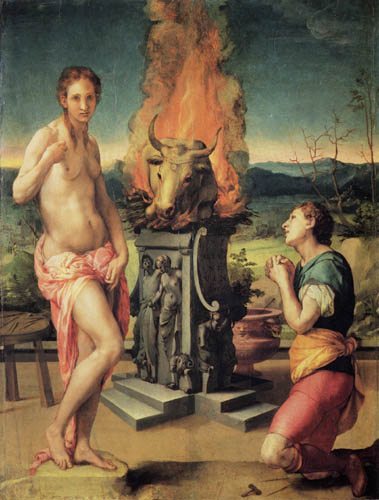
I am currently reading The Magician by Maugham, and it is turning out to be your basic fin de siècle novel, and would pair nicely with The Picture of Dorian Grey and The Strange Case of Dr. Jekyll and Mr. Hyde, Walter Pater and Baudelaire. I have yet to see that it does anything incredibly interesting, and some of its invocation of the occult is disturbing. There is a passage that evokes artworks and artists with which (and whom) I was previously unacquainted: this one by Juan Valdés de Leal, who seems rather generally extraordinary, Jusepe (or José) de Ribera, whose "dwarfs" don't seem to be well represented online (I only found this one), and a Pygmalion by Bronzino, which is the only one that seems to fit Maugham's description. Maugham's works and Greene's seem to suffer from a lack of footnotes that I attribute to a more general lack of critical attention--and yet, both names are well-known.
The Painted Veil is intriguing, and I may require it in the course I am teaching in the fall. It raises some interesting questions about depictions of women, includes some elements of the society novel that would not be out of place in Henry James or Edith Wharton, depicts the sexual act in a way that that would have seemed bold for Lawrence (who was generally more subtle), and contains lots & lots of colonialism. Of particular interest to me is Maugham's depiction of a convent of French missionary nuns in China, situated literally in the middle of a cholera epidemic. The nuns are easily the most noble characters in the novel, both in terms of bloodline and lineage (the Mother Superior is descended from nobility) and in terms of their bearing, serenity, closeness to the divine (though this is not quite how the characters in the novel or the narrator articulate it). It is interesting here to see the contrast between how the English speak of clergy of the Church of England, or how dismissive the characters are of the Anglican Church, and how the French nuns are portrayed. I'm not sure I have much to say about it beyond that, but I'm collecting data! ;)
So I am engaged in filling in a few less-than-apparent gaps in my reading of early- to mid-20th-century British fiction, asking along the way why I have not encountered these authors before, and whether it will matter at all, after I have read them, that I have read them--matter professionally, that is. I am already glad that I am reading them, and still believe in the inherent value of the act of reading--yes, I really do.
I have actually been motivated to read more in the past few weeks/months, which has its good points and bad--good, because I have been feeling that I should read more (or at all), bad because when I read, other things are pushed aside. It started with the campus visit. On the trip, I brought as reading material the student essays and creative writing that the school had provided for me, and also Bernard Schlink's The Reader. The appeal should be obvious: as I tell my students (sometimes, when I feel like mentioning my scholarly interests will help the rapport), when a novel portrays someone reading or writing, that's when I become interested. And there were so many other interesting things going on. I became interested in the book when I saw a commercial on TV for the film--which I saw afterwards (watched it on DVD with my mom), and was vastly disappointed. The book, however, is brilliantly complex and suggests some interesting ideas about literacy that I plan to form into a new chapter of my (conceptually) evolving (finished) dissertation. I have yet to read the other contemporary work that I plan to pair it with but Oprah would be proud (unfortunately, I think both books are Oprah Book Club selections, though for the life of me, I can't understand why she liked The Reader, unless she misread it or someone else selected it).
After that, my reading didn't pick up the way I wanted it to for one reason or another. I think the primary reason may have been a lack of direction--I have been feeling it for a while. So much is out there that I'm just not sure where to turn next. One writer in particular has kept creeping into my peripheral vision, however. Many of you have read him, I'm sure--Graham Greene, England's premier twentieth century Catholic novelist (well, I guess G. K. Chesterton could contend for that position from the opposite end of the political spectrum!). I didn't quite know what to read by him, and had no particular motivation to seek him out, except that the position I desperately wanted (yes, there was ONE that I knew I wanted) that was cancelled (hopefully to be reopened) was a position to teach 20th Century Catholic writers, and Greene was one specifically named. But he kept coming up. So when I accidently found myself reading an article about his file with the Vatican, I made up my mind to read The Power and the Glory, and did so during the drive to New Orleans. It is nothing short of brilliant. It captures with poignancy the struggle of the believer who recognizes his/her sinfulness, but even more than that, it captures the coexistence of hope and despair, and the contrast between the office of the priesthood and the fallible humans who are ordained to that office. I find it hard to consider it a work of British literature, since it is set in Mexico and focuses on Mexicans rather than the foreigners who live there, but even in that there is a curious Englishness, and I may be inclined to investigate in the future the strange draw that English writers have to Mexico, or more interestingly (to me), to Catholic culture(s). I am eager to read more of Greene, but I do not find that any of his novels sound as compelling as The Power and the Glory. I checked out a couple, though--Monsignor Quixote and The Heart of the Matter--so they're on the "to read" list.
A few days ago, I was in a local book/media store looking for more Graham Greene, and in the classics section I stumbled across a work by W. Somerset Maugham, The Painted Veil. The summary sounded intriguing, and it occurred to me that Maugham is in my time period, but another whose works I had never read. So when I went to the library to get the aforementioned Greene, I also grabbed The Painted Veil and another by Maugham, The Magician. On the way out, as I was thinking that I should look up some Walker Percy (another name on the list of Catholic authors desired by that coveted Assistant Professor position), I glanced to the side and found--the Walker Percy shelves! It was uncanny. So I have The Thanatos Syndrome and Love in the Ruins to read also.
I am currently reading The Magician by Maugham, and it is turning out to be your basic fin de siècle novel, and would pair nicely with The Picture of Dorian Grey and The Strange Case of Dr. Jekyll and Mr. Hyde, Walter Pater and Baudelaire. I have yet to see that it does anything incredibly interesting, and some of its invocation of the occult is disturbing. There is a passage that evokes artworks and artists with which (and whom) I was previously unacquainted: this one by Juan Valdés de Leal, who seems rather generally extraordinary, Jusepe (or José) de Ribera, whose "dwarfs" don't seem to be well represented online (I only found this one), and a Pygmalion by Bronzino, which is the only one that seems to fit Maugham's description. Maugham's works and Greene's seem to suffer from a lack of footnotes that I attribute to a more general lack of critical attention--and yet, both names are well-known.
The Painted Veil is intriguing, and I may require it in the course I am teaching in the fall. It raises some interesting questions about depictions of women, includes some elements of the society novel that would not be out of place in Henry James or Edith Wharton, depicts the sexual act in a way that that would have seemed bold for Lawrence (who was generally more subtle), and contains lots & lots of colonialism. Of particular interest to me is Maugham's depiction of a convent of French missionary nuns in China, situated literally in the middle of a cholera epidemic. The nuns are easily the most noble characters in the novel, both in terms of bloodline and lineage (the Mother Superior is descended from nobility) and in terms of their bearing, serenity, closeness to the divine (though this is not quite how the characters in the novel or the narrator articulate it). It is interesting here to see the contrast between how the English speak of clergy of the Church of England, or how dismissive the characters are of the Anglican Church, and how the French nuns are portrayed. I'm not sure I have much to say about it beyond that, but I'm collecting data! ;)
So I am engaged in filling in a few less-than-apparent gaps in my reading of early- to mid-20th-century British fiction, asking along the way why I have not encountered these authors before, and whether it will matter at all, after I have read them, that I have read them--matter professionally, that is. I am already glad that I am reading them, and still believe in the inherent value of the act of reading--yes, I really do.
Wednesday, February 18, 2009
Literacy & Children's Fiction: A Running List
I have discovered some more books for my running list of children's lit books about literacy. It may be an overly ambitious or redundant project, since of course children's literature is concerned with conceptions of reading. But I do at least see different emphasis in some of the books. Is literacy primarily a social concern, or an individual concern--of primary use to individuals? That does seem to be something that different authors represent differently. I haven't managed to find a thematic list of children's fiction that includes literacy as I'm defining it, so my main question at this point is how to find books that relate to my topic?
But anyway, here are some:
The Book Thief by Markus Zusak
Fly By Night by Frances Hardinge
Voices (Annals of the Western Shore) by Ursula Le Guin
Exchange by Paul Magrs
The Green Book by Jill Paton Walsh
The Day They Came to Arrest the Book by Nat Hentoff (An overt statement about censorship--dealing with it directly by portraying a battle with parents who want to ban Huck Finn. Yawn. But very representative of why this is an issue in children's lit in the first place.)
Some of the themes will no doubt make good comparisons with 1984 and Brave New World.
But anyway, here are some:
The Book Thief by Markus Zusak
Fly By Night by Frances Hardinge
Voices (Annals of the Western Shore) by Ursula Le Guin
Exchange by Paul Magrs
The Green Book by Jill Paton Walsh
The Day They Came to Arrest the Book by Nat Hentoff (An overt statement about censorship--dealing with it directly by portraying a battle with parents who want to ban Huck Finn. Yawn. But very representative of why this is an issue in children's lit in the first place.)
Some of the themes will no doubt make good comparisons with 1984 and Brave New World.
Sunday, January 11, 2009
Recommended by Sister Mary Martha
(On her blog)
I would love to read Sisters: Catholic Nuns and the Making of America. That's all I wanted to say for now. Here is what she says (brief anecdote):
Here's a good read, by the way, to get a grip on seeing a job that needs doing and doing it. The book is called, "Sisters: Catholic Nuns and the Making of America" and is an amazing trip from Europe to America by young women who were sent alone into the wilderness (when it really was wilderness) to build schools and hospitals and orphanages from nothing. There is a very entertaining story about a nun who befriended Billy the Kid because she was the only person who would give medical attention to one of his buddies who had been shot. She saved the man's life. Billy the Kid visited her whenever he was in town and had his horse do tricks for her.
This reminds me of a book I do not particularly want to read, Double Crossed: Uncovering the Catholic Church's Betrayal of American Nuns, in part because it reeks of a smear-campaign against the Church initiated by bitter people, and who wants to read that? But I keep seeing it, and something in me wants to know what they are talking about, if only to disagree. So I am curious to know what an actual, orthodox nun thinks of the book, or the phenomenon--real or imagined--that it depicts. If only Sister Mary Martha would stop by & visit. . .
I would love to read Sisters: Catholic Nuns and the Making of America. That's all I wanted to say for now. Here is what she says (brief anecdote):
Here's a good read, by the way, to get a grip on seeing a job that needs doing and doing it. The book is called, "Sisters: Catholic Nuns and the Making of America" and is an amazing trip from Europe to America by young women who were sent alone into the wilderness (when it really was wilderness) to build schools and hospitals and orphanages from nothing. There is a very entertaining story about a nun who befriended Billy the Kid because she was the only person who would give medical attention to one of his buddies who had been shot. She saved the man's life. Billy the Kid visited her whenever he was in town and had his horse do tricks for her.
This reminds me of a book I do not particularly want to read, Double Crossed: Uncovering the Catholic Church's Betrayal of American Nuns, in part because it reeks of a smear-campaign against the Church initiated by bitter people, and who wants to read that? But I keep seeing it, and something in me wants to know what they are talking about, if only to disagree. So I am curious to know what an actual, orthodox nun thinks of the book, or the phenomenon--real or imagined--that it depicts. If only Sister Mary Martha would stop by & visit. . .
Friday, December 5, 2008
Books I Want (to Read)
In my spare time. . . ;)
Cross-posted at Words, Words.
In Barnes and Noble the other day, I was looking in the nonfiction section to try to find a compelling book to replace the one we are currently using in our freshman composition course. I found one that I will be using in my own comp class next semester: Remix: Making Art and Commerce Thrive in the Hybrid Economy. It is a compelling topic that has impact on the life of universities--internet and copyright. Students have been trying to write about NAPSTER since I started teaching, and we are getting to the point where there is abundant scholarly material on the topic. In addition, the book stresses issues of writing and rhetoric and writing. The introduction refers to Lakoff and Johnson, gurus of metaphor and its implications. Another chapter begins with a discussion of use of sources in English papers--perfect! At any rate, I hope so. Of course, the best thing is that these are intellectual topics--subject to some emotional response, but not one that college freshmen (or non-freshmen) will be unable to control--and topics that I wouldn't mind discussing. This should prove to be an interesting book, but not one that I would necessarily read if not for teaching. . .
On the other hand, I found another book in B & N that I would really like to read: Anne Rice's memoir of her return to Catholicism, Called Out of Darkness: A Spiritual Confession. I love conversion narrative--though not the early 17th century kind that you find in American Lit textbooks! I love the book Prodigal Daughters: Catholic Women Come Home to the Church, for example. Interesting thing--like the Anne Rice book, it is not really a conversion narrative, but a reversion--except that a conversion is a "turning toward," so indeed, it is a conversion, just not as "conversion" is usually meant. I have seen critiques of Rice's "brand" of Catholicism--that is, her failure to accept Church teaching on prominent social issues. This is hardly surprising, especially given her connection to New Orleans. On the other hand, it is perhaps important to recognize "conversion" as a process for anyone, including those who already see themselves as faithful Catholics. All of us have moments when we drift, even just a little, and come back, the important part is that we remind ourselves of the True Goal. So I am not looking to Anne Rice as a model of Catholicism, which I hope others do not do. I am well acquainted with Rice's novels, having read the first 4 vampire chronicles--repeatedly--in high school and early in my college career. Interestingly, it was Rice that first led me to investigate the meaning of the words "tabernacle" and "Transubstantiation." That alone is reason for me to read of her spiritual journey. I expect to find more than a touch of arrogance, even in her semblance of humility--but again, I'm not reading her as a spiritual guide, and it takes a bit of egotism to write such a book, though humility is a necessary part of the ethos of such an undertaking (a little rhetorical analysis). I am not particularly interested in her Road to Cana, etc. I picked it up once--in SAM'S club, I think--and was a little put off by the whole project. I'm not crazy about the idea of fictionalizing the life of Jesus. It just seems like treading on dangerous territory--theologically speaking. Remember that arrogance I mentioned? Yeah, that too. What I am primarily looking for in Called Out of Darkness is a feeling. And Rice is particularly good at evoking feeling. And seeing how rooted her feelings are in a particular place, and how we share that place as a common background, and share a common (or uncommon) religious experience, well, I think I could really enjoy reading the book. I told my son the other day that when I was a little girl, all little old ladies were Catholic, and their houses were all adorned with statues of saints and holy pictures. And that created a feeling--something that has become meaningful for me in recent years. I want to read about the influences of the beauty of Catholic culture on Rice, and how it influenced her conversion, since I know--on a level--what she is talking about. Perhaps one of these days I will have the opportunity to read it.
There are two others that catch my attention for cerebral reasons. From the New York Times "Notable Books of 2008":
The Ten-Cent Plague: The Great Comic Book Scare and How it Changed America by David Hajdu
and
A Great Idea at the Time: The Rise, Fall and Curious Afterlife of the Great Books Project by Alex Beam
Because I am sitting down for the 4th or 5th time to try to finish this post, and because interruption seems imminent, I will not give too many of my impressions. After all, I have not actually held these books, I have just seen them online. You can, after all, tell a great deal about a book just from perusing it for 15 minutes--enough to write a decent review! I will say that these are rather predictable choices--being about literacy. Books about books--my specialty!
Cross-posted at Words, Words.
In Barnes and Noble the other day, I was looking in the nonfiction section to try to find a compelling book to replace the one we are currently using in our freshman composition course. I found one that I will be using in my own comp class next semester: Remix: Making Art and Commerce Thrive in the Hybrid Economy. It is a compelling topic that has impact on the life of universities--internet and copyright. Students have been trying to write about NAPSTER since I started teaching, and we are getting to the point where there is abundant scholarly material on the topic. In addition, the book stresses issues of writing and rhetoric and writing. The introduction refers to Lakoff and Johnson, gurus of metaphor and its implications. Another chapter begins with a discussion of use of sources in English papers--perfect! At any rate, I hope so. Of course, the best thing is that these are intellectual topics--subject to some emotional response, but not one that college freshmen (or non-freshmen) will be unable to control--and topics that I wouldn't mind discussing. This should prove to be an interesting book, but not one that I would necessarily read if not for teaching. . .
On the other hand, I found another book in B & N that I would really like to read: Anne Rice's memoir of her return to Catholicism, Called Out of Darkness: A Spiritual Confession. I love conversion narrative--though not the early 17th century kind that you find in American Lit textbooks! I love the book Prodigal Daughters: Catholic Women Come Home to the Church, for example. Interesting thing--like the Anne Rice book, it is not really a conversion narrative, but a reversion--except that a conversion is a "turning toward," so indeed, it is a conversion, just not as "conversion" is usually meant. I have seen critiques of Rice's "brand" of Catholicism--that is, her failure to accept Church teaching on prominent social issues. This is hardly surprising, especially given her connection to New Orleans. On the other hand, it is perhaps important to recognize "conversion" as a process for anyone, including those who already see themselves as faithful Catholics. All of us have moments when we drift, even just a little, and come back, the important part is that we remind ourselves of the True Goal. So I am not looking to Anne Rice as a model of Catholicism, which I hope others do not do. I am well acquainted with Rice's novels, having read the first 4 vampire chronicles--repeatedly--in high school and early in my college career. Interestingly, it was Rice that first led me to investigate the meaning of the words "tabernacle" and "Transubstantiation." That alone is reason for me to read of her spiritual journey. I expect to find more than a touch of arrogance, even in her semblance of humility--but again, I'm not reading her as a spiritual guide, and it takes a bit of egotism to write such a book, though humility is a necessary part of the ethos of such an undertaking (a little rhetorical analysis). I am not particularly interested in her Road to Cana, etc. I picked it up once--in SAM'S club, I think--and was a little put off by the whole project. I'm not crazy about the idea of fictionalizing the life of Jesus. It just seems like treading on dangerous territory--theologically speaking. Remember that arrogance I mentioned? Yeah, that too. What I am primarily looking for in Called Out of Darkness is a feeling. And Rice is particularly good at evoking feeling. And seeing how rooted her feelings are in a particular place, and how we share that place as a common background, and share a common (or uncommon) religious experience, well, I think I could really enjoy reading the book. I told my son the other day that when I was a little girl, all little old ladies were Catholic, and their houses were all adorned with statues of saints and holy pictures. And that created a feeling--something that has become meaningful for me in recent years. I want to read about the influences of the beauty of Catholic culture on Rice, and how it influenced her conversion, since I know--on a level--what she is talking about. Perhaps one of these days I will have the opportunity to read it.
There are two others that catch my attention for cerebral reasons. From the New York Times "Notable Books of 2008":
The Ten-Cent Plague: The Great Comic Book Scare and How it Changed America by David Hajdu
and
A Great Idea at the Time: The Rise, Fall and Curious Afterlife of the Great Books Project by Alex Beam
Because I am sitting down for the 4th or 5th time to try to finish this post, and because interruption seems imminent, I will not give too many of my impressions. After all, I have not actually held these books, I have just seen them online. You can, after all, tell a great deal about a book just from perusing it for 15 minutes--enough to write a decent review! I will say that these are rather predictable choices--being about literacy. Books about books--my specialty!
Tuesday, September 23, 2008
The Giver, Sexuality & Literacy
Warning!: If you are consulting this paper for a school assignment on The Giver, it will not help you. If you are planning to plagiarize part of this--don't. This writer has a Ph.D. Your teacher will never believe it is you, and you will be caught. In fact, the only reason this post has not been taken down is so that your teacher will know if you plagiarize. This writer has also used Turnitin.com, and knows how it works. Trust her. That is all.
***
This is more a reminder than an actual post. My son's 6th grade English class is reading The Giver by Lois Lowry, which I have never read, and after his mention that a few things seemed "inappropriate," I decided to see what I could find out about the book. Well, I learned that the part he found inappropriate was an erotic dream in which the (male) protagonist imagines trying to convince his friend (a girl) to remove her clothes so he can bath her. His accompanying feelings are his first "Stirrings"--of puberty, of sexual feelings, which are too strong to be permitted in a perfectly ordered society, and so must be suppressed with medicine. There are a few interesting things here, the point that I'm not really ready for him to be reading this notwithstanding. . . First, this is pretty standard stuff for dystopia. But it seems to me that the minimization of difference, the promotion of sameness, is associated with a different area of the political spectrum than the suppression of sexuality. This probably means that, like most dystopian novels, The Giver critiques not one particular form of government, but all the dehumanizing tendencies of society. Is Brave New World a critique of Marxism or Fascism? Exactly. The thing I find interesting is that there is a pill taken to suppress sexual urges. This stands in stark contrast to Brave New World, in which women take a "Malthusian" regimen of contraceptive pills to enable sexual availability at all times, the theory being that if the sexual urges are released at will, they will not erupt, resulting in social disorder. Of course, the sexual urges of a non-civilized individual do erupt, resulting in social disorder in Brave New World, so perhaps the eunuch pill (my term) really is a better strategy than compulsive, institutionalized sexual availability. The Giver is also a children's book. What I find interesting is the contrast between the birth control pill and the sexual urge control pill. Both are uses of hormones that regulate sexuality. One acknowledges--while suppressing--fertility. The other does not. The message of The Giver seems to be that suppression of sexual urges is dehumanizing. Brave New World suggests that the separation of sexuality from fertility is dangerous in some way, and also dehumanizing. The Giver does not, as far as I can tell, link sexuality and fertility in any way. Now, this is a feature of the society, but it is also a feature of the novel. After all, separation of sexuality from fertility is a feature of the society of Brave New World, but the novel emphasizes that the separation is unnatural. How to remedy this in a children's novel, I'm not sure. However, the author chose to address sexuality in the first place, and the production of children is a separate issue. Completely. Separate. (As far as I can tell.) This is by way of reminding myself to verify this impression whenever I am able to read the novel myself.
Literacy becomes relevant because, as is common in dystopia, access to books is restricted. Only the individual who is the keeper of memories of the past, including emotion, unique experiences, and pain, has unrestricted (it seems) access to books. Now, I am not completely sure why this is--for consolation, perhaps? To allow the individual to cope with his/her knowledge of pain? (Very Freudian, btw) Or possibly to supplement the memories by providing records of other experiences and provide knowledge to use as the basis for important decisions. At any rate, books are seen as unnecessary and possibly dangerous for the populus, who have access only to the dictionary, community volume, Book of Rules--decidedly utilitarian volumes. That there is an association between the Receiver of Memories (who is permitted to feel and think deeper than anyone else) suggests an association between literacy and introspection. I'm not sure where Lowry takes this association, or whether she carries the implied literacy discourse any further, but it will be interesting to see if she does anything further with this dystopian theme. . .
***
This is more a reminder than an actual post. My son's 6th grade English class is reading The Giver by Lois Lowry, which I have never read, and after his mention that a few things seemed "inappropriate," I decided to see what I could find out about the book. Well, I learned that the part he found inappropriate was an erotic dream in which the (male) protagonist imagines trying to convince his friend (a girl) to remove her clothes so he can bath her. His accompanying feelings are his first "Stirrings"--of puberty, of sexual feelings, which are too strong to be permitted in a perfectly ordered society, and so must be suppressed with medicine. There are a few interesting things here, the point that I'm not really ready for him to be reading this notwithstanding. . . First, this is pretty standard stuff for dystopia. But it seems to me that the minimization of difference, the promotion of sameness, is associated with a different area of the political spectrum than the suppression of sexuality. This probably means that, like most dystopian novels, The Giver critiques not one particular form of government, but all the dehumanizing tendencies of society. Is Brave New World a critique of Marxism or Fascism? Exactly. The thing I find interesting is that there is a pill taken to suppress sexual urges. This stands in stark contrast to Brave New World, in which women take a "Malthusian" regimen of contraceptive pills to enable sexual availability at all times, the theory being that if the sexual urges are released at will, they will not erupt, resulting in social disorder. Of course, the sexual urges of a non-civilized individual do erupt, resulting in social disorder in Brave New World, so perhaps the eunuch pill (my term) really is a better strategy than compulsive, institutionalized sexual availability. The Giver is also a children's book. What I find interesting is the contrast between the birth control pill and the sexual urge control pill. Both are uses of hormones that regulate sexuality. One acknowledges--while suppressing--fertility. The other does not. The message of The Giver seems to be that suppression of sexual urges is dehumanizing. Brave New World suggests that the separation of sexuality from fertility is dangerous in some way, and also dehumanizing. The Giver does not, as far as I can tell, link sexuality and fertility in any way. Now, this is a feature of the society, but it is also a feature of the novel. After all, separation of sexuality from fertility is a feature of the society of Brave New World, but the novel emphasizes that the separation is unnatural. How to remedy this in a children's novel, I'm not sure. However, the author chose to address sexuality in the first place, and the production of children is a separate issue. Completely. Separate. (As far as I can tell.) This is by way of reminding myself to verify this impression whenever I am able to read the novel myself.
Literacy becomes relevant because, as is common in dystopia, access to books is restricted. Only the individual who is the keeper of memories of the past, including emotion, unique experiences, and pain, has unrestricted (it seems) access to books. Now, I am not completely sure why this is--for consolation, perhaps? To allow the individual to cope with his/her knowledge of pain? (Very Freudian, btw) Or possibly to supplement the memories by providing records of other experiences and provide knowledge to use as the basis for important decisions. At any rate, books are seen as unnecessary and possibly dangerous for the populus, who have access only to the dictionary, community volume, Book of Rules--decidedly utilitarian volumes. That there is an association between the Receiver of Memories (who is permitted to feel and think deeper than anyone else) suggests an association between literacy and introspection. I'm not sure where Lowry takes this association, or whether she carries the implied literacy discourse any further, but it will be interesting to see if she does anything further with this dystopian theme. . .
Sunday, June 15, 2008
SF Stories: "The Bookshop" by Nelson Boyd (1946)
I have been trying to get the ball rolling on a research project I'm committed to. I'll be investigating representation of literacy in science fiction in the archives of the university where I live. Last Saturday I managed to squeeze in an hour before they closed up to talk to the Science Fiction archive librarian, a friend who has helped me a lot with knowing where to start looking! This Saturday, having taken his hints and gotten in my request of things for them to pull ahead of time, I still only managed to squeeze in a little while before they closed, but even so, I managed to look at a few things and read one short story. This truly is archival research, as some of the stories are not available in anthologies--ANY anthologies. Pretty exciting. If there was not already a glut of super-specialized Science Fiction anthologies, both in and out of print, that serve only about 5 science fiction readers and researchers each, I might have dreams of a "literacy in SF" anthology. Oh well. I'll stick to my dreams of a fantasy anthology that would actually work for the class I teach.
This weekend's story is "The Bookshop" by Nelson Boyd (1946), republished in Avon Fantasy Reader in 1951. The interesting thing about these early SF/F short stories is that they are very reminiscent of early Twilight Zone episodes. Maybe because they often became Twilight Zone episodes. Or Star Trek.
"The Bookshop" has that familiar feel about it. The narrator begins the tale trying to complete a novel--his best, he believes--but he is stuck, and feeling the heat. He gradually realizes he is sick--actually physically ill. In his illness, he comes to fixate on a bookshop where a poet friend of his stops suddenly during a bus ride--a bookshop our narrator has never noticed before--very shortly before the poet friend dies suddenly of a heart attack. The narrator is drawn to visit the place when he recovers, and finds a familiar-looking proprietor presiding over a very dark shop containing volumes upon volumes by many of the usual names--Shakespeare and Twain among them--but unusual titles: Shakespeare's Agamemnon, for example. He sees among the books, the work his poet friend told him he was writing before his death--supposedly, his masterpiece. The bookshop, then, contains the works that authors were unable to finish (or even begin) in their lifetimes, including the novel of our narrator, in all of its perfection.
The bookshop, then, is an allegory for heaven, suggesting a comparison to E. M. Forster's "The Celestial Omnibus," in which "heaven" is a literary creation--filled with the characters from literature as early as Homer and continuing through the 19th century with Dickens's Mrs. Gamp and Fielding's Tom Jones. The idea, I argue, is that literary enjoyment (as opposed to dispassionate "appreciation" of literary texts) transports one to heaven--though in retrospect, Forster's allegory suggests a disbelief in an actual Heaven in a way that "The Bookshop" does not. In "The Bookshop," one can not return from "heaven" where one's works exist in their perfection (much like Plato's realm of Forms). In "The Celestial Omnibus," one is transported back and forth between "heaven" and "the real world" by the authors themselves, who pilot the omnibuses. (Dante is one of the drivers, and his horses are black, grey, and white--the grey being the finest.) The idea of perfection isn't important for Forster, who seems to focus more on how the literary works act upon or are received by the reader rather than the writer's quest for perfection (which is largely irrelevant to the reader once the work has been published).
Some of the important ideas in "The Bookshop" from the perspective of literacy theory are some tidbits about the permanence of writing, curiously undermined by the ephemeral nature of the unwritten masterpiece. There is a kind of lonely near-despair that permeates the story, which clearly takes the solitary vision of the "writer writing in isolation" to heart. The idea of "the Story" as it could be or should be rather than the story that "IS" situates the perspective of "The Bookshop" as far removed from the theoretical reader, who doesn't really matter to the writer-as-artist. However much we might wish to read Shakespeare's Agamemnon (a singularly unlikely title), we realize, being left in the cold by the voice of Sarumon, that it (like Hamlet or Macbeth) was clearly not written for us.
This weekend's story is "The Bookshop" by Nelson Boyd (1946), republished in Avon Fantasy Reader in 1951. The interesting thing about these early SF/F short stories is that they are very reminiscent of early Twilight Zone episodes. Maybe because they often became Twilight Zone episodes. Or Star Trek.
"The Bookshop" has that familiar feel about it. The narrator begins the tale trying to complete a novel--his best, he believes--but he is stuck, and feeling the heat. He gradually realizes he is sick--actually physically ill. In his illness, he comes to fixate on a bookshop where a poet friend of his stops suddenly during a bus ride--a bookshop our narrator has never noticed before--very shortly before the poet friend dies suddenly of a heart attack. The narrator is drawn to visit the place when he recovers, and finds a familiar-looking proprietor presiding over a very dark shop containing volumes upon volumes by many of the usual names--Shakespeare and Twain among them--but unusual titles: Shakespeare's Agamemnon, for example. He sees among the books, the work his poet friend told him he was writing before his death--supposedly, his masterpiece. The bookshop, then, contains the works that authors were unable to finish (or even begin) in their lifetimes, including the novel of our narrator, in all of its perfection.
The bookshop, then, is an allegory for heaven, suggesting a comparison to E. M. Forster's "The Celestial Omnibus," in which "heaven" is a literary creation--filled with the characters from literature as early as Homer and continuing through the 19th century with Dickens's Mrs. Gamp and Fielding's Tom Jones. The idea, I argue, is that literary enjoyment (as opposed to dispassionate "appreciation" of literary texts) transports one to heaven--though in retrospect, Forster's allegory suggests a disbelief in an actual Heaven in a way that "The Bookshop" does not. In "The Bookshop," one can not return from "heaven" where one's works exist in their perfection (much like Plato's realm of Forms). In "The Celestial Omnibus," one is transported back and forth between "heaven" and "the real world" by the authors themselves, who pilot the omnibuses. (Dante is one of the drivers, and his horses are black, grey, and white--the grey being the finest.) The idea of perfection isn't important for Forster, who seems to focus more on how the literary works act upon or are received by the reader rather than the writer's quest for perfection (which is largely irrelevant to the reader once the work has been published).
Some of the important ideas in "The Bookshop" from the perspective of literacy theory are some tidbits about the permanence of writing, curiously undermined by the ephemeral nature of the unwritten masterpiece. There is a kind of lonely near-despair that permeates the story, which clearly takes the solitary vision of the "writer writing in isolation" to heart. The idea of "the Story" as it could be or should be rather than the story that "IS" situates the perspective of "The Bookshop" as far removed from the theoretical reader, who doesn't really matter to the writer-as-artist. However much we might wish to read Shakespeare's Agamemnon (a singularly unlikely title), we realize, being left in the cold by the voice of Sarumon, that it (like Hamlet or Macbeth) was clearly not written for us.
Saturday, May 31, 2008
Literacy Narratives and Children's Lit: A Review from The Wine Dark Sea [UPDATED]
I have been sadly idle after my ambition and promise of bookish thoughts. That should change eventually, as deadlines become more pressing! For now, I will be content with reading about books from time to time, and recording interesting ones that cross my path.
Two books that interest me from a literacy perspective, if not from a literary one, are children's books. The first, I saw at the bookstore yesterday, did not buy, and forgot the author and title. Oops! It looked to be fantasy, and the cover resembles the Series of Unfortunate Events umm... series? or the Spiderwick Chronicles--dark & cartoony, if you know what I mean. [UPDATE: The book is Fly By Night by Frances Hardinge. I have a library copy and hope to review it in the future.] The cover also had across it, "Imagine a world in which books have been outlawed" or some such. My response? Ummm, yeah. It's been done. Multiple times. Clearly, I am not their intended audience. Still, from professional interest, I should probably take a look. Or at least go back & find the author & title to add to my list of literacy fictions. Guess I need to start a young adult list. That actually should be interesting!! I just find it grating when someone peddles an old idea as a new one. *sigh*
The second literacy narrative masquerades (sort of) as the story of a saint's life, but attempts to be a kind of How the Irish Saved Civilization for kids. Definitely not intended to inspire your children to Faith. So says Melanie at The Wine Dark Sea:
I had high hopes for Across a Dark and Wild Sea, writen and illustrated by Don Brown, the story of St. Columcille (also known as St. Columba), but I am sadly disappointed. It isn't a terrible book, but it falls short of what it should be and could be and its deficiencies are in strong contrast when it's read next to the excellent book about St Kevin.
I had two main complaints. The first is an overly didactic tone that gets in the way of telling a good story. Brown's decision to incorporate definitions of words, information about the historical period, and a long discourse about the process of making manuscripts into the flow of the story is an unfortunate one. This information, while quite welcome, could have been included as notes at the back of the book rather than in the text of the story. (This is what the story of St Kevin does and I think it allows the story to be entertaining to a much younger audience while still informing an older reader.) The story frequently bogs down and I noticed Isabella's interest waning at the same time I began to be annoyed.
My second complaint is that the book is completely secular in its approach. That Columcille is a saint is only mentioned in the author's note at the end. It doesn't appear at all in the text of the story. God is never mentioned and religion, faith and prayer seem to be embarrassing incidentals to be glossed over and talked around as much as possible. The author seems to be an outsider, distinctly uncomfortable with the vocabulary of religion.
I think this discomfort can be demonstrated best in contrasting the way the two books handle the protagonists' entrance to monastic life. The Blackbird's Nest states simply:
Another passage that sounded a wrong note was when after a bloody battle Columcille imposes a penance of exile upon himself. Note, though, the absence of the vocabulary of faith (words such as vows, sin, virtue, and penance):
Later we are told that the monks at Iona "struggled to live worthy lives and shared their faith with their Scottish neighbors." That adjective "worthy" is anemic! Were I writing this story, I'd have written about their living lives of heroic virtue, serving God, and bringing the light and love of Christ to their Scottish neighbors.
Brown seems to want to tell the story of how the Irish monks saved civilization while being embarrassed that religion has to come into it at all. This is not a story about a man of faith, but about literacy and books. Not a bad thing in itself; but, as I said, disappointing when I was hoping for an inspiring story of a great saint. Here's the conclusion of the book:
Two more minor quibbles, I almost think it's overkill to include them. From the first page I was uncomfortable with the characterization of the Medieval period as "the dark ages". From a Catholic perspective the middle ages were in fact an era of light, the light of Christ shining in a formerly pagan world as monasteries spread . But the introduction presents the familiar secular perspective: "the darkness of ignorance and the shadow it cast over people's minds."
I also was distinctly uncomfortable with this characterization: "Reading and writing were like magic and the people who knew their secrets as rare as wizards. Columcille became one of them."
I think this book may still be useful, especially for studies of Ireland, Irish history, medieval history, etc. Not so good for catechetical purposes, looking at religious themes. It certainly isn't wrong in anything it says and I do appreciate the literacy narrative aspects of Columcille story.
Melanie's description interests me, but I can see the reasons for her reservations. The characterization of the Middle Ages is not only troubling from a perspective of faith, but also an intellectual perspective. Ask your professor of Medieval Literature or History about this time period. The monasteries were seats of mini-Renaissances! Even from the perspective of literacy-orality studies, some things seem a little simplistic. . . The ending, for example. Ummm. . . Let's think. . . Would his story have been transmitted entirely by way of literacy? What about the other ways Tradition/traditions and lives of the saints have been passed on? That's right! Orality! The two did not tend to exist independently of one another. It seems to preserve the superiority of literacy, which is a definite faux-pas as literacy studies go these days. Not one with which I'm super concerned, though. I do think that books brightened people's minds, though this language is rather telling:
The books made colonies of learning, and people's minds, once dark with ignorance, were brightened.
Let's look at that for a moment. These books have just been described as "little boats" being "made and dispatched." Now the books are making "colonies of learning." Hmmm. . . Aren't colonies baaaad?? The implicit discourse here is the discourse of colonization. The book itself seems almost to be making a post-colonial point: that people were having their minds colonized by ideas about faith and religion, which was (we guess) okay given the times and that it was all the people had access to. On the other hand, they were learning to read, which is generally accepted as "good" and must have had some residual benefits for the poor ignorant people. I find this fascinating on a number of levels. I really have to find this one. I don't expect to love it, but sometimes that's what scholarship is all about.
Two books that interest me from a literacy perspective, if not from a literary one, are children's books. The first, I saw at the bookstore yesterday, did not buy, and forgot the author and title. Oops! It looked to be fantasy, and the cover resembles the Series of Unfortunate Events umm... series? or the Spiderwick Chronicles--dark & cartoony, if you know what I mean. [UPDATE: The book is Fly By Night by Frances Hardinge. I have a library copy and hope to review it in the future.] The cover also had across it, "Imagine a world in which books have been outlawed" or some such. My response? Ummm, yeah. It's been done. Multiple times. Clearly, I am not their intended audience. Still, from professional interest, I should probably take a look. Or at least go back & find the author & title to add to my list of literacy fictions. Guess I need to start a young adult list. That actually should be interesting!! I just find it grating when someone peddles an old idea as a new one. *sigh*
The second literacy narrative masquerades (sort of) as the story of a saint's life, but attempts to be a kind of How the Irish Saved Civilization for kids. Definitely not intended to inspire your children to Faith. So says Melanie at The Wine Dark Sea:
I had high hopes for Across a Dark and Wild Sea, writen and illustrated by Don Brown, the story of St. Columcille (also known as St. Columba), but I am sadly disappointed. It isn't a terrible book, but it falls short of what it should be and could be and its deficiencies are in strong contrast when it's read next to the excellent book about St Kevin.
I had two main complaints. The first is an overly didactic tone that gets in the way of telling a good story. Brown's decision to incorporate definitions of words, information about the historical period, and a long discourse about the process of making manuscripts into the flow of the story is an unfortunate one. This information, while quite welcome, could have been included as notes at the back of the book rather than in the text of the story. (This is what the story of St Kevin does and I think it allows the story to be entertaining to a much younger audience while still informing an older reader.) The story frequently bogs down and I noticed Isabella's interest waning at the same time I began to be annoyed.
My second complaint is that the book is completely secular in its approach. That Columcille is a saint is only mentioned in the author's note at the end. It doesn't appear at all in the text of the story. God is never mentioned and religion, faith and prayer seem to be embarrassing incidentals to be glossed over and talked around as much as possible. The author seems to be an outsider, distinctly uncomfortable with the vocabulary of religion.
I think this discomfort can be demonstrated best in contrasting the way the two books handle the protagonists' entrance to monastic life. The Blackbird's Nest states simply:
When he was seven, Kevin's parents sent him to live at a monastery where he could learn to read, write and pray. As he knelt beside the monks in chapel, he felt he almost belonged there.Across a Dark and Wild Sea, on the other hand, though clearly written at a much more advanced reading level, seems distinctly uncomfortable with the vocabulary of faith and introduces awkward circumlocutions to define the words "monastery" and "monk", words which the Kevin book simply uses naturally without any glosses:
These schools were part of religious communities called monasteries and were candles of learning in a dark world. Columcille became a monastery member known as a monk.Really, "monastery member"!?! Give me a break!
Another passage that sounded a wrong note was when after a bloody battle Columcille imposes a penance of exile upon himself. Note, though, the absence of the vocabulary of faith (words such as vows, sin, virtue, and penance):
Yet the victory felt hollow and wrong to Columcille. The blood shed over the book had betrayed his pledge as a monk to live a worthy life. He decided he must be punished and set the punishment himself: He would leave his beloved Ireland to make a more worthy life elsewhere.
Later we are told that the monks at Iona "struggled to live worthy lives and shared their faith with their Scottish neighbors." That adjective "worthy" is anemic! Were I writing this story, I'd have written about their living lives of heroic virtue, serving God, and bringing the light and love of Christ to their Scottish neighbors.
Brown seems to want to tell the story of how the Irish monks saved civilization while being embarrassed that religion has to come into it at all. This is not a story about a man of faith, but about literacy and books. Not a bad thing in itself; but, as I said, disappointing when I was hoping for an inspiring story of a great saint. Here's the conclusion of the book:
Books were made and dispatched, like small boats on a dark and wild sea, to places where reading and writing had been forgotten or ignored. The books made colonies of learning, and people's minds, once dark with ignorance, were brightened.Though I'm fascinated by Columcille the man who loved books, I think he would agree with me that more important than his love for books was his love for Christ. St. Columba wasn't just copying words but The Word. His greatest work was bringing light to darkened minds, the light of Christ. Sadly, the author of this book seems blind to that greater light.
Columcille, the man who loved books, helped the world love books. So we remember him and retell his story.
IN A BOOK.
Two more minor quibbles, I almost think it's overkill to include them. From the first page I was uncomfortable with the characterization of the Medieval period as "the dark ages". From a Catholic perspective the middle ages were in fact an era of light, the light of Christ shining in a formerly pagan world as monasteries spread . But the introduction presents the familiar secular perspective: "the darkness of ignorance and the shadow it cast over people's minds."
I also was distinctly uncomfortable with this characterization: "Reading and writing were like magic and the people who knew their secrets as rare as wizards. Columcille became one of them."
I think this book may still be useful, especially for studies of Ireland, Irish history, medieval history, etc. Not so good for catechetical purposes, looking at religious themes. It certainly isn't wrong in anything it says and I do appreciate the literacy narrative aspects of Columcille story.
Melanie's description interests me, but I can see the reasons for her reservations. The characterization of the Middle Ages is not only troubling from a perspective of faith, but also an intellectual perspective. Ask your professor of Medieval Literature or History about this time period. The monasteries were seats of mini-Renaissances! Even from the perspective of literacy-orality studies, some things seem a little simplistic. . . The ending, for example. Ummm. . . Let's think. . . Would his story have been transmitted entirely by way of literacy? What about the other ways Tradition/traditions and lives of the saints have been passed on? That's right! Orality! The two did not tend to exist independently of one another. It seems to preserve the superiority of literacy, which is a definite faux-pas as literacy studies go these days. Not one with which I'm super concerned, though. I do think that books brightened people's minds, though this language is rather telling:
The books made colonies of learning, and people's minds, once dark with ignorance, were brightened.
Let's look at that for a moment. These books have just been described as "little boats" being "made and dispatched." Now the books are making "colonies of learning." Hmmm. . . Aren't colonies baaaad?? The implicit discourse here is the discourse of colonization. The book itself seems almost to be making a post-colonial point: that people were having their minds colonized by ideas about faith and religion, which was (we guess) okay given the times and that it was all the people had access to. On the other hand, they were learning to read, which is generally accepted as "good" and must have had some residual benefits for the poor ignorant people. I find this fascinating on a number of levels. I really have to find this one. I don't expect to love it, but sometimes that's what scholarship is all about.
Thursday, May 22, 2008
Welcome to My New Blog! -and- A Statement of Purpose
I have had this blog address "on reserve" for an unknown purpose--or perhaps as a springboard from my other blog, Words, words. But inspired by Chris at Stuff as Dreams are Made On and the multitude of hardcore book bloggers I have encountered through his posts, links, and challenges, the purpose has now come to light! "Booknotes from Literacy-chic" will (hopefully) be a record of the various books I want to read in the coming weeks, months, even--who knows?--years, as I gather material for future scholarship and teaching. I don't promise reviews, this will be more "thoughts that occur to me" with a wrap-up when I finish the book. But if I'm posting thoughts on the book all along, it might keep me honest--you know, I might actually finish the book lest the blog be disappointed.
The first things I will likely be reading are related to various academic projects. I have been given a short list of Modernist works that I need to read in order to market myself as an "expert" on the authors I cover in my dissertation. I will be working on some archival research on representation of literate activity in science fiction of the early 20th century. I will be preparing to teach children's literature in July. And I will be reviewing some nonfiction for freshman comp in the fall.
I recently read D. H. Lawrence's Women in Love, though perhaps not recently enough to have many coherent thoughts. I may see what I can recall from that reading endeavor, though, just as a starting point!
I hope to have many visitors--both familiar and new. Looking forward to sharing some bookish ideas!
The first things I will likely be reading are related to various academic projects. I have been given a short list of Modernist works that I need to read in order to market myself as an "expert" on the authors I cover in my dissertation. I will be working on some archival research on representation of literate activity in science fiction of the early 20th century. I will be preparing to teach children's literature in July. And I will be reviewing some nonfiction for freshman comp in the fall.
I recently read D. H. Lawrence's Women in Love, though perhaps not recently enough to have many coherent thoughts. I may see what I can recall from that reading endeavor, though, just as a starting point!
I hope to have many visitors--both familiar and new. Looking forward to sharing some bookish ideas!
Subscribe to:
Posts (Atom)