Thursday, August 19, 2010

Alex O'Donnell and the 40 Cyber Thieves: A Review of Regina Doman's Most Recent Fairy Tale Novel, Pt. 1

Sometimes it is a painful thing to write a review.  In general, I think the blogging convention is to follow the old advice that begins,  "If you don't have anything nice to say. . ."  In fact, that is a general guideline for all writers of reviews.  So I want to begin by saying that I do have nice things to say about the book.  I think that Doman is an excellent storyteller.  With the proper editorial support, I believe that her books would be as good as anything that J. K. Rowling has produced.  The last 1/3 of Alex O'Donnell and the 40 Cyber Thieves, in fact, had me on the edge of my seat.  I "accidentally" stayed up until almost 3 A.M. finishing the book because I simply never found a stopping-point.  The action sequences were gripping, and even though I did figure out who the "bad guy" was--it will be obvious for most by the time it is important--I still wanted to see how everything would unfold.  I had so much adrenaline pumping when I finished that it was a while before I got to sleep, and I did not sleep restfully.  This is not a typical response for me, but it does justify my comparison to J. K. Rowling.  Though Rowling does not make the adrenaline pump, her books are definitely page-turners, and it can be difficult to sleep because my mind is stimulated by the action of the story.

I can also point to Doman's skill with characterization--by the end of the novel, a character who annoyed me--whom I simply did not want to like--gained a hold on my interest in spite of the fact that I didn't know how a reader was supposed to perceive this character.  In fact, I am rather frustrated on behalf of the character because there are some things that I would like to see better conceptualized.  I have a high opinion of Regina Doman's talent, and I can't wait until she really distinguishes herself as a novelist and gains a significant readership and critical attention.  In my last review of Doman's work, I expressed my eagerness "to read more in the series to see how Doman has developed as a writer across multiple books, and how she has developed her characters."  This book isn't there yet.

Others might be, however.  By Doman's description on her web page, Alex O'Donnell and the 40 Cyber Thieves is "campy."  While other of her novels deal with "more serious themes," this is a lighter book.  I would not agree with that assessment, though it definitely explains the title.  My next disclaimer is that I have not read the books that she wrote between The Shadow of the Bear and Alex O'Donnell and the 40 Cyber Thieves.

And, finally, I want to explain my motivation for writing a critical review--that is, a review that criticizes.  I believe that every author is entitled to the highest level of criticism available.  I approach every book I read with the same critical eye.  I believe that it shows the highest respect for a novelist and her work to treat it as I would a work that I teach in my college courses.  I further believe that by providing criticism--negative criticism, if you will--we stand to expand the dialogue on the novel and the author's works more generally.  The purpose, ultimately, is to inspire, not to tear down.  I believe that Doman has talent, and that her project--writing Catholic fiction for teens--is an admirable one.  Ideally, I would like to see her succeed on a greater scale.  Hopefully, my piece of criticism will contribute in some way to that goal.

With such a lengthy disclaimer, my reader must at this point expect a brutal review.  Let me further contextualize, then, and say for any who do not already know that I am an academic by training.  My perspective is different from a fan's perspective.  My question from the outset is, "What might prevent this book from becoming a classic of children's literature?"  And it is from that point that I begin my critique.

My first complaint about the book is something that I noted in The Shadow of the Bear, too--the tendency to set up an easy dichotomy to explain evil behavior.  In both novels, the bad guy is a flaming atheist.  This, to my mind, is a bit too easy.  It was far-fetched (and sketched in a much more detailed way) in The Shadow of the Bear, but in Alex O'Donnell, the motif is repeated in an offhanded way that sends the reader the message that bad guys are conscious atheists out to belittle and undermine Christian belief.  It isn't enough that the bad guys are trying to KILL the protagonists, they have to try to destroy their worldview, too.  And it sets up a persecution complex--everyone bad is trying to destroy my beliefs.  In both cases, you have a figure who is like the demon un-man from C. S. Lewis's Perelandra--consciously doing evil in order to fly in the face of God and belief--but without the demonic possession that justifies that character.

As a remedy, I would like to see a "Catholic gone bad" "bad guy" (which, in The Shadow of the Bear, he kind of was--on an exaggerated level) or an atheist/agnostic "good guy":  not someone who is held up as an example of belief, but simply someone helpful who does not share the same beliefs as the protagonist(s), and yet enters into dialogue with the protagonists about belief.  Someone for whom the protagonists could say a passing prayer for understanding--hers or theirs.  In a similar vein, I would rather like to see an evil character, who, like Gollum, gives us the shadow of the possibility of redemption.  We are Catholic.  We believe that the possibilities of Redemption and God's grace exist for every human being.  Many of us resist the death penalty for this reason--perhaps we need to remember this in our fiction.

Like my concern about dichotomies, my next critique is strongly informed by my academic training--and it renders the books unacceptable in mainstream circles, though it pains me to say so.  The concern is culture.  The novel is based on a story from 1001 Arabian Nights--a Persian work of literature--one that may have been a fake.  Frankly, I expected a Middle Eastern protagonist.  I may have been relieved to learn that this was not the case, but I was waiting for when the Middle Eastern subtext would become apparent.  It never did.  And again--perhaps this is good.  It might have been playing into--or against--a trend.  But by choosing to use "Ali Baba and the 40 Thieves" as the fairy tale, the author makes the choice to evoke either near-eastern/Middle Eastern culture (if the story is actually Persian) or European orientalism, which exoticises that region.

The cultural confusion is only enhanced by the characters of the novel.  First there is Alex, an Irish Catholic boy whose family is obsessed with aspects of Asian (mainly Japanese) culture (mainly martial arts) but remains ignorant of most other aspects of that culture.  Then there is Kateri, a Polish-Vietnamese girl whose name nevertheless evokes a Native American Saint.  There is a moment in the text in which the narrator notes that Kateri is often presumed to be Native American, but sadly, there is no follow-up to this compelling revelation.  Kateri has a chip on her shoulder because non-Asian Americans lump all Asians together--an accusation that, rather than being dis-proven by, is epitomized by her boyfriend Alex.

So the novel starts with two competing cultural sub-texts--the Persian (Oriental) and the Japanese/Vietnamese (Oriental), both of which are objectified by Westerners. Referring to the Near East and Far East as Oriental was an error committed in different time periods, but the only way to reconcile the Persian story with the Asian and Asian-loving characters is to conflate both into Oriental, which would lead the reader into a significant cultural error or a simplistic cultural analogy.

Like the passing Native American reference, the Irish Catholic identity of the O'Donnells has unexplored potential, though their relative poverty and untidiness border on stereotype.

The novel thus provides the reader with a huge melting pot mess that can not be sorted out.  If Doman's point is to stress the continuity between cultures, particularly given that both families are members of the Universal Church, or if the cultural conflict and correspondence are meant to seem quintessentially American, these are points that are not made in the novel; the reader has to reach for what s/he knows of Catholicism and America, and piece things together for herself.  Every evocation of culture makes a point.  The professional writer who seeks an audience for her ideas must articulate very clearly what point her novel makes about culture.

More to come. . .

Sunday, April 25, 2010

Theoretical Musing on Rossetti's Goblin Market

I'm looking at a book I have about Marian theology and imagery being used for feminist purposes in the Victorian period, and it underscores a fear I have--I don't exactly want to say that this is a feminist move by Rossetti. In fact, I want to say that it's quite a traditionalist move, and unlike the author I'm reading, I don't particularly think that this is an example of religious traditionalism being used in the service of the Victorian women's movement.  I do not think that Rossetti has any kind of positive regard for Laura's sexual "energy," but neither do I think that Lizzie is being submissive. I rather want to say that this is, in a way, a Christian allegory reworked for the express purpose of leading women to Christ through the intercession of Mary--or other women.  This is not, in itself, a feminist move because it lacks the socio-political implications.  The only social implications are the part of the allegory that deals with RESISTING the sexual advances of men, who are grotesque in their pursuits of pure women.  Not a feminist statement.

Is Christina Rossetti's Goblin Market a Marian Poem? - pt. 1

I have taught Christina Rossetti's Goblin Market several times-mostly in the context of my Introduction to Literature course focused on fantasy, but most recently in my Survey of British Lit II. Through teaching the poem, and including selections from C. Rossetti when I teach Children's Lit, I have come to an appreciation of her as an author that I otherwise would not possess. Goblin Market in particular is a strange poem--one of the "long" poems that were popular among poets of the Victorian Period, sharing this designation with E. B. Browning's Aurora Leigh (another I have come to appreciate through teaching), Robert Browning's The Ring and the Book, In Memoriam and Idylls of the King by Tennyson. Unlike the others, which are about British, poetic, or personal identity, and unlike In Memoriam, which is about the conflict between religious belief and, well, just about every aspect of contemporary life in the event of a loved one's death, Goblin Market is about temptation, sin, and redemption. I am not at this point terribly well acquainted with what critics have said about this poem, as I like to teach literary works from an understanding of the author, time period, and navigate meaning via student responses and my own interpretive instincts rather than relying on what the standard opinion happens to be. When my students have written papers about Goblin Market, we have had difficulty locating sources on the poem. One interpretive difficulty, however, is the ending of the poem, and how to interpret the relationship between sisters Lizzie and Laura.

The poem tells the story of Laura and Lizzie, who are subjected to temptation by goblin men, who offer them choice fruits for their pleasure. While Lizzie takes a "see no evil, hear no evil" approach (l. 50-51), Laura succumbs to the temptation, buying the goblins' goods with a lock of hair, and begins to be consumed with desire for the forbidden fruits--a desire which causes her to waste away and lose interest in ordinary sustenance and "modest" activities and pleasures, and which can not be fulfilled because the goblin men are no longer visible or audible to her (l. 242-259). The eroticism of the poem is striking, and has been captured in many illustrations, including illustrations published in Playboy. When Laura buys the fruit, for example, for which she pays with her body-- "a precious golden lock" and "a tear more rare than pearl"--she "suck'd their fruit globes fair or red" ((l. 126-128). The description of the experience of eating the fruits and the fruit itself fairly oozes with sexuality (no pun intended):


Sweeter than honey from the rock,
Stronger than man-rejoicing wine,
Clearer than water flow'd that juice;
She never tasted such before,
How should it cloy with length of use?
She suck'd and suck'd and suck'd the more
Fruits which that unknown orchard bore;
She suck'd until her lips were sore. . . .

That the poem's subject is sexual temptation is very thinly veiled, and presents no interpretive difficulty.

However, the poem does the unexpected: it redeems the sinner. Laura's sister Lizzie opts to communicate with the goblin men in an attempt to save her sister--she offers to pay with money, but the goblins are unwilling to have her take the fruit rather than consuming it. The sexual allegory here may be seen to fail or to remain consistent, as sexual experience is not something that can be carried away, or taken for another, and certainly two sexual sins do not produce redemption. Lizzie does not, however, consume the fruit, though she is subjected to physical abuse and though the goblins smash the fruits on her lips in their attempts to make her eat. These juices, licked and sucked off of Lizzie, make Laura well.

The nature of the sisterly relationship and the nature of the redemption are points open for analysis, as both are provocative. Any Christian allegory would have to place Lizzie as a Christ figure who sacrifices herself--albeit only partially--to redeem her sister but it seems unlikely that Rossetti, a strict, traditional, and increasingly High Church Anglican, would have created a female allegory for Christ.A facile answer is that it is not meant to be strict allegory, but merely an allegorical tale of Christian self-sacrifice. Even accepting it as such, it is difficult to see how, in the Victorian period, a fallen woman could be redeemed, in spite of the prevalence of paintings that treat the theme of redemption after sexual sin. In the paintings, the woman is sometimes taken from the streets by a male relative or simply has her conscience awaken from within as she bestirs herself to leave the lover who "keeps"her. In Goblin Market, the fallen woman is redeemed by a woman in a scene that is almost as erotic as Laura's original sexual encounter with goblin fruits.

The redemption of woman by woman is not necessarily a surprise given Rossetti's own work with reforming prostitutes--testimony to her own belief in female solidarity in the face of men's sexual use and abuse.The poem's moral focuses on the nature of sisterhood rather than sexual temptation, downgrading what has previously seemed to be the focal point of the poem:

"For there is no friend like a sister
In calm or stormy weather;
To cheer one on the tedious way,
To fetch one if one goes astray,
To lift one if one totters down,
To strengthen whilst one stands."

The final lines of the poem provide both a puzzle and a somehow unsatisfying resolution. "There is no friend like a sister" seems a weak close to a poem that seems to portray allegorically both male-female and female same-sex eroticism.The relationship between the sisters is described in sensual terms early in the poem, as

Golden head by golden head,
Like two pigeons in one nest
Folded in each other's wings,
They lay down in their curtain'd bed:

The sisters sleep entwined, "Cheek to cheek and breast to breast/Lock'd together in one nest" (197-198).When Lizzie returns with the juices, the sensual descriptions begin to seem sexually charged, as Lizzie tells Laura,

"Never mind my bruises,
Hug me, kiss me, suck my juices
Squeez'd from goblin fruits for you,
Goblin pulp and goblin dew.
Eat me, drink me, love me;
Laura, make much of me;
For your sake I have braved the glen
And had to do with goblin merchant men.(467-474)

And Laura does:

She clung about her sister,
Kiss'd and kiss'd and kiss'd her:
Tears once again
Refresh'd her shrunken eyes,
Dropping like rain
After long sultry drouth;
Shaking with aguish fear, and pain,
She kiss'd and kiss'd her with a hungry mouth.(485-492)

This seemingly sexually charged encounter with her sister causes Laura, in essence, to die to self and sexual desire, to suffer and emerge reborn.

Critics have discussed whether this is, indeed, a homoerotic encounter, thinly veiled by the invocation of biological sisterhood that is reinforced by the somewhat forced moral at the end. It seems that the relationship between the two women is either homoerotic, with "sisterhood" as a metaphor, or a literal "sisterly" relationship in which sensuality spills into sexual imagery. On the other hand, existing within the sisterly relationship (however defined) is a sub-text of woman-for-woman Christian self-sacrifice that can redeem (hetero)sexual sin. The nature of this Christian self-sacrifice is somewhat vague, as it can not be linked allegorically to what Tolkien would later call "the true myth" of Christianity, which means that this kind of redemption must only have personal and perhaps social significance rather than pointing, as Christian allegory is wont to do, to religious Truth--unless it points directly to the role of woman in the "true myth" of Christianity, and so reveals a religious Truth that directly impacts the sisterhood of all women. There is much in Goblin Market that points to Mary, the new Eve, as intercessor who reveals Christ to women, or leads women to Christ. In fact, Goblin Market might be said to recommend Mary as an intercessor to women whose experiences of men make them unable to accept God in the person of a man.

To Be Continued. . .

Sunday, February 21, 2010

Musing: Author-Audience Engagement and "Issues"

This is a repost from a comment I made on a friend's Facebook status.  It started as a discussion of summer reading choices for high school students, but I found myself considering the choices and asking (again--as I did with The Giver) why assigned reading in middle and high school so clearly focuses on specific social and political topics:

I find that in middle school and high school, often the idea is to introduce the students to "issues" that someone or other feels that the students need to or will need to consider in their lives. So the works are front-loaded with sexuality, race, gender, abortion--you name it. That tends to bug me pedagogically and as a parent. And when I was in high school and college, I resented it as a cheap way of getting me to talk about politics! ;) The funny thing is that I don't dislike books about social concerns, but so often the "message" or "issue" dominates. It's like teaching from an anthology that divides the literary works into sections like "coming of age," "love & relationships," "death & dying," etc. The book announces too plainly what you're supposed to be considering while reading it, and for me, that eliminates the interest because there's nothing to engage me.

In another post, I considered how authors engage readers with matters of spirituality, and without rereading what I wrote then, I will assert that open-ended questioning, even if it tends toward one reading or another (as in Clarke's "The Star") is more effective than something like Lewis's allegorical treatment of Christianity in The Lion, the Witch, and the Wardrobe, for example, which answers the questions for the reader rather than encouraging further consideration of the relevant questions.  This is something that Lewis improved upon as he developed as a writer.


In the case of The Power and the Glory, The Lion, the Witch, and the Wardrobe, or "The Star," it is clear enough what the author wants the reader to be considering.  In a book that dramatizes a woman's consideration of abortion, it is equally clear.  Or is it more so?  Initially, considering just why those big social issues bothered me, I wrote the above, that the books are limiting my ability to interpret what the narrative is "about," if you will, and also the following:


I like books that give me enough complexity that I can insert myself into the dilemma, and enough flexibility that if I'm not particularly interested in thinking about one question, I can engage with something else.

I'm not sure this statement applies to why I'm drawn to The Power and the Glory, The Lion, the Witch, and the Wardrobe, and "The Star," or even Fahrenheit 451.  It is pretty clear that the former deal with questions of spirituality and the truth of religious belief, and the latter deals pretty explicitly with questions of literacy.  But they don't make me feel constrained to think in a certain way.  The difference could be in the level of analysis in the novel--how closely the reader experiences the dilemma, or how closely the character experiences the dilemma--the complexity/theoretical nature of the issue--why this is important, whether its importance is situational, and how broadly applicable the questions are--and perhaps how mundane the issue is--is it a daily life issue, or is it something that applies to Life?  This last question flies in the face of feminist theory, among others, which sees the particular as having the importance ("the personal is political," after all. . .) and while I wouldn't argue, I would ask what importance one finds in the particulars that are presented, and whether it is possible to broaden out that importance to connect other particulars.  When I read about someone's relationship foibles, what exactly am I supposed to get from that?  When I read D. H. Lawrence, E. M. Forster, and Virginia Woolf, those relationship foibles are supposed to tell me quite a lot about power structures, personal interactions, and the possibility of closeness.  The particulars broaden out.  When I read about someone's decision whether or not to have an abortion, what am I supposed to do with that?  If I already know my own conviction on the subject, is dramatizing someone else's dilemma going to tell me anything beyond the reasons why someone considers this particular action?  Am I supposed to reexamine my conviction?  From the novelist's point, likely.  From the teacher's perspective, why else tech it but to introduce and hash through the topic/"issue"?  But I'm not sure that this is what makes a truly engaging literary text.  Is this what readers want to get from a text?  Some readers, sometimes, sure.  But this is not, perhaps, the most sophisticated use of literature.  Do Uncle Tom's Cabin and To Kill a Mockingbird cause us to consider the bases on which we judge other human beings?  Most likely.  But other abolitionist novels might only lead us to consider whether slavery should be legal, or if we should own the slaves that we have.  These questions are no longer relevant, and so the novels' temporary importance is now historical evidence.

To be continued. . .

Monday, February 8, 2010

The Shadow of the Bear: A Review of Regina Doman's Fairy Tale Novel for Teens

On Friday afternoon, I received The Shadow of the Bear by Regina Doman.  On Friday, before going to bed, I finished The Shadow of the Bear by Regina Doman.  I had already read Ch. 1 online, which you can find here.  At 221 pages, the book is a quick and engaging read.  I have been interested in Doman's novels for a while, having seen them reviewed by Sarah Reinhard, and mentioned elsewhere, and having an interest (professional and otherwise) in fairy tale retellings (the course I'm teaching this semester focuses on retellings/revisions, and includes quite a few fairy tales).  Beyond that, however, I wanted to see what a Catholic adolescent novel looked like, and whether it could be done well.

That last sentence reveals me as the skeptic I am.  I have read contemporary Christian fiction for teens before, of the Protestant variety, as a pre- to early-teen, and found the "troubled-teen-finding-Christ-and-a-boyfriend" motif, well, boring.  Far-fetched.  Trite.  But then, I was one of those (along with Neil Gaiman) who felt rather betrayed when she realized that the Chronicles of Narnia were really about Christianity, and not just good stories.  I got over it.  Fairy tales, Narnia, and Christian fiction notwithstanding, I have an interest in children's literature that is both professional and personal.  Fantasy is my preference, but I am interested in what makes quality children's literature--a term that is both disputed and controversial.  This is my disclaimer of sorts, a prelude to the review.

I enjoyed the book very much.  I found it compelling to the point that I realized that in order to get anything else done over the weekend, I would have to read it on Friday--hence, the rush.  It was a quick read, and elements of suspense propelled it along.  The first chapter raised enough questions to entice the reader, though the necessary exposition in chapters two and three slows things down a bit.  In these chapters, I experienced certain doubts about the book.  It seemed too self-consciously what it was, namely--a Catholic novel for literary-minded high school students, from the reference to "sheltering the stranger and tending the sick" in Ch. 1, to the overt Frost reference in Ch. 2, and the brief discourse on art, beauty, and truth in Ch. 3 with its allusion to Keats.  The last reference in particular made me groan a little, especially since it was a follow-up to a discussion of form, content, and Truth in the previous chapter that peaked my curiosity, but which was not truly developed and instead evolved into the idea that sacred objects should be treated appropriately and added to  the characterization of the "good guy" and the "bad guy."  My literary sensibilities cringe a little for similar reasons when the character Bear takes to calling Blanche "Snow White."

The novel has an interesting typographical feature, in which a white or shaded rose at the beginning of the paragraph designates whose consciousness is narrated in that section--that of Blanche or her sister Rose.  I discovered this device when a narrative ambiguity led me to question which sister's "voice" was represented in a passage.  It was in one of the "Blanche" sections, at the end of Ch. 4, that I detected a shift from the background material and discovered how evocative  a writer Dolman could be.  The passage describes a subway ride that is full of uncertainty because the character's trust in the mysterious "Bear" is not complete.  There is a tension between the reticence of one sister and the excitement of the other, and the shadows and reflections in the subway car enhance the tensions and doubt that colors the scene.  I was significantly impressed.

One of the novel's great strengths is characterization.  I was immediately drawn to the hesitant, doubting, outcast Blanche.  For me, she is like a Catholic version of MTV's Daria.  Her sister Rose, while likable, was not as accessible to me, though I am uncertain whether this is because of my own personality or narrative bias.  Bear, while vague, contradictory, and inaccessible, is immensely attractive, and Fish, while not really fleshed out, reminds me of Christian Slater's role as Robin Hood's brother in the Kevin Costner "Prince of Thieves" film--sarcastic and likable.  Doman evokes character depth without working too hard on the psychological portrait.  In so doing, she strikes a balance between a flat fairy tale character and the round characters we expect from contemporary novels.  The supporting characters are a bit less satisfying, falling too easily into types.  I was rather disappointed in the villain, as having a murderous atheist aesthete sketched with broadly homosexual overtones as the evil character in a Catholic novel was kind of facile--stacking the decks a bit.  And his association with post-Vatican II habit-less, possibly lesbian nuns was another moment in the early chapters that seemed a bit overdone.

The greatest surprise for me was the novel's treatment of chastity.  Beyond one more of those early exposition moments, which left me singing, "Come out Virginia, don't let me wait. You Catholic girls start much too late. . . .", I was impressed by the handling of the theme.  The most striking thing is that the novel assumes the moral standard.  It is not a matter for negotiation within the action of the novel.  The reader does not enter into a tormented discourse on the pressures of teen sexual urges.  Rather, you enter into the worldview of the characters, which holds chastity as an acknowledged good.  Though Blanche and Rose are not necessarily in line with their peers when it comes to their high regard for sexual morality and unwillingness to compromise, this fact does not cause the sisters any mental anguish--just the usual cruelty inflicted by teenagers on their classmates. In some circles this might be regarded as naive.  Decades ago Judy Blume set the standard by presupposing compromised morality as a natural feature of adolescent and pre-adolescent hormones and social scenes.  This novel is not so prescriptive.  The effect is not to deny that adolescents are confused about this topic.  But this is fiction, and as fiction, it takes as its prerogative the ability to select the worldview it represents.  So if the tormented adolescent enters a novel in which the characters are not confused about chastity, and uphold this value, perhaps s/he will emerge with a new consideration of why chastity might be a value to uphold.  On the other hand, if a self-assured adolescent enters the novel, s/he will not be subjected to the kind of moral relativism that generally accompanies portrayals of adolescent sexuality.


In reading The Shadow of the Bear, I asked myself if I would feel comfortable giving it to my 13-year-old son.  It is a challenge to find books written for a teen or pre-teen audience, especially for a child who reads above his/her grade/age level, that do not address overly-mature themes.  It is a challenge to find fiction for this same age range that assumes that boys will be an interested audience!  Speculating on reading habits of boys vs. girls, I believe that this execution of the fairy-tale novel, cast as it is within the school-story genre with a Nancy Drew twist, is more likely to interest female readers, in part because of the female protagonist(s).  Thinking about situations that arise in the book, there is one that I consider too mature for my 13-year-old, involving as it does an incredibly awkward, potentially exploitative situation at an after-prom party.  The situation was very realistic and believable, and tastefully executed, but it centers around a senior prom, an experienced teen boy, alcohol, and unchaperoned movie-watching.  I would not feel betrayed if he was given the book by a kindly librarian and read the scene, but as a parent, I'm not sure he's ready for an introduction to that kind of situation.  But I know my son, and this is not a general rule for every 13-year-old.  The odd thing is, I didn't have the same reservations about the casual "snogging" in Harry Potter, but there was never the suggestion in HP, as there was here, that the "snogging" might end in sex--consensual or non-consensual.


The Shadow of the Bear interested me, entertained me, and finally, impressed me, and I am eager to read more in the series to see how Doman has developed as a writer across multiple books, and how she has developed her characters.

Monday, September 14, 2009

Eden, Suffering, and Redemption

In Mass tonight, I was struck by something in the homily. It was nothing new, really. The deacon was mentioning a common theme of our pastor's--that everyone around us has their own crosses to bear. He went so far as to catalogue possible misfortunes or causes for suffering that one or another person there might have had to bear, or might currently be bearing. This strategy has a mixed effect on me. On the one hand, I recognize its truth, on the other hand, I find the suppositions--the anonymous attributions--to separate me further from the people around me rather than bringing me closer, simply because of the emphasis placed on the unknowability. It ends up registering a little bit existential.

But at one point, the deacon paused and said, "What people have a hard time with . . . . is that," and he turned to the large, centrally placed, intricately carved wooden crucifix that I have always considered a little too evocative, or graphic, or whatever, with its drawn face and jutting ribs. 'Lest it sound like his words and gesture bordered on irreverent, they were not. In fact, they were deeply reverent. When he continued, he elaborated his meaning: that people are puzzled by the role of suffering in redemption. The reference was to Peter's shocked denial that any of the horrible things Jesus said would happen to him would, in fact, happen. We don't want to believe that those things will happen to someone we care about, look up to, someone who is so real and present to us. But they can and they do. He did not mention directly that people question why, but it was implicit: that question people ask about why God allows suffering. I admit that I was turning inward, thinking not about why God allows suffering, which never seemed a question worth asking, really. Suffering is a part of life. We know this. Why God would see fit to end suffering might be a more valid question, and often in the midst of creating my own suffering, I ask tentatively, gratefully, and perhaps fearfully why I am allowed to have the existence that I take for granted. It is perhaps because the deacon mentioned our occasional moments of clarity that I had what I consider to be a moment of clarity. It is difficult to know which thought came first. I believe it was the idea that in suffering, we realize the full strength of our human potential--that there is a spark of the divine in our nobility in the face of suffering. And I thought of the beauty of art that focuses on human suffering--how does beauty come out of suffering? Why does beauty come out of suffering? Perhaps because in bearing our suffering, we are approximating the beauty of the Redemption, which also came out of suffering. "About suffering, they were never wrong, the Old Masters. . ."

But the second thought involved the Garden of Eden. And it occurred to me that in the story of the Garden of Eden, Man and Woman are in an ideal, sinless state, we see that peace does not prevent the human traits of jealousy and greed from emerging. Rather, in that ideal state we find a breeding-ground for competitive impulses and jealousy of God--it only required a seed. It may be a problematic conclusion, but human nature, once corrupted by the suggestion, could only descend into ignobility in that idyllic state. I do not mean that the idyllic state produced the greed and jealousy, only that in peace there was nothing to prevent the corrupting suggestion from inspiring rebellious thoughts and defiant actions. After the first disobedience, suffering entered the world. The story gives a basis for understanding the presence of suffering--and why God allows suffering to persist. Suffering, by this account, seems so intrinsic to the human condition--such a direct result of our natures--that it seems pointless to question it. However, if suffering is intrinsic to the human condition, so is the bearing of suffering with nobility one of the most admirable human traits. It is in adversity that we see what a person "is made of," as the saying goes. And in this, we tap into the Redemption through suffering, that suffering that leads to Redemption. And I suppose this is what is meant by "taking up the cross."

I have posted this on my Booknotes blog, first because it was too large a thought to commit to the obscurity of memory, and second because it relates back to The Power and the Glory, which all Catholic thoughts about suffering seem to do. I couldn't help thinking about the suffering of the priest in that novel, much of it self-inflicted, and I struggled to think of a setting or scene in which he is allowed relative peace, and relieved of suffering. I thought fairly quickly, though not at first, of the house/estate/town of Mr. Lehr, a protestant, who is kind, polite and tolerant of the religion that he does not understand. I thought of the routine quality of the priest's dealing with the people there--his dealings admit no empathy with the people, and he almost forgets his own pain in the comfort and the promise of peace. And he slips back into the wheedling to make certain the people are paying enough for their sacraments--in short, in peace, all that made his character ignoble, traits buried for most of the novel, resurfaces. Were he to die in this place, there would be no question of his being a saint. However, he does not die there. Rather, he is made by pity and by duty, and by the virtues bestowed by his office, to return into danger, to administer last rites to a dying criminal who would surely be damned without him, and it is in the pull of his sacramental duty--and the accompanying suffering--that he begins to appear noble to the reader. In Eden, we are pulled toward greed and jealousy; in suffering we are noble, and are redeemed.

Friday, August 21, 2009

Meaningful quote from a Facebook friend

"You arrive at enough certainty to be able to make your way, but it is making it in darkness. Don’t expect faith to clear things up for you. [Faith] is trust, not certainty." - Flannery O’ Connor


It seems related to my sacramental fiction ideas, mainly because of the reference to darkness.

Saturday, July 4, 2009

Triangulation, Participation, Sacramental Fiction

My reading took a more recreational turn as I tore through Harry Potter and the Half-Blood Prince to refresh my memory before the movie comes out later this month. I was struck by some distinct similarities to The Lord of the Rings, although I had been thinking that the books became less derivative as the series progressed. . . Mainly, the Inferii in the lake reminded me of the dead marshes, the link between Dumbledore and light and fire was conspicuous, and the last chapter, "The White Tomb" seemed reminiscent of a certain "white tower" and "white tree." I was a bit bothered, this read, by the seats all clustered around the "white table" on which Dumbledore's body was to be lain--it reminded me uncomfortably of an altar--and by Harry's being splattered with "water and blood" from his unintentional (almost) attack on Malfoy. Those scenes reminded me of certain charges of anti-Catholicism, though I wouldn't be prepared to go that far. I might attribute those examples to a misjudged appropriation of Christian imagery instead.

At the end of the book, I was struck by the blatant message of happiness and normalcy in the midst of fear and darkness, as well as the reminder that we should continually fight evil although there is no final defeat of evil--both themes of Lord of the Rings, rather more artfully communicated by Tolkien. The similarities led to the contrast--that Rowling seems much less trusting of her reader, and seeks to directly point to the meaning behind the events rather than letting readers ruminate on it. The only things we are left to speculate about are characters--specifics about the wizards and their world rather than the meanings communicated. Basically, when reading Harry Potter, one gets caught up in the characters and their world, the plot, the fantasy that is ordinary wizarding life. One does not get caught up in the great ideas, however many Rowling may have tried to sprinkle throughout the books. Contemplating big ideas--such as the nature of good and evil, and whether we are good or evil according to nature or according to the choices we make, for example--often leads to dead ends or uncomfortable conclusions in the Harry Potter books.

These dead ends stand in marked contrast to the other works I have been reading, notably the Graham Greene. His works are pointedly open--they create openings in theological questions to invite consideration of the nature of God and humanity, God's forgiveness and human frailty, understanding, and misunderstanding. I am rather obsessed with this idea of "opening up space" for contemplation of ideas, or for experience of spiritual crisis before renewal or despair. And this has a lot to do with the reader--the relationship that the author fosters between the reader, the work, and the subject matter of the work, in addition to how the author wishes the reader to act on the ideas transmitted by the work.

In an off-blog (on Facebook) follow-up discussion to my last Graham Greene post, Melanie (of the Wine Dark Sea blog) helped me toward a further development of this "Sacramental fiction" concept that I'm working through right now. Thinking about my analogy between the saint's "dark night of the soul" and the author's exploration of spiritual crisis, Melanie remarked that "the difference between the saint and the poet, I suppose is that the saint never despairs but even in the darkness is certain that there is light and grace. While the poet can get stuck in the dark and grace is more oblique." (Thank you, Melanie!!) This points in part to the nature of the different writers/personalities involved--the saint is heaven-bound, while the author is mucking around in this (human, secular) world. As one who has always enjoyed mucking around in the darkness--Existentialism, Symbolism, Decadence, Modernism--I couldn't help thinking about what it is in the darkness that I find so enlightening. As I remarked to Melanie, I think the interesting thing about getting stuck in the dark is that the reader has to search for the light and really contribute to making meaning by thinking his/her way through the darkness. Now, this is not true of all of the movements I mentioned--indeed, with Symbolism and Decadence, the whole point is to revel in the darkness and mock the light (been there, done that, grew up. . .) But thinking about the type of fiction (and poetry) I mentioned in my previous post, the kind that I find typified in Greene, T. S. Eliot, Tolkien, Auden, and Joyce, I'm led to think that the spiritual crisis--the darkness represented by authors who nevertheless leave some room for hope--is that the open-endedness of the fiction as well as the presentation of ideas about the nature of God and human nature make for a participatory model of fiction. And for a while, that's as far as I had gone with this idea.

For me, bringing the reader into the equation rather smacks of Reader Response Theory, which falls under the category of critical methodologies to avoid, since Reader Response Theory rather serves to deconstruct any idea of fixed meaning in a text, and I don't go there. Ever. Reader Response Theory is also rather a nightmare theory when considered from a teaching perspective since it rather feeds into students' assumptions that "anything goes" in terms of interpretation of texts. I spent the better part of the fall semester in a futile attempt to shake 33 or so education majors out of the assumption that literature is about the reader's impressions. I rather worry that a "participatory" mode of fiction might imply that the reader's participation in the meaning of the text creates the meaning itself, rendering meaning subjective. On the other hand, a well-articulated theory of "participatory" fiction might serve to bring the concept of the reader to the forefront in a way that validates the reader's role in fiction while contradicting the more subjective notion.

I'm not really sure where along the lines I became enamored of the reader, but it must have happened in the course of my investigation of representations of literacy in fiction, which followed on the heels of my interest in narrative theory, which theorizes the "implied" and "actual" reader. The implied reader is a textual construct; the real/actual reader can not be categorized, as the audience of a work of literature is shifting and unpredictable. Studying literacy theory, the literate individual (or, more often, the literate culture or society) is more often the subject than the piece of writing, and what I generally look for is the representation of the reader in the work of literature, to get an idea of what vision of "the reader" or "the literate individual" more generally is presented in the work of fiction. My overarching question is what theories about the uses of literacy do literary texts project? By extension, I might ask, what do we as readers learn about literacy from works of literature? -or- What are various consequences of reading and writing, according to literary texts from various time periods and authors? The goal, of course, is for the individual reader to better understand how reading operates on his/her own consciousness. Yeah, it's pretty much justification for being a bookworm and devoting one's life to studying literature.

So I find that my fascination with the reader has grown and expanded into different places, but still relates to the purpose of literature, and how literature acts on the consciousness of the individual. I think at root, that the acknowledgment that literature acts on the consciousness of the individual in abstract ways and concern with how it does so is very un-academic, at least in terms of literary study. At least, that is how I fear it will be perceived. I think my theories are very great-books-y, which I think is great, since I have always admired a great-books approach to liberal arts education, but that model is outdated and rejected by most universities these days. So much for that digression.

A few years ago now, I read the introduction to an anthology of contemporary Catholic poetry edited by a professor of mine. At the time, I was trying to understand, basically, various Catholic concepts related to the term "Sacrament." Not being raised Catholic, and having attended various Protestant churches, there was a lot for me to wrap my mind around! I had recently read Andrew Greeley's book The Catholic Imagination, the gist of which seems to have been, if you've been influenced by Catholicism culturally, you know about Catholicism indirectly--or all that you need to know. It was very much a divorcing of Catholic culture from the Catholic Church and the practice of the Catholic Faith, which is a common gesture in popular culture. But I think there must have been something theoretically interesting in the Greeley book, since it is linked in my mind to the anthology of poetry that I mentioned at the beginning of this meandering paragraph. If I'm remembering it correctly, the anthology's introduction discusses the idea that literature can be "sacramental," not "sacramental literature" as in "literature relating to the Sacraments," or literature used directly for prayer or lectio divina, but rather, literature that can act like a sacramental--a visible sign that reminds us of God and propels us toward Him. Again, not a very "academic" line of reasoning. But can it be?

I was reaching toward a concept of "Sacramental fiction" when I wrote my earlier Graham Greene post. But I want a theory that does not limit itself to Catholic authors writing determinedly Catholic works--such as Greene or Tolkien. Even in my previous discussion of Greene, I mention non-Catholic writers whom I feel participate in this mode of literature, and even Joyce, who was raised Catholic but repudiated it. Clearly, these are not writers who intend (bad, evil word for literary critics) to write Catholic literature. But can they nevertheless tap into something larger? A discourse, perhaps, on the nature of God that involves the reader directly? And if so, how do they do so?

So I turn from the abstract theorizing of audience, reader, and text, from the realm of theorizing the nature of literature that propels humanity toward God, to the very tangible realm of rhetorical theory, grounded in words and situations, about which I am presumed to know more than I actually do.

I think that the concepts I'm reaching toward--this authorial linking of audience with subject matter in a way that encourages "audience participation"--can be discussed in terms of "triangulation." This "triangulation" is a nautical metaphor used in rhetoric to describe authorial use of rhetorical appeals to align the reader's position with his/her own in relation to a subject of interest to both (Killingsworth, Appeals in Modern Rhetoric p. 3-4):

"The act of navigation . . . depends upon triangulation. Sailors navigate by the stars. The ship goes from launch to landing, but the direction is guided by the stars. Appeals go from author to audience but their success may well be determined by some association the author forms with a third entity, the metaphorical equivalent of the stars." (Killingsworth 3)

The importance of rhetorical theory, here, is that seeing the fictional work as a piece of rhetoric implies movement of author and audience from disparate positions to positions that are closer together--that is, there is the movement, not just of plot, but also of the reader, of whom the writer/text demands action. However, the plot is what inspires the movement in the case of fiction--makes the appeal to the reader, in rhetorical terms--and in the specific case that I'm considering, the spiritual crisis, the Dark Night of the Soul, is the appeal that the author makes to the reader, asking the reader to join in the journey to reach--somewhere else. In the case of the saint, the "somewhere else" would be God. For the character in the novel, the "somewhere else" might be death, despair, Salvation, but that is not where the author wants the audience/reader to go. Rather, the author wants the reader to enter into a deeper consideration of the questions that are raised by the action of the literary work.

The image of steering by the stars is very important in this construct. When the author is writing the work of fiction that will form the appeal to the reader, s/he navigates by a set of ideas or values--the "stars" in the navigation metaphor, or the "position of authority or value" in rhetorical terms (Killingsworth 3)--that leads to the destination. The vehicle by which the author steers is the plot itself. But considering the literary text is that vehicle (boat), and exists in different space for each reader than it does for the original author, it stands to reason that the geography in which the reader sails with the text as vehicle (to a destination analogous to--though not exactly the same as--that reached by the author) is different from the original geography--and so the stars that shine down on reader and text are different than those by which the author navigated. Here, rhetorical theory falters a bit, and Reader Response theory stands ready to pounce, because in fiction the appeals may be more oblique or ambiguous, metaphorical rather than literal, indirect rather than direct. And the geography in which the boat sails anew in the hands of each new reader--isn't that the collective experience of the reader that contributes to his/her subjective interpretation of the text?

Rhetoric assumes, at least in part, that the author and audience share some context, or works to foster that impression. Fiction does not assume a shared context, but asks the reader to enter into a setting and set of experiences on the author's terms. Not everything in the reader's experience can be left behind, of course, but more importantly, the reader does not necessarily bring with him/her the luggage that the trip requires. To stop mixing metaphors, the reader often starts from someplace completely different, and so the context from which the writer was working is lost. In a good work of literature, the author and reader do not need to share every context. The fact that the author has studied his Montaigne makes no difference to the reader, who may not catch every specific reference, but nevertheless gets the gist of the ideas involved. How specifically the reader is able to identify the author's context, however, is determined by the shared experience of author and reader. It's the difference between identifying the elves' lembas as "spiritually sustaining food" vs. "the Eucharist." All this goes to say that the extent to which literature is "Sacramental" depends on not only the stars by which the author steers, and the seaworthiness of the vehicle, but also on the geography from which the reader embarks, or, if you prefer, the luggage that accompanies him/her. The importance, then, is the ability of the work to propel the reader into consideration of common ideas--the nature of God, etc. The author starts the process--gets the reader to share a set of common questions (and that is the shared destination)--but the reader's geography determines in what direction the reader's questions tend, or even if s/he is interested in pursuing the questions.

The point, here, is that the reader is a participant. In a closed work of fiction, the author has wrapped plot and worldview in a neat package, and the reader is invited to accept the truth of what the work concludes--or not. I am thinking of the difference between the Chronicles of Narnia and The Lord of the Rings. In a "closed" work, such as the former, there is no further action required of the reader other than to pick up the text and read, then to close the text and regard it as something experienced, perhaps, but a completed experience. It can be revisited, but it doesn't ask anything of the reader--the reader is not expected to act in any way in order to complete the reading process. It might be worth noting that my two "closed" examples--Narnia and Potter--were written explicitly for child audiences.

Here, I want to give a very different example--that of Arthur C. Clarke's "The Star." Clarke's story of a Jesuit priest and scientist who travels with an expedition to a distant planet only to discover that the civilization that inhabited the planet was annihilated by the very star that illuminated the path for the magi to find Christ invites theological questioning. Indeed, only extreme intellectual laziness stands as an excuse for not turning the matter over in one's mind: What kind of God would allow such an event? The question implies criticism. According to Clarke's worldview, it should imply criticism and questioning--of God. But the very presence of a Jesuit priest begs the question--is the only possible conclusion the inhumanity of God? The reader is invited to contribute to the meaning of the story, but if the reader is starting from a position of faith rather than atheism or agnosticism, that faith may be able to reconcile the speculative scenario presented in the story. The point is not so much the conclusion reached, but the common questioning--that the reader participates in the meaning of the story--extends that meaning past the boundaries of the story--and moves toward some greater understanding of God (or the nature of the universe, if you prefer).

Monday, June 29, 2009

Note on W. Somerset Maugham

From the introduction to the Penguin Twentieth-Century Classics version of The Razor's Edge by Anthony Curtis, in reference to "a stage-play that was neither performed nor published called The Road Uphill":

. . . [T]he young man, Joseph Sheridon, has had the same experience as Larry in The Razor's Edge. He is a former aviator who formed a close friendship with a fellow fighter-pilot. During a dogfight in the air, his friend risked his own life to beat off an attacker from Joe's aircraft, and as a result of a hit sustained during the encounter he dies on landing, in full sight of Joe. The spectacle of his dead friend gives the young man so unforgettable a trauma that it causes him on his release from the air force to give up all chances of a business career in order to spend every hour of the day reading and studying to try to make sense of what has happened to him. He becomes wholly possessed by the task of trying to discover, through the received wisdom of mankind, if human life really does have a meaning." (xi)

Saturday, June 27, 2009

Graham Greene, Catholic Discourse, and the Dark Night of the Soul

The above title is what I would title the article if I were writing one. Unfortunately, the ideas that I get in the shower or bath never seem as unified once I get back to my computer. My husband suggested that the humidity in the air might influence the way the oxygen gets to the brain. If so, that might explain why I feel smarter in New Orleans than in Texas.

I finished reading a second book by Graham Greene last night, The Heart of the Matter. It was an interesting read, but not what I would call riveting all the way through--unlike The Power and the Glory. It picked up momentum at the end, though. An interesting thing about this book is that it didn't begin as a Catholic novel, but it became one, and certainly ended that way. It presents a number of particularly Catholic dilemmas, asks theological questions, and only begins to hint at any possible answers. As the protagonist is British in West Africa, his fellow countrymen are not Catholic, which becomes a subject of comment and contrast as the book progresses, and his fellow Catholics (other than the priests, who do not enter into the story much) are separate from him by station, skin color, culture, and language. His wife is separated from him both because of the human dilemma of what it means, what it costs, and whether it is possible to understand another person, and also because she wishes to leave the place they are living, and he arranges for her passage to a more hospitable part of the coast while he remains to perform his police duties. So the concept of the Church as "One Body" is only present in its insistent absence. There is nothing in the text to indicate that that was a concept stressed in Greene's time in the way it is now.

Indeed, there is a real conflict in The Heart of the Matter, as in The Power and the Glory, between duty to one's own soul and duty to others. In The Power and the Glory, the conflict arises because the unnamed priest, whom critics call the "whiskey priest," a derogatory term used in the novel which the character nevertheless transcends, has an unconfessed mortal sin, but still must preside over Masses when he arrives in villages (including consuming the Body of Christ himself), administer the Sacrament of Reconciliation, and finally, instead of crossing the border into a relatively "safe" zone for Catholics, who were being persecuted throughout Mexico during the revolution, he is called to give the Last Rites to a dying criminal. So his choice is to face almost certain capture and execution in order to perform his priestly duty, or to tend to his own soul by going into safety, where he can easily confess the sin he has carried with him since before the time frame of the novel. The person of the priest and his office, though sometimes conflated in the reflections of the character on his own actions, are distinct from each other in the eyes of the reader, who realizes that the priest does not fail (though he does falter) in his vocational duties, and so judges him lightly both for his unworthy reception of the Body of Christ, and for his sin and inability to Confess. Throughout both novels, the characters repeat (and in The Power and the Glory it takes the tone of a mantra), that an individual's first duty is the salvation of his own soul.

In The Heart of the Matter, the conflict between personal salvation and attention to others' needs is more ambiguous, as the duties to others are secular, perceived needs based on social and self-imposed obligations. Interestingly, though he has spent his life attending to others' needs at the expense of his own peace, it is duty to God that causes the central character, Scobie, to lose hope. That in itself is a strange concept, that while the main character doubts his faith in God, and resolves himself to mortal sin because he can not find the motivation to stop or to confess, he nevertheless is moved to the unforgivable sin--suicide--by his knowledge that to receive God in his state of mortal sin is desecration, like inflicting wounds on an already suffering Christ. His desire not to wound anyone, and least of all God, leads him to inflict wound after wound on his own soul, descending finally into despair and rationally calculated damnation. Greene leads us to question the notion that any sin--including suicide, final abandonment to despair, the final rejection of the redeeming and healing power of God--is truly unforgivable, even indicating in one scene that God, who is capable of anything and can break His own rules, can certainly break this one, and allow for redemption. Greene suggests at the end that Scobie calls upon God in something that might be seen as repentance, but is too brief. But it is essential that Scobie does not believe that there will be an exception for himself. Had he killed himself with the notion that he could be forgiven, the act would not have held the pathos or illustrated the despair that it does otherwise.

I read a review of The Power and the Glory by a user of an application that I access through Facebook--I forget the name of the app--that says that "only Catholicism can find beauty in spiritual rot." This was intended as a backhanded comment--a critique, insult, what have you. I had to read further to determine this for myself, though, as my instinctive reaction was "YES! YES!!" But truly, there is a tradition in Catholic fiction, nonfiction and poetry that acknowledges the dark times of faith--the Dark Night of the Soul tradition that St. John of the Cross so poignantly displays in his poetry, that Dante chronicles before meeting Virgil in the Commedia, that Santa Theresa de Avila experiences as well as Mother Theresa. It is, in fact, a mark of great faith to have experienced such spiritual darkness. It is also a mark of great twentieth-century Christian writers of the Catholic and Anglo-Catholic traditions that they see in the darkness of humanity something of beauty, as if by acknowledging the darkness we are reaching out to forces larger than ourselves, acknowledging their power and our smallness in the face of such things. I think, here, of Eliot in The Four Quartets, or Auden in many of his poems, but especially "Musée des Beaux Arts": "About suffering they were never wrong, the Old Masters. . . ." In a sense, there is redemption in despair for these writers. In the writings of the saints, they struggle not to succumb to despair, and in the performance of everyday tasks, as in the sustenance of the Eucharist, they are able to continue, though the blackness might continue also. In the writings of Tolkien, the inexorable sense of loss that permeates even victory against evil suggests a final defeat of humanity, and a light that transcends that defeat. Even Joyce partakes of this to a degree in Dubliners, most notably in "The Dead."

In the Liturgy of the Eucharist, the congregation and priest pray "protect us from all anxiety as we wait in joyful hope for the coming of our Savior, Jesus Christ." There is much less of "joyful hope" in the works of the writers I have mentioned than there is of "anxiety." And if we are supposed to wait "in joyful hope," why do we find beauty in works that emphasize the darkness? Certainly, in his portrayal of spiritual darkness in The Heart of the Matter, Greene shows how descent into despair leads to an acknowledgment of need for God. It even opens up the possibility of a dialogue with God, which may lead to personal spiritual redemption. This dialogue with God is dramatized in the final pages of The Heart of the Matter. But there is an even earlier precedent that dramatizes the power of spiritual darkness that leads to dialogue with God--the Agony of Christ in the Garden. And it is perhaps His spiritual darkness that is poignantly evoked, that makes us feel the power and beauty of the questioning and striving against the darkness, and makes the most skillfully executed accounts reach out to something larger rather than staying within the meanness of human experience. It is what makes Father Rake declare in the end that Scobie perhaps loved God more than anything at all: that his despair, though he was finally unable to conquer it, was larger than the despair of human existence.

"Le Mont des oliviers," a French Romantic poem by Alfred de Vigny transforms the Agony in the Garden into a dialogue of the Son with the Father. Though Vigny lived during the Revolution in France, at a time when the Church was challenged, rejected, and even demonized, and participated in a literary and artistic movement that sought to glorify the "energy" of evil (as in Blake's Marriage of Heaven and Hell) and redeem Satan (as in one of Vigny's own poems), he taps into the Dark Night of the Soul in all of its poignancy, power, loneliness, and near despair in "Le Mont des oliviers"--"The Mount of Olives"--which I translated (in part) when I was an undergraduate: Then it was night, and Jesus walked alone/ Clothed in white, like one who is already dead/ the disciples slept at the foot of the hill,/ Towards the olives, a sinister wind blew. . . A few lines later: He fell to his knees, his chest against the earth;/ Then looking at the sky, called, "Oh My Father!"/ -But the sky was black, and God did not respond.
The conclusion of the poem is to reject the divinity by whom we are rejected--a truly existential moment in French Romantic poetry. And given that the twentieth century saw the advent of existential philosophy as such, one might expect that Greene would come to similar conclusions. While he is able to condemn humanity to the judgment of God, Greene is unable to condemn humanity to God's indifference.

Here, I have lost a reference I believed I read in The Power and the Glory to Christ's Agony in the Garden--one of those pieces that would have tied everything together for me and created beautiful symmetry in my discussion. There are many references to the sacrifice of Christ in The Heart of the Matter--more obvious references than in The Power and the Glory, though it too has many New Testament references. But this brings me to the Liturgy of the Eucharist again. In the Liturgy, one finds represented the Last Supper ("On the night He was betrayed, He took bread and gave You thanks and praise. . .") and the Crucifixion. However, apart from the Triduum, the Church does not reenact the Agony in the Garden during the Sacrifice of the Mass. (The Agony in the Garden is memorialized in the Sorrowful Mysteries of the Rosary, however.) In rhetorical terms, we might conclude that that absence in the regular liturgy of reference to the Christ's Agony creates a kind of discursive space which is filled by the experiences of the faithful, the writings of the saints, and the moments of spiritual darkness that emerge in Catholic Sacramental literature.

Here, I'm afraid I must end abruptly, as this is the beginning of something rather than something complete and unified. Without being too abrupt in this transition, I want to finish with the observation that both of Greene's novels, as well as The Painted Veil by W. Somerset Maugham, strike me as mature works--not pointing to the maturity of the novelist as a practitioner of his craft, but rather his representation of the life of the individual. In The Heart of the Matter, there is great emphasis on responsibility, and on the consequences of one's actions. The Power and the Glory could not have been written without the sense of responsibility that is greater than oneself. But that responsibility is not something that the characters rebel against--they recognize that it would not remove the responsibility to rebel. I have been fond of saying lately that the Romantics are the adolescents of English literature while Modernism is its mid-life crisis. Which would leave mature adulthood for the Victorians? Perhaps. Perhaps not. But I have found myself disillusioned with the Romantics and the Modernists both because well, that's not where I am in life right now. And admittedly, the Greene novels and Maugham novels do not portray characters that I can relate to, but they engage me with ideas that I find compelling from where I am in life, and actions that do not disgust me with their triviality.

Sunday, June 14, 2009

Summer Reading

Cross-posted on Words, Words.

I have actually been motivated to read more in the past few weeks/months, which has its good points and bad--good, because I have been feeling that I should read more (or at all), bad because when I read, other things are pushed aside. It started with the campus visit. On the trip, I brought as reading material the student essays and creative writing that the school had provided for me, and also Bernard Schlink's The Reader. The appeal should be obvious: as I tell my students (sometimes, when I feel like mentioning my scholarly interests will help the rapport), when a novel portrays someone reading or writing, that's when I become interested. And there were so many other interesting things going on. I became interested in the book when I saw a commercial on TV for the film--which I saw afterwards (watched it on DVD with my mom), and was vastly disappointed. The book, however, is brilliantly complex and suggests some interesting ideas about literacy that I plan to form into a new chapter of my (conceptually) evolving (finished) dissertation. I have yet to read the other contemporary work that I plan to pair it with but Oprah would be proud (unfortunately, I think both books are Oprah Book Club selections, though for the life of me, I can't understand why she liked The Reader, unless she misread it or someone else selected it).

After that, my reading didn't pick up the way I wanted it to for one reason or another. I think the primary reason may have been a lack of direction--I have been feeling it for a while. So much is out there that I'm just not sure where to turn next. One writer in particular has kept creeping into my peripheral vision, however. Many of you have read him, I'm sure--Graham Greene, England's premier twentieth century Catholic novelist (well, I guess G. K. Chesterton could contend for that position from the opposite end of the political spectrum!). I didn't quite know what to read by him, and had no particular motivation to seek him out, except that the position I desperately wanted (yes, there was ONE that I knew I wanted) that was cancelled (hopefully to be reopened) was a position to teach 20th Century Catholic writers, and Greene was one specifically named. But he kept coming up. So when I accidently found myself reading an article about his file with the Vatican, I made up my mind to read The Power and the Glory, and did so during the drive to New Orleans. It is nothing short of brilliant. It captures with poignancy the struggle of the believer who recognizes his/her sinfulness, but even more than that, it captures the coexistence of hope and despair, and the contrast between the office of the priesthood and the fallible humans who are ordained to that office. I find it hard to consider it a work of British literature, since it is set in Mexico and focuses on Mexicans rather than the foreigners who live there, but even in that there is a curious Englishness, and I may be inclined to investigate in the future the strange draw that English writers have to Mexico, or more interestingly (to me), to Catholic culture(s). I am eager to read more of Greene, but I do not find that any of his novels sound as compelling as The Power and the Glory. I checked out a couple, though--Monsignor Quixote and The Heart of the Matter--so they're on the "to read" list.

A few days ago, I was in a local book/media store looking for more Graham Greene, and in the classics section I stumbled across a work by W. Somerset Maugham, The Painted Veil. The summary sounded intriguing, and it occurred to me that Maugham is in my time period, but another whose works I had never read. So when I went to the library to get the aforementioned Greene, I also grabbed The Painted Veil and another by Maugham, The Magician. On the way out, as I was thinking that I should look up some Walker Percy (another name on the list of Catholic authors desired by that coveted Assistant Professor position), I glanced to the side and found--the Walker Percy shelves! It was uncanny. So I have The Thanatos Syndrome and Love in the Ruins to read also.

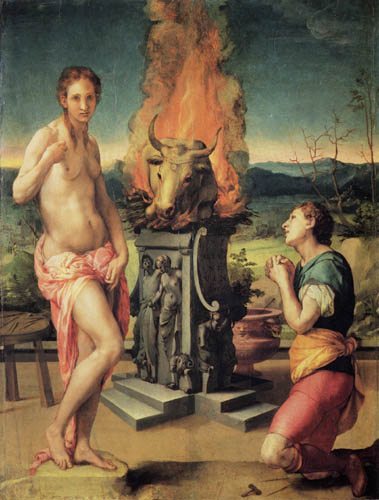
I am currently reading The Magician by Maugham, and it is turning out to be your basic fin de siècle novel, and would pair nicely with The Picture of Dorian Grey and The Strange Case of Dr. Jekyll and Mr. Hyde, Walter Pater and Baudelaire. I have yet to see that it does anything incredibly interesting, and some of its invocation of the occult is disturbing. There is a passage that evokes artworks and artists with which (and whom) I was previously unacquainted: this one by Juan Valdés de Leal, who seems rather generally extraordinary, Jusepe (or José) de Ribera, whose "dwarfs" don't seem to be well represented online (I only found this one), and a Pygmalion by Bronzino, which is the only one that seems to fit Maugham's description. Maugham's works and Greene's seem to suffer from a lack of footnotes that I attribute to a more general lack of critical attention--and yet, both names are well-known.

The Painted Veil is intriguing, and I may require it in the course I am teaching in the fall. It raises some interesting questions about depictions of women, includes some elements of the society novel that would not be out of place in Henry James or Edith Wharton, depicts the sexual act in a way that that would have seemed bold for Lawrence (who was generally more subtle), and contains lots & lots of colonialism. Of particular interest to me is Maugham's depiction of a convent of French missionary nuns in China, situated literally in the middle of a cholera epidemic. The nuns are easily the most noble characters in the novel, both in terms of bloodline and lineage (the Mother Superior is descended from nobility) and in terms of their bearing, serenity, closeness to the divine (though this is not quite how the characters in the novel or the narrator articulate it). It is interesting here to see the contrast between how the English speak of clergy of the Church of England, or how dismissive the characters are of the Anglican Church, and how the French nuns are portrayed. I'm not sure I have much to say about it beyond that, but I'm collecting data! ;)

So I am engaged in filling in a few less-than-apparent gaps in my reading of early- to mid-20th-century British fiction, asking along the way why I have not encountered these authors before, and whether it will matter at all, after I have read them, that I have read them--matter professionally, that is. I am already glad that I am reading them, and still believe in the inherent value of the act of reading--yes, I really do.

Wednesday, February 18, 2009

Literacy & Children's Fiction: A Running List

I have discovered some more books for my running list of children's lit books about literacy. It may be an overly ambitious or redundant project, since of course children's literature is concerned with conceptions of reading. But I do at least see different emphasis in some of the books. Is literacy primarily a social concern, or an individual concern--of primary use to individuals? That does seem to be something that different authors represent differently. I haven't managed to find a thematic list of children's fiction that includes literacy as I'm defining it, so my main question at this point is how to find books that relate to my topic?

But anyway, here are some:

The Book Thief by Markus Zusak

Fly By Night by Frances Hardinge

Voices (Annals of the Western Shore) by Ursula Le Guin

Exchange by Paul Magrs

The Green Book by Jill Paton Walsh

The Day They Came to Arrest the Book by Nat Hentoff (An overt statement about censorship--dealing with it directly by portraying a battle with parents who want to ban Huck Finn. Yawn. But very representative of why this is an issue in children's lit in the first place.)

Some of the themes will no doubt make good comparisons with 1984 and Brave New World.

Sunday, January 11, 2009

Recommended by Sister Mary Martha

(On her blog)

I would love to read Sisters: Catholic Nuns and the Making of America. That's all I wanted to say for now. Here is what she says (brief anecdote):

Here's a good read, by the way, to get a grip on seeing a job that needs doing and doing it. The book is called, "Sisters: Catholic Nuns and the Making of America" and is an amazing trip from Europe to America by young women who were sent alone into the wilderness (when it really was wilderness) to build schools and hospitals and orphanages from nothing. There is a very entertaining story about a nun who befriended Billy the Kid because she was the only person who would give medical attention to one of his buddies who had been shot. She saved the man's life. Billy the Kid visited her whenever he was in town and had his horse do tricks for her.

This reminds me of a book I do not particularly want to read, Double Crossed: Uncovering the Catholic Church's Betrayal of American Nuns, in part because it reeks of a smear-campaign against the Church initiated by bitter people, and who wants to read that? But I keep seeing it, and something in me wants to know what they are talking about, if only to disagree. So I am curious to know what an actual, orthodox nun thinks of the book, or the phenomenon--real or imagined--that it depicts. If only Sister Mary Martha would stop by & visit. . .

Friday, December 5, 2008

Books I Want (to Read)

In my spare time. . . ;)

Cross-posted at Words, Words.

In Barnes and Noble the other day, I was looking in the nonfiction section to try to find a compelling book to replace the one we are currently using in our freshman composition course. I found one that I will be using in my own comp class next semester: Remix: Making Art and Commerce Thrive in the Hybrid Economy. It is a compelling topic that has impact on the life of universities--internet and copyright. Students have been trying to write about NAPSTER since I started teaching, and we are getting to the point where there is abundant scholarly material on the topic. In addition, the book stresses issues of writing and rhetoric and writing. The introduction refers to Lakoff and Johnson, gurus of metaphor and its implications. Another chapter begins with a discussion of use of sources in English papers--perfect! At any rate, I hope so. Of course, the best thing is that these are intellectual topics--subject to some emotional response, but not one that college freshmen (or non-freshmen) will be unable to control--and topics that I wouldn't mind discussing. This should prove to be an interesting book, but not one that I would necessarily read if not for teaching. . .

On the other hand, I found another book in B & N that I would really like to read: Anne Rice's memoir of her return to Catholicism, Called Out of Darkness: A Spiritual Confession. I love conversion narrative--though not the early 17th century kind that you find in American Lit textbooks! I love the book Prodigal Daughters: Catholic Women Come Home to the Church, for example. Interesting thing--like the Anne Rice book, it is not really a conversion narrative, but a reversion--except that a conversion is a "turning toward," so indeed, it is a conversion, just not as "conversion" is usually meant. I have seen critiques of Rice's "brand" of Catholicism--that is, her failure to accept Church teaching on prominent social issues. This is hardly surprising, especially given her connection to New Orleans. On the other hand, it is perhaps important to recognize "conversion" as a process for anyone, including those who already see themselves as faithful Catholics. All of us have moments when we drift, even just a little, and come back, the important part is that we remind ourselves of the True Goal. So I am not looking to Anne Rice as a model of Catholicism, which I hope others do not do. I am well acquainted with Rice's novels, having read the first 4 vampire chronicles--repeatedly--in high school and early in my college career. Interestingly, it was Rice that first led me to investigate the meaning of the words "tabernacle" and "Transubstantiation." That alone is reason for me to read of her spiritual journey. I expect to find more than a touch of arrogance, even in her semblance of humility--but again, I'm not reading her as a spiritual guide, and it takes a bit of egotism to write such a book, though humility is a necessary part of the ethos of such an undertaking (a little rhetorical analysis). I am not particularly interested in her Road to Cana, etc. I picked it up once--in SAM'S club, I think--and was a little put off by the whole project. I'm not crazy about the idea of fictionalizing the life of Jesus. It just seems like treading on dangerous territory--theologically speaking. Remember that arrogance I mentioned? Yeah, that too. What I am primarily looking for in Called Out of Darkness is a feeling. And Rice is particularly good at evoking feeling. And seeing how rooted her feelings are in a particular place, and how we share that place as a common background, and share a common (or uncommon) religious experience, well, I think I could really enjoy reading the book. I told my son the other day that when I was a little girl, all little old ladies were Catholic, and their houses were all adorned with statues of saints and holy pictures. And that created a feeling--something that has become meaningful for me in recent years. I want to read about the influences of the beauty of Catholic culture on Rice, and how it influenced her conversion, since I know--on a level--what she is talking about. Perhaps one of these days I will have the opportunity to read it.

There are two others that catch my attention for cerebral reasons. From the New York Times "Notable Books of 2008":

The Ten-Cent Plague: The Great Comic Book Scare and How it Changed America by David Hajdu

and

A Great Idea at the Time: The Rise, Fall and Curious Afterlife of the Great Books Project
by Alex Beam

Because I am sitting down for the 4th or 5th time to try to finish this post, and because interruption seems imminent, I will not give too many of my impressions. After all, I have not actually held these books, I have just seen them online. You can, after all, tell a great deal about a book just from perusing it for 15 minutes--enough to write a decent review! I will say that these are rather predictable choices--being about literacy. Books about books--my specialty!

Tuesday, September 23, 2008

The Giver, Sexuality & Literacy

Warning!:  If you are consulting this paper for a school assignment on The Giver, it will not help you.  If you are planning to plagiarize part of this--don't.  This writer has a Ph.D.  Your teacher will never believe it is you, and you will be caught.  In fact, the only reason this post has not been taken down is so that your teacher will know if you plagiarize.  This writer has also used Turnitin.com, and knows how it works.  Trust her. That is all.

***
This is more a reminder than an actual post. My son's 6th grade English class is reading The Giver by Lois Lowry, which I have never read, and after his mention that a few things seemed "inappropriate," I decided to see what I could find out about the book. Well, I learned that the part he found inappropriate was an erotic dream in which the (male) protagonist imagines trying to convince his friend (a girl) to remove her clothes so he can bath her. His accompanying feelings are his first "Stirrings"--of puberty, of sexual feelings, which are too strong to be permitted in a perfectly ordered society, and so must be suppressed with medicine. There are a few interesting things here, the point that I'm not really ready for him to be reading this notwithstanding. . . First, this is pretty standard stuff for dystopia. But it seems to me that the minimization of difference, the promotion of sameness, is associated with a different area of the political spectrum than the suppression of sexuality. This probably means that, like most dystopian novels, The Giver critiques not one particular form of government, but all the dehumanizing tendencies of society. Is Brave New World a critique of Marxism or Fascism? Exactly. The thing I find interesting is that there is a pill taken to suppress sexual urges. This stands in stark contrast to Brave New World, in which women take a "Malthusian" regimen of contraceptive pills to enable sexual availability at all times, the theory being that if the sexual urges are released at will, they will not erupt, resulting in social disorder. Of course, the sexual urges of a non-civilized individual do erupt, resulting in social disorder in Brave New World, so perhaps the eunuch pill (my term) really is a better strategy than compulsive, institutionalized sexual availability. The Giver is also a children's book. What I find interesting is the contrast between the birth control pill and the sexual urge control pill. Both are uses of hormones that regulate sexuality. One acknowledges--while suppressing--fertility. The other does not. The message of The Giver seems to be that suppression of sexual urges is dehumanizing. Brave New World suggests that the separation of sexuality from fertility is dangerous in some way, and also dehumanizing. The Giver does not, as far as I can tell, link sexuality and fertility in any way. Now, this is a feature of the society, but it is also a feature of the novel. After all, separation of sexuality from fertility is a feature of the society of Brave New World, but the novel emphasizes that the separation is unnatural. How to remedy this in a children's novel, I'm not sure. However, the author chose to address sexuality in the first place, and the production of children is a separate issue. Completely. Separate. (As far as I can tell.) This is by way of reminding myself to verify this impression whenever I am able to read the novel myself.

Literacy becomes relevant because, as is common in dystopia, access to books is restricted. Only the individual who is the keeper of memories of the past, including emotion, unique experiences, and pain, has unrestricted (it seems) access to books. Now, I am not completely sure why this is--for consolation, perhaps? To allow the individual to cope with his/her knowledge of pain? (Very Freudian, btw) Or possibly to supplement the memories by providing records of other experiences and provide knowledge to use as the basis for important decisions. At any rate, books are seen as unnecessary and possibly dangerous for the populus, who have access only to the dictionary, community volume, Book of Rules--decidedly utilitarian volumes. That there is an association between the Receiver of Memories (who is permitted to feel and think deeper than anyone else) suggests an association between literacy and introspection. I'm not sure where Lowry takes this association, or whether she carries the implied literacy discourse any further, but it will be interesting to see if she does anything further with this dystopian theme. . .

Sunday, June 15, 2008

SF Stories: "The Bookshop" by Nelson Boyd (1946)

I have been trying to get the ball rolling on a research project I'm committed to. I'll be investigating representation of literacy in science fiction in the archives of the university where I live. Last Saturday I managed to squeeze in an hour before they closed up to talk to the Science Fiction archive librarian, a friend who has helped me a lot with knowing where to start looking! This Saturday, having taken his hints and gotten in my request of things for them to pull ahead of time, I still only managed to squeeze in a little while before they closed, but even so, I managed to look at a few things and read one short story. This truly is archival research, as some of the stories are not available in anthologies--ANY anthologies. Pretty exciting. If there was not already a glut of super-specialized Science Fiction anthologies, both in and out of print, that serve only about 5 science fiction readers and researchers each, I might have dreams of a "literacy in SF" anthology. Oh well. I'll stick to my dreams of a fantasy anthology that would actually work for the class I teach.

This weekend's story is "The Bookshop" by Nelson Boyd (1946), republished in Avon Fantasy Reader in 1951. The interesting thing about these early SF/F short stories is that they are very reminiscent of early Twilight Zone episodes. Maybe because they often became Twilight Zone episodes. Or Star Trek.

"The Bookshop" has that familiar feel about it. The narrator begins the tale trying to complete a novel--his best, he believes--but he is stuck, and feeling the heat. He gradually realizes he is sick--actually physically ill. In his illness, he comes to fixate on a bookshop where a poet friend of his stops suddenly during a bus ride--a bookshop our narrator has never noticed before--very shortly before the poet friend dies suddenly of a heart attack. The narrator is drawn to visit the place when he recovers, and finds a familiar-looking proprietor presiding over a very dark shop containing volumes upon volumes by many of the usual names--Shakespeare and Twain among them--but unusual titles: Shakespeare's Agamemnon, for example. He sees among the books, the work his poet friend told him he was writing before his death--supposedly, his masterpiece. The bookshop, then, contains the works that authors were unable to finish (or even begin) in their lifetimes, including the novel of our narrator, in all of its perfection.

The bookshop, then, is an allegory for heaven, suggesting a comparison to E. M. Forster's "The Celestial Omnibus," in which "heaven" is a literary creation--filled with the characters from literature as early as Homer and continuing through the 19th century with Dickens's Mrs. Gamp and Fielding's Tom Jones. The idea, I argue, is that literary enjoyment (as opposed to dispassionate "appreciation" of literary texts) transports one to heaven--though in retrospect, Forster's allegory suggests a disbelief in an actual Heaven in a way that "The Bookshop" does not. In "The Bookshop," one can not return from "heaven" where one's works exist in their perfection (much like Plato's realm of Forms). In "The Celestial Omnibus," one is transported back and forth between "heaven" and "the real world" by the authors themselves, who pilot the omnibuses. (Dante is one of the drivers, and his horses are black, grey, and white--the grey being the finest.) The idea of perfection isn't important for Forster, who seems to focus more on how the literary works act upon or are received by the reader rather than the writer's quest for perfection (which is largely irrelevant to the reader once the work has been published).

Some of the important ideas in "The Bookshop" from the perspective of literacy theory are some tidbits about the permanence of writing, curiously undermined by the ephemeral nature of the unwritten masterpiece. There is a kind of lonely near-despair that permeates the story, which clearly takes the solitary vision of the "writer writing in isolation" to heart. The idea of "the Story" as it could be or should be rather than the story that "IS" situates the perspective of "The Bookshop" as far removed from the theoretical reader, who doesn't really matter to the writer-as-artist. However much we might wish to read Shakespeare's Agamemnon (a singularly unlikely title), we realize, being left in the cold by the voice of Sarumon, that it (like Hamlet or Macbeth) was clearly not written for us.